

Two stories define this week's transport market. National diesel prices set an all-time record the week of September 21, 2026, hitting $6.529 a gallon. This week, prices eased to $6.382, a decline of $0.147, but that's still only 2.3% off the record.
At the same time, a rare and historically strong nor'easter tore through New Jersey, New York, and New England from September 23-27, drawing comparisons in national coverage to Hurricane Sandy and Hurricane Irene. It killed one person, injured four others, knocked out power to more than 100,000 customers, cancelled over 400 flights, and shut down Amtrak service between New York and Boston. Atlantic City's water level hit its highest point since Superstorm Sandy.
If you're budgeting transport costs or routing shipments through the Northeast this week, both of these stories matter, and neither one is over just because the headlines have moved on.
The Fuel Picture: A Pause, Not a Reversal
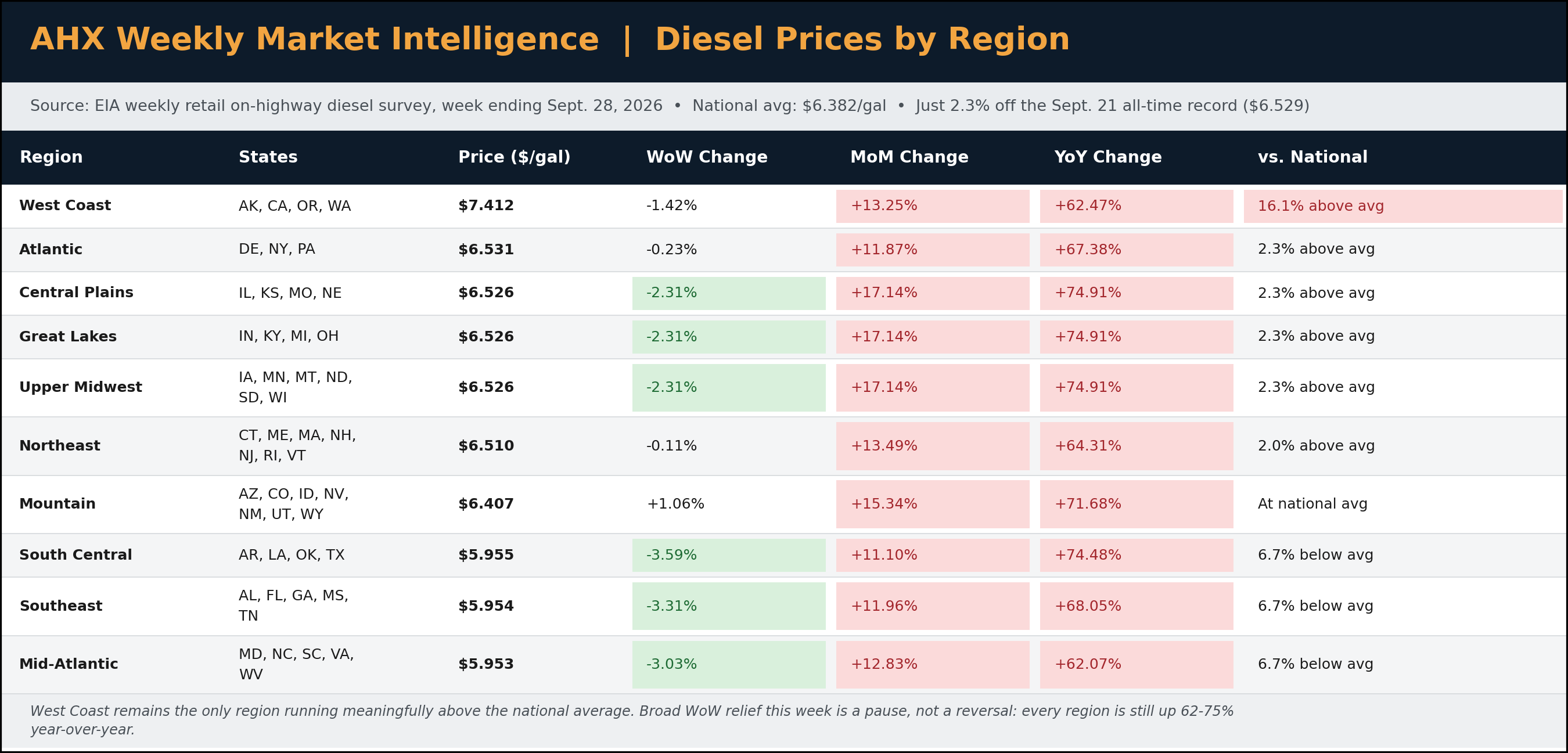
National average: $6.382/gal, week ending September 28, 2026.
No region posted a sharp weekly jump this week (the kind we'd flag as a spike), the first quiet fuel week in a while. But "quiet" needs context: national diesel is one week removed from an all-time record, not one week into a decline. Every region is up more than 60% year-over-year, and month-over-month increases in the 11-17% range across the board show how fast this run-up happened between August and September.
West Coast remains the country's most expensive corridor at $7.412 a gallon, running 16.1% above the national average. South Central posted the strongest relief, down 3.59% to $5.955, roughly tied with Mid-Atlantic and Southeast as the cheapest reading in the data. Mountain was the one region moving against the grain, up 1.06% to $6.407, worth watching given the weather risk building there (more below).
The Northeast Storm: What a Historic Nor'easter Did to the Region
A nor'easter that formed September 23 and peaked in intensity September 26 (986 mbar central pressure) battered the East Coast from Virginia to Maine, with the heaviest impact concentrated on New Jersey, New York, and southern New England. National meteorologists described it as unusually strong for September, drawing direct comparisons to Hurricane Sandy and Hurricane Irene given the scale of coastal flooding.
The numbers are stark. One person was killed and four others injured when trees fell in Brooklyn. A swimmer went missing off Long Island's south shore. Peak wind gusts hit 81 mph at Montauk, NY. Power outages topped 100,000 customers across Massachusetts, Pennsylvania, New Jersey, New York, and Connecticut at the storm's peak, with New Jersey alone seeing 17,300-plus outages from Jersey Central Power and Light and tens of thousands more from PSE&G. More than 400 flights were cancelled.
Atlantic City's water level rose 3.26 feet above dry ground, the highest point since Hurricane Sandy in 2012, and city officials said conditions were among the worst since that storm. New York's Kings Park recorded a 3.54-foot storm surge.
For transport specifically, the disruption was significant. New Jersey Route 35 closed at the Sayreville-Old Bridge border due to flooding. Delaware Route 1 closed between Bethany Beach and Dewey Beach. All Amtrak service between New York and Boston was suspended during the storm. The Long Island Rail Road's Long Beach Branch was suspended. Philadelphia's 30th Street Station saw delays. States of emergency were declared in New York City, Long Island, Westchester County, and eight New Jersey counties.
The storm dissipated September 29. It's not an active weather event anymore, but if you're routing anything through New Jersey, New York, Connecticut, Rhode Island, or Massachusetts this week, expect lingering cleanup, downed-tree removal, and the possibility that some local roads remain restricted a few days out. Confirm road status before committing to a hard ETA through the affected corridor.
The Weather Picture: Flooding Touches Nearly Every Corridor
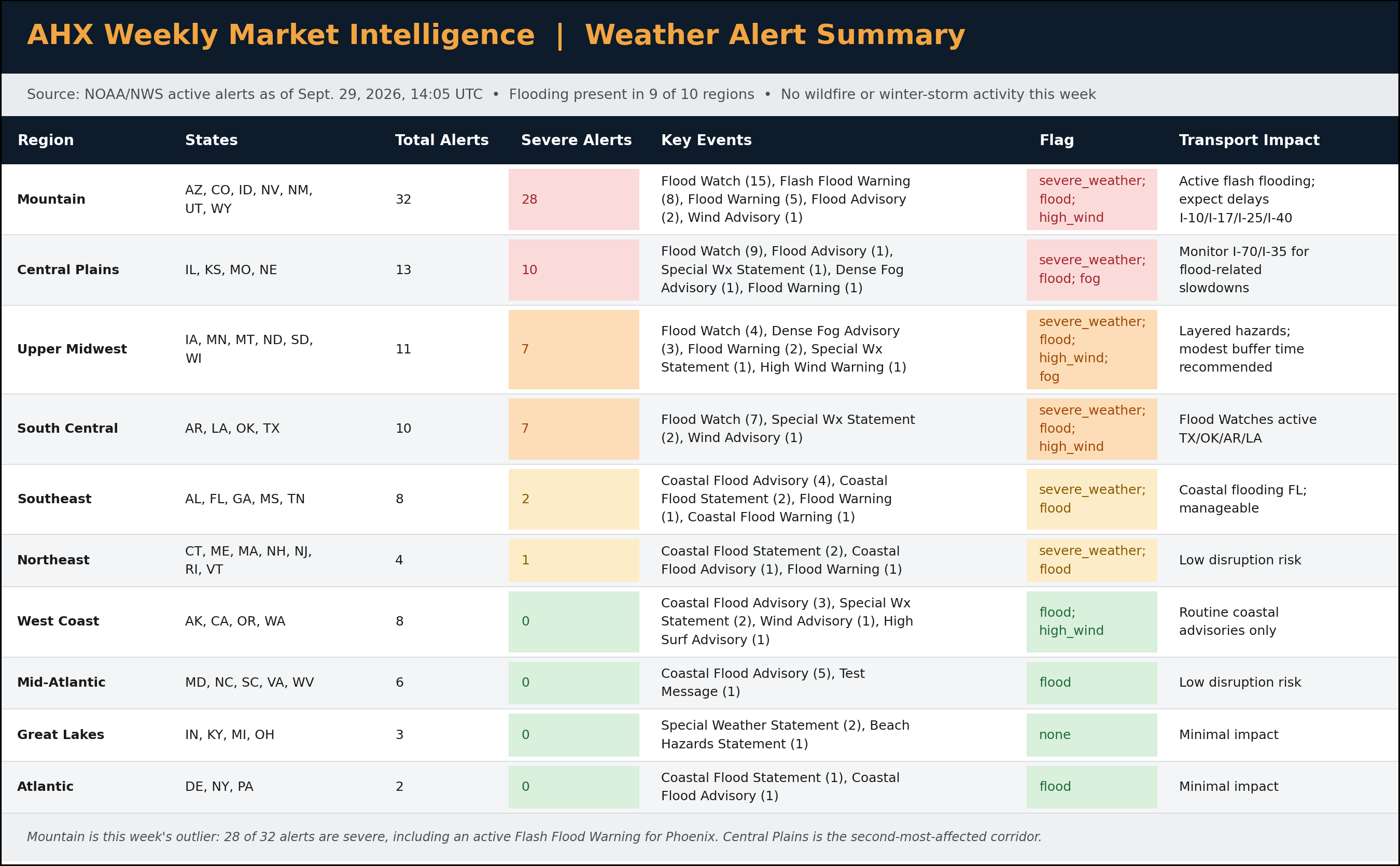
A note on the Northeast and Atlantic numbers above: our weather data is a live snapshot as of September 29, 2026, taken the same day the nor'easter fully dissipated. By that point NWS had already cleared most of the storm's warnings, so the alert counts shown for Northeast and Atlantic look routine. They aren't a reflection of what actually happened in that corridor September 23-27; see the dedicated section above for the real picture.
Mountain is this week's clear outlier outside the Northeast, with 28 of its 32 alerts rated severe, including an active Flash Flood Warning for the Phoenix area and 15 separate Flood Watches spread across Arizona, Utah, Colorado, and New Mexico. Central Plains is the second-most-affected corridor in the live data, with 10 of 13 alerts severe. Upper Midwest and South Central each carry 7 severe alerts.
No wildfire or winter storm flags appear anywhere in this week's data.
Corridor Outlook
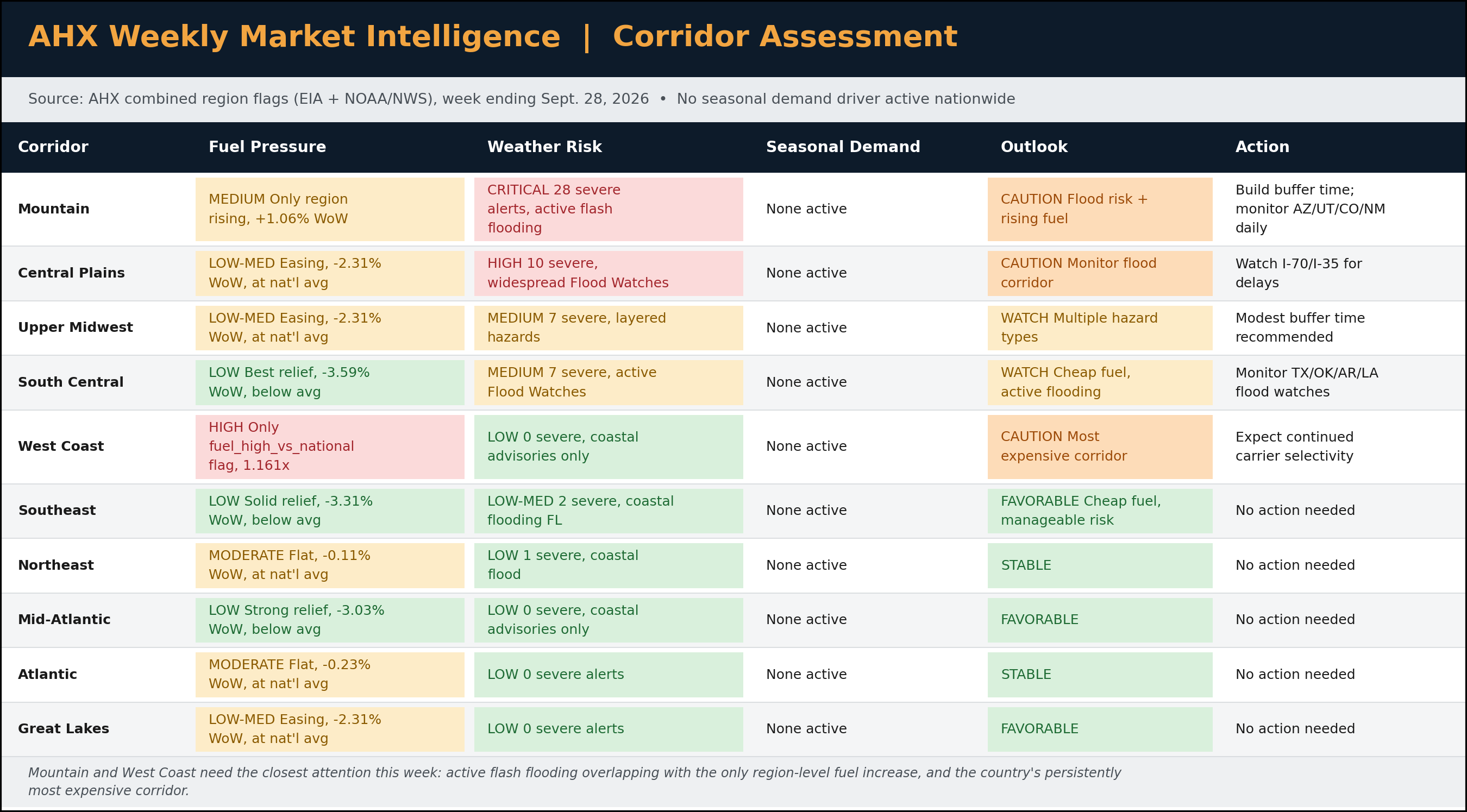
Three corridors deserve the closest attention this week: the Northeast/Atlantic, recovering from a historic nor'easter with real road and rail disruption; Mountain, where active flash flooding overlaps with the only region-level fuel increase in the data; and West Coast, where fuel costs remain structurally the highest in the country.
What We're Seeing on the Platform
Carrier match coverage is strong right now, nearly every posted shipment on AHX is drawing at least one carrier match. But a meaningful share of loads are pulling carrier offers above the shipper's posted price, a sign carriers are pricing assertively given current fuel costs rather than taking the first shipment available. No single lane or corridor is dominating volume this week; activity is spread across a lot of smaller routes.
The practical takeaway: if you're posting shipments manually and pricing them off last week's numbers, expect more carrier pushback than usual. The AHX AI Pricing Engine adjusts posted prices automatically within the range you set, so pricing keeps pace with what carriers are actually asking for without you having to renegotiate every load by hand.
What Dealers Should Do This Week
- Confirm road and rail status before quoting hard ETAs through NJ, NY, CT, RI, or MA. Last week's nor'easter is over, but cleanup, downed trees, and some local road restrictions likely persist into this week.
- Don't plan around falling fuel costs. One quiet week of WoW relief doesn't offset a YoY increase north of 60% almost everywhere, or the fact that we're one week removed from an all-time record.
- Build extra transit time into anything routed through the Southwest. Active flash flooding and 15 Flood Watches across Arizona, Utah, Colorado, and New Mexico mean real delay risk on I-10, I-17, I-25, and I-40 through early October.
- Take advantage of relative pricing in South Central, Southeast, and Mid-Atlantic if your sourcing or delivery lanes run through those corridors, though note the Outer Banks and DE-1 disruptions above.
- Watch the Mountain region closely into next week. It's the only corridor where fuel moved against the national trend, and it's carrying real weather risk on top of that.
- Use a tool that reprices automatically rather than guessing at fuel-adjusted rates by hand. The AHX AI Pricing Engine adjusts pricing recommendations to current market conditions.
- Expect continued carrier selectivity on West Coast lanes. It's the only region flagged as running meaningfully above the national average, a consistent pattern, not a one-week blip.
FAQ
Is diesel actually going down right now? Barely, and not in a way that changes the bigger picture. National diesel eased $0.147 to $6.382 this week after hitting an all-time record of $6.529 the week before. It's still up 62-75% year-over-year depending on the region.
Was the spring 2026 diesel spike the high point for the year? No. Diesel pulled back after the spring run-up, then climbed through the summer into a new, higher record in September. National diesel's 2026 high is $6.529 (week of September 21), well above the April figure that circulated earlier this year.
How bad was the nor'easter that hit New Jersey and New York? Historic. Atlantic City's water level hit its highest point since Hurricane Sandy in 2012. The storm killed one person, injured four others, knocked out power to more than 100,000 customers across five states, and shut down Amtrak between New York and Boston.
Are roads still closed from the nor'easter? The storm dissipated September 29. Some roads, including NJ Route 35 and Delaware Route 1, were closed during the storm; confirm current status before routing through those areas, as cleanup and local restrictions may still be in effect this week.
Which region has the most expensive diesel right now? West Coast, at $7.412 a gallon, running 16.1% above the national average.
Is there a seasonal demand factor affecting the market right now? No major one, outside of nor'easter recovery in the Northeast. We're between Labor Day and the Q4 holiday ramp, a typically quiet stretch for seasonal demand drivers.
Are carriers pushing back on pricing right now? Yes, to a degree. A meaningful share of posted shipments are drawing carrier offers above the posted price, which is typical when fuel costs are elevated. Carrier match coverage remains strong overall, so it's more a pricing conversation than a capacity shortage.
Sign Up Free
Track pricing, weather, and carrier activity across every lane in real time. Sign up free at autohaulerexchange.com.
Data Attribution: Diesel pricing from the EIA weekly retail on-highway diesel survey, week ending September 28, 2026, with full-year verification through the week of September 21, 2026. Weather data from NOAA/NWS active alerts as of September 29, 2026, 14:05 UTC. September 2026 nor'easter facts via Wikipedia ("September 2026 nor'easter"), cross-referenced against CNN, CBS News, Reuters, and AccuWeather reporting dated September 24-27, 2026. Platform signals from AHX's live posted-load board, as of 3:14 PM ET, September 29, 2026.



.png)
