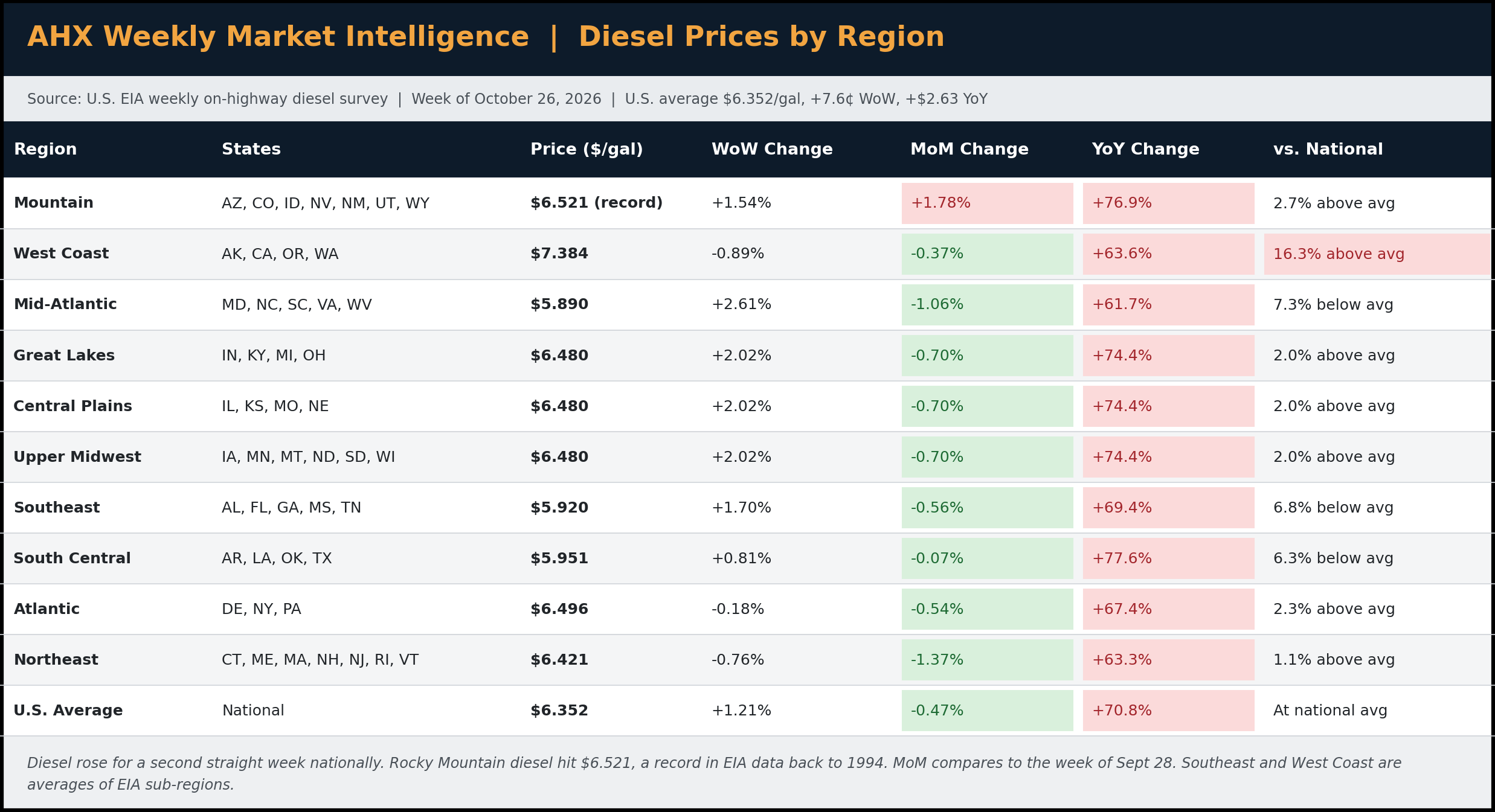
Diesel in the Rocky Mountain states reached $6.521 a gallon this week. That's the highest weekly price the U.S. Energy Information Administration has ever recorded for the region.
The national picture isn't far behind. The U.S. average rose 7.6 cents to $6.352, its second straight weekly gain, and now sits just 18 cents below the 2026 high of $6.529 set the week of September 21. Compared with a year ago, diesel is up $2.63 a gallon, or 70.8%.
The short version for dealers: the three-week pullback after the September peak has ended. If your transport budget assumed fuel would keep easing into November, it's time to revisit that assumption.
Weather, on the other hand, gave everyone a break. Severe alerts fell sharply nationwide, and four regions have no active alerts or fog only. The exceptions are the Mountain region, Florida's Atlantic coast, and the first winter weather of the season out West.
Here's the full breakdown.
Diesel Prices by Region
What the fuel numbers say
The Rockies are now the story. Mountain diesel has climbed for three straight weeks and is the only region up month over month. Running a shipment through Colorado, Wyoming, or Utah costs more in fuel than at any point in EIA's history for that region. Carriers know this, and they're pricing it.
The Midwest is moving again. Great Lakes, Central Plains, and Upper Midwest all share the same EIA reading, which rose 12.8 cents to $6.48 this week. That's still 20 cents below the late-September level of $6.68, but the direction has flipped. Two weeks ago, Midwest diesel was falling.
The Mid-Atlantic posted the largest weekly gain. Diesel there rose 15 cents (+2.6%) to $5.89. Even so, the Mid-Atlantic remains the cheapest region in the country, 7.3% below the national average.
The West Coast stays expensive. At $7.38, the West Coast slipped about 7 cents this week but remains the only region running meaningfully above the national average, at 16.3% higher. It has given back only 1.8% since the September peak.
Nobody got real relief. Only three regions declined (Northeast, West Coast, and Atlantic), and none fell by even 1%. No region posted a sharp weekly spike either. This is a steady upward drift on top of a price level that is already 60% to 78% above last year everywhere.
Weather Alert Summary
What the weather numbers say
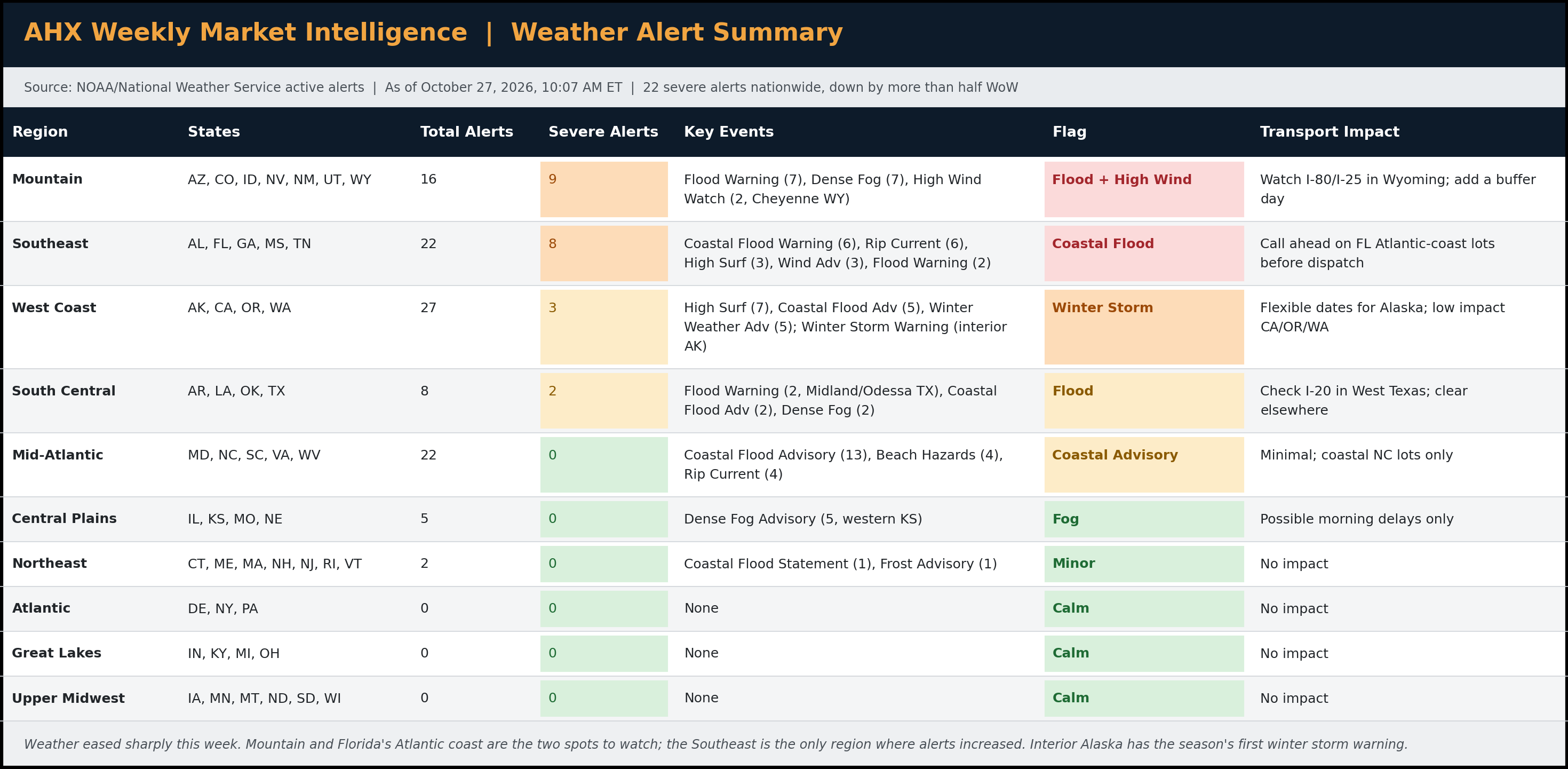
Nationally, the count of severe alerts is down by more than half from a week ago. That's good news for transit times almost everywhere.
Mountain still leads with 9 severe alerts, mostly flood warnings, plus a high wind watch around Cheyenne. Combine that with record fuel and you have the one corridor this week where both cost and timing are under pressure.
Southeast is the only region where alerts are increasing. Coastal flood warnings along Florida's Atlantic coast, including river flood warnings out of the Melbourne office, can mean flooded lots and closed low-lying roads around the Space Coast. Call ahead before you dispatch.
West Coast severe alerts fell from 20 to 3, but winter is showing up. Interior Alaska has a winter storm warning and a high wind warning, and the region carries five winter weather advisories. For dealers shipping in or out of Alaska, plan on flexible dates.
South Central has two flood warnings around Midland and Odessa along I-20. Everything east of there is clear.
Corridor Outlook
Mountain: Caution
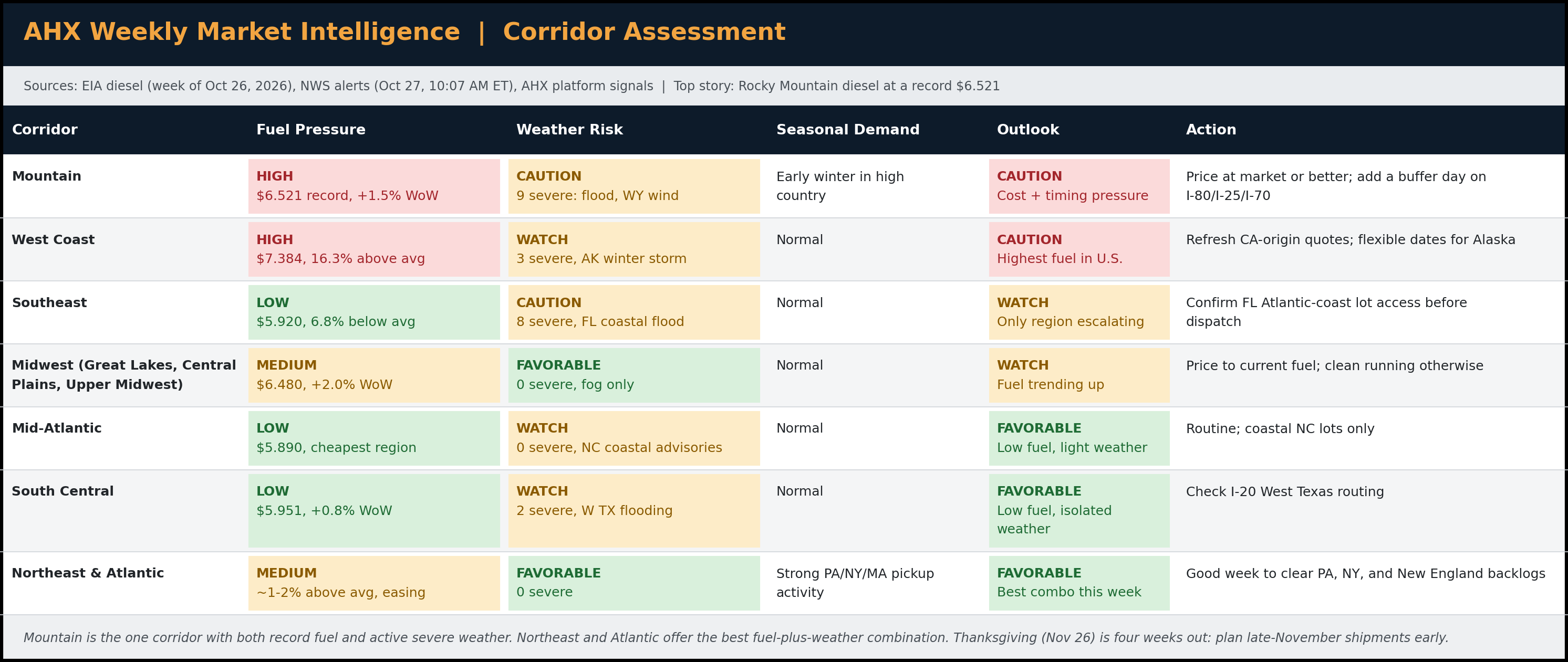
Record diesel, the only region rising month over month, and 9 severe alerts. If you're moving vehicles into or out of Colorado, Wyoming, Utah, or Arizona, price at market or above and allow an extra day. With fuel at a record, carriers will look hard at the price on any Mountain shipment.
West Coast: Caution
Fuel is the most expensive in the country at $7.38, and early winter weather is active in Alaska. California, Oregon, and Washington are running clean on weather. Keep your pricing current; quotes from September still reflect lower fuel than you might think.
Southeast: Watch
Fuel is below the national average, but coastal flooding in Florida is the region's only escalating weather story. Well-priced shipments will still move quickly.
Midwest (Great Lakes, Central Plains, Upper Midwest): Watch
Weather is clean, with only morning fog in western Kansas. Fuel is the watch item: up 12.8 cents this week after rising the week before. Price to current fuel and this corridor should run smoothly.
Mid-Atlantic and South Central: Favorable
Both regions sit 6% to 7% below the national diesel average. Weather impacts are limited to coastal North Carolina and West Texas.
Northeast and Atlantic: Favorable
This is the best fuel-plus-weather combination in the country right now. Diesel eased slightly in both regions, severe alerts are at zero, and pickup activity out of Pennsylvania, New York, and Massachusetts is strong.
What We're Seeing on the Platform
Prices haven't come down. With diesel up 70% from a year ago, carriers have real costs to cover every mile they run, so they're still going after the best-paying shipments first. Price at market and you'll move.
Carrier coverage is healthy across all major lanes. No major lane is short on capacity. The question this week isn't whether a carrier is available. It's whether your price gets their attention ahead of the next shipment on the board.
The most active pickup markets this week are Pennsylvania, Michigan, Massachusetts, and New York. On the delivery side, Virginia, Ohio, Texas, and Michigan are leading. If you're sourcing from or delivering into those markets, expect fast bookings at market price.
With 5,500+ vetted carriers on the platform, shipments priced at market typically book in one day on average. The AI Pricing Engine automatically adjusts posted prices within the range you set, so a shipment doesn't sit while fuel drifts higher. And every active shipment has real-time ELD tracking, so you can see where your vehicle is without making a phone call.
What Dealers Should Do This Week
- Price Mountain-region shipments at market or better. Record fuel and active flood and wind alerts make Colorado, Wyoming, Utah, and Arizona the toughest corridor to move right now. A low price there costs you days.
- Refresh any quote built on early-October fuel. National diesel has climbed 17 cents in two weeks. Run a fresh estimate through the AHX Market Estimate Tool before you post, especially for long-haul shipments.
- Set a range, not a fixed price. Fuel is drifting up a few cents a week. Setting a price range lets the AI Pricing Engine adjust within your limits instead of leaving a shipment stuck below market.
- Start your Thanksgiving plan. Thanksgiving is Thursday, November 26. Thanksgiving week is the largest carrier-availability dip of the year. If you know you'll need vehicles moved in late November, post early.
Frequently Asked Questions
Why did diesel go up again this week?
The national average rose 7.6 cents to $6.352 in EIA's October 26 survey, the second straight weekly increase. The biggest gains were in the Mid-Atlantic (+15 cents), the Midwest (+12.8 cents), and the Rocky Mountain region (+9.9 cents). Prices are still below the September 21 peak of $6.529, but the three-week decline after that peak has reversed.
Is Rocky Mountain diesel really at a record?
Yes. At $6.521 a gallon, EIA's Rocky Mountain (PADD 4) average is the highest weekly figure in the agency's records for the region, which date to 1994. The prior high before 2026 was $5.782 in June 2022. That region covers Colorado, Idaho, Montana, Utah, and Wyoming, and it's the main driver of costs on Mountain-corridor shipments.
How much more does diesel cost than a year ago?
Nationally, $2.63 more per gallon, or 70.8%. Every region is between 61% and 78% higher than last year. South Central (+77.6%) and Mountain (+76.9%) have seen the largest increases on a percentage basis.
Should I expect transport costs to drop before the holidays?
Don't plan on it. Diesel is 18 cents off its 2026 high and has risen two weeks in a row. Thanksgiving week also brings the lowest carrier availability of the year. Dealers who post late-November shipments early and price them at market will have the most options.
Which regions have the worst weather for shipping this week?
The Mountain region (9 severe alerts, mostly flooding plus high wind around Cheyenne, Wyoming) and the Southeast (8 severe alerts, mostly coastal flooding on Florida's Atlantic coast). Overall, severe alerts fell by more than half nationwide compared with last week.
Why is the West Coast so much more expensive than everywhere else?
West Coast diesel, at $7.38, runs about 16% above the national average, largely because California prices exceed $8 a gallon. The region dipped slightly this week but remains well above every other region. Shipments originating in California carry the highest fuel cost in the country.
The Bottom Line
Fuel is drifting higher again, the Rockies just set a record, and Thanksgiving is four weeks away. The good news: weather is cooperating across most of the country and carrier coverage is healthy. Dealers who price to today's fuel and plan their late-November shipments now will have the easiest month.
Sign up free at autohaulerexchange.com
Data sources: U.S. Energy Information Administration (EIA) Weekly Retail On-Highway Diesel Prices, survey week of October 26, 2026 (released October 27, 2026); EIA Rocky Mountain (PADD 4) weekly diesel price history, 1994–2026. NOAA/National Weather Service active alerts as of October 27, 2026, 10:07 AM ET. AHX platform marketplace data as of October 27, 2026. Regional figures for Southeast and West Coast are averages of EIA sub-regions.