
Diesel is climbing again. Two weeks ago, the national average was sliding off its September high. It slipped once more, then EIA's Oct 19 survey put it back up 9.7 cents to $6.276 per gallon. That's the sixth straight week above $6.00, roughly 73% higher than a year ago, and only $0.25 below the 2026 high of $6.529 set the week of September 21.
The weather turned over just as fast. Two weeks ago, Southern California was under Extreme Heat Warnings. Mid-month, severe storms and flash flooding hit the Plains and Texas while red flag warnings covered California. This week, most of the country is quiet. Southern Arizona is under flood watches, and the North Carolina and Florida coasts are dealing with coastal flooding.
Here's how the past two weeks played out, and what it means for your vehicle shipments this week.
The Fuel Story: Two Weeks, One Reversal
From the September 21 peak, national diesel fell three straight weeks: down 14.7 cents, then 18.3 cents, then 2 cents. Our last update landed in the middle of that slide, with the national average at $6.199. One week later it was $6.179. Then the Oct 19 survey came in up 9.7 cents, to $6.276.
Net change since our last update: up 7.7 cents.
Our take: the September-to-October decline was a pullback from the year's high, not a reset. Costs are still far above where they started the year, and anyone budgeting for diesel to keep falling through Q4 is making a bet the data doesn't support.
Every Region Rose
The increase wasn't limited to one corner of the map. All 10 regions rose in the Oct 19 survey:
- West Coast: up 2.1% to $7.451, the biggest weekly gain. Still the most expensive region by a wide margin.
- Mountain: up 1.9% to $6.422. That's the highest weekly price in EIA's Rocky Mountain records, which go back to 1994 (not adjusted for inflation). It's also above the region's late-September level.
- Mid-Atlantic, Southeast, South Central, and the Midwest: up roughly 1.5% to 1.7% each.
- Atlantic and Northeast: the smallest increases, about half a percent.
Where Each Region Stands vs. the September Peak
Even after this week's increase, most regions are still below their Sept. 21 levels:
- Mid-Atlantic: $0.40 below, at $5.740. Still the cheapest diesel in the country.
- Southeast: $0.34 below, at $5.822.
- Midwest (Central Plains, Great Lakes, Upper Midwest): $0.33 below, at $6.352.
- South Central: $0.27 below, at $5.903.
- West Coast: $0.07 below its 2026 high, set Sept. 21, at $7.451.
- Atlantic and Northeast: only about 4 to 5 cents below.
- Mountain: now above its September levels, at a record.
What to Watch This Week
EIA's next weekly survey is scheduled for release Tuesday, Oct 27. After one up week, the question is whether the September-to-October decline resumes or the rebound sticks. With every region moving the same direction, we wouldn't bet on more relief in the near term.
Diesel Prices by Region
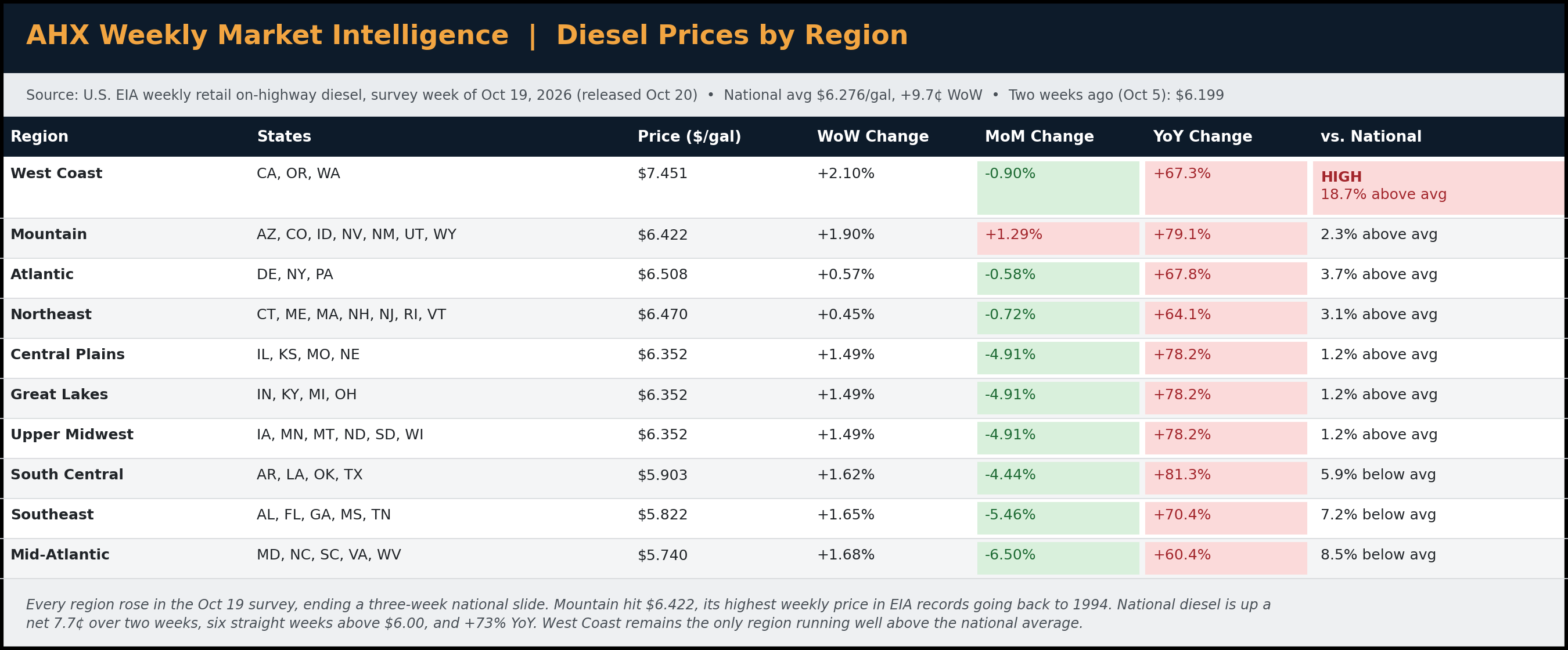
EIA survey week of Oct 19, 2026 (released Oct 20). National average: $6.276/gal, up 9.7¢ on the week. Two weeks ago (Oct 5): $6.199.
Two things stand out. First, the West Coast is the only region running meaningfully above the national average, at more than $1.70 per gallon over the Mid-Atlantic. Second, the year-over-year numbers are extreme everywhere: every region is up at least 60%, and South Central leads at +81%. That's not because Texas diesel is expensive. South Central is still below the national average. The year-ago base was simply the lowest in the country.
The Weather Story: Heat, Then Storms, Now Mostly Clear
How the Past Two Weeks Played Out
- Two weeks ago: Extreme Heat Warnings across Southern California, an extreme heat watch in Phoenix, flood warnings in Nebraska, Kansas, and Iowa, and freeze warnings in New York and Massachusetts.
- Mid-month: Severe thunderstorm watches and flash flooding across Kansas, Missouri, Texas, and Oklahoma. California added red flag and high wind warnings on top of lingering heat.
- Now: California, the Plains, and Texas are clear. The remaining risk sits in southern Arizona and along the Carolina and Florida coasts.
What's Active Heading Into This Week
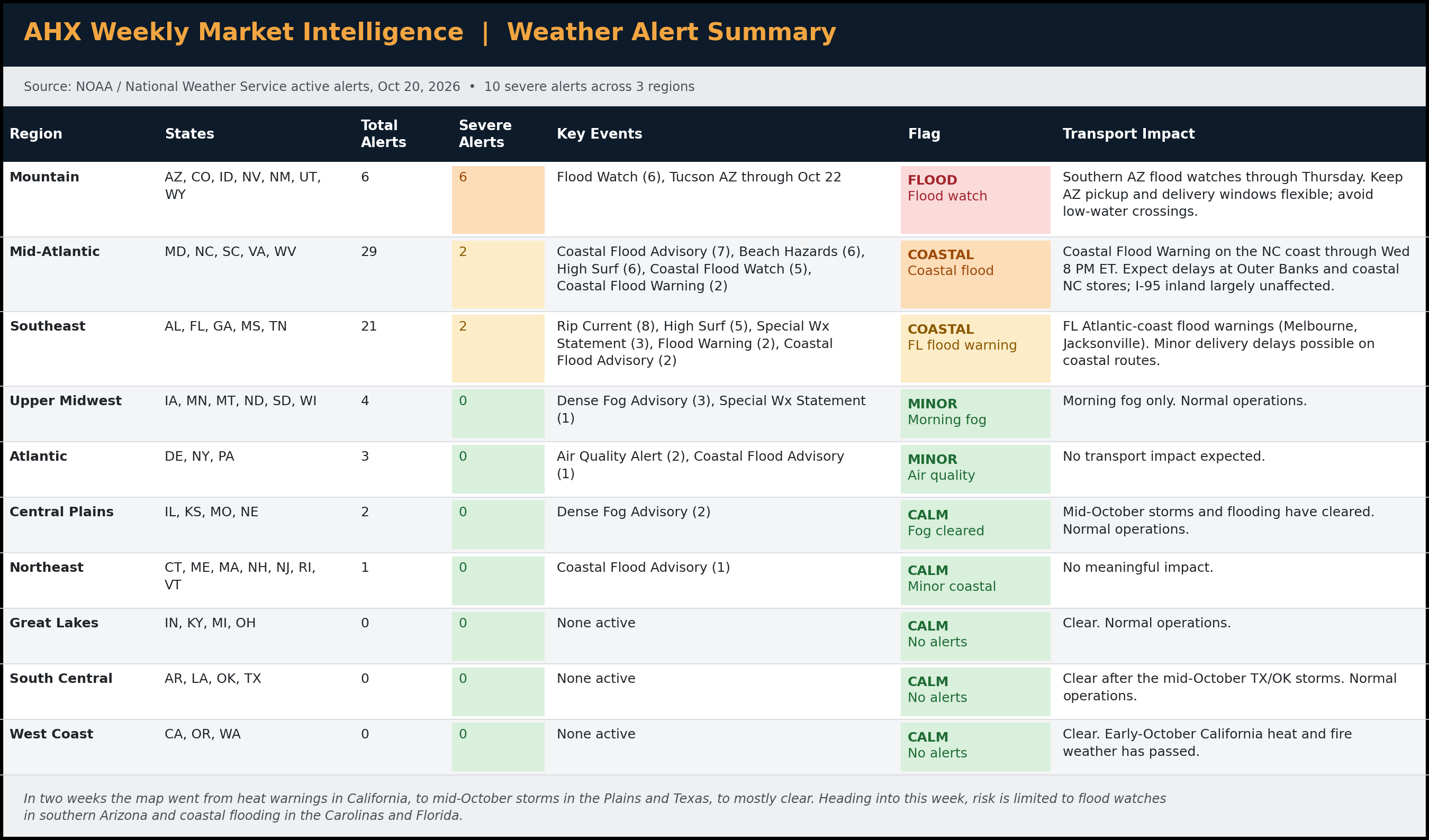
Mountain: desert flooding. All 6 alerts in the Mountain region are severe-rated Flood Watches, centered on southern Arizona (NWS Tucson) through Thursday, Oct 22. Desert flash flooding closes roads quickly. Keep Arizona pickup and delivery windows flexible through the end of the week.
Mid-Atlantic and Southeast: coastal flooding. The Mid-Atlantic (29 alerts, 2 severe) is dominated by coastal flood advisories, high surf, and a Coastal Flood Warning on the North Carolina coast through Wednesday at 8 PM ET. The Southeast (21 alerts, 2 severe) has Flood Warnings on Florida's Atlantic coast near Melbourne and Jacksonville. Most of the count is rip current and surf alerts, which don't affect transport. Inland I-95 and I-85 lanes are operating normally.
Everywhere else: clear. California, Oregon, and Washington have no active alerts, and the Central Plains, Great Lakes, Upper Midwest, South Central, Atlantic, and Northeast show zero severe alerts between them, mostly morning fog and minor coastal advisories.
Weather Alert Summary
Corridor Outlook for This Week
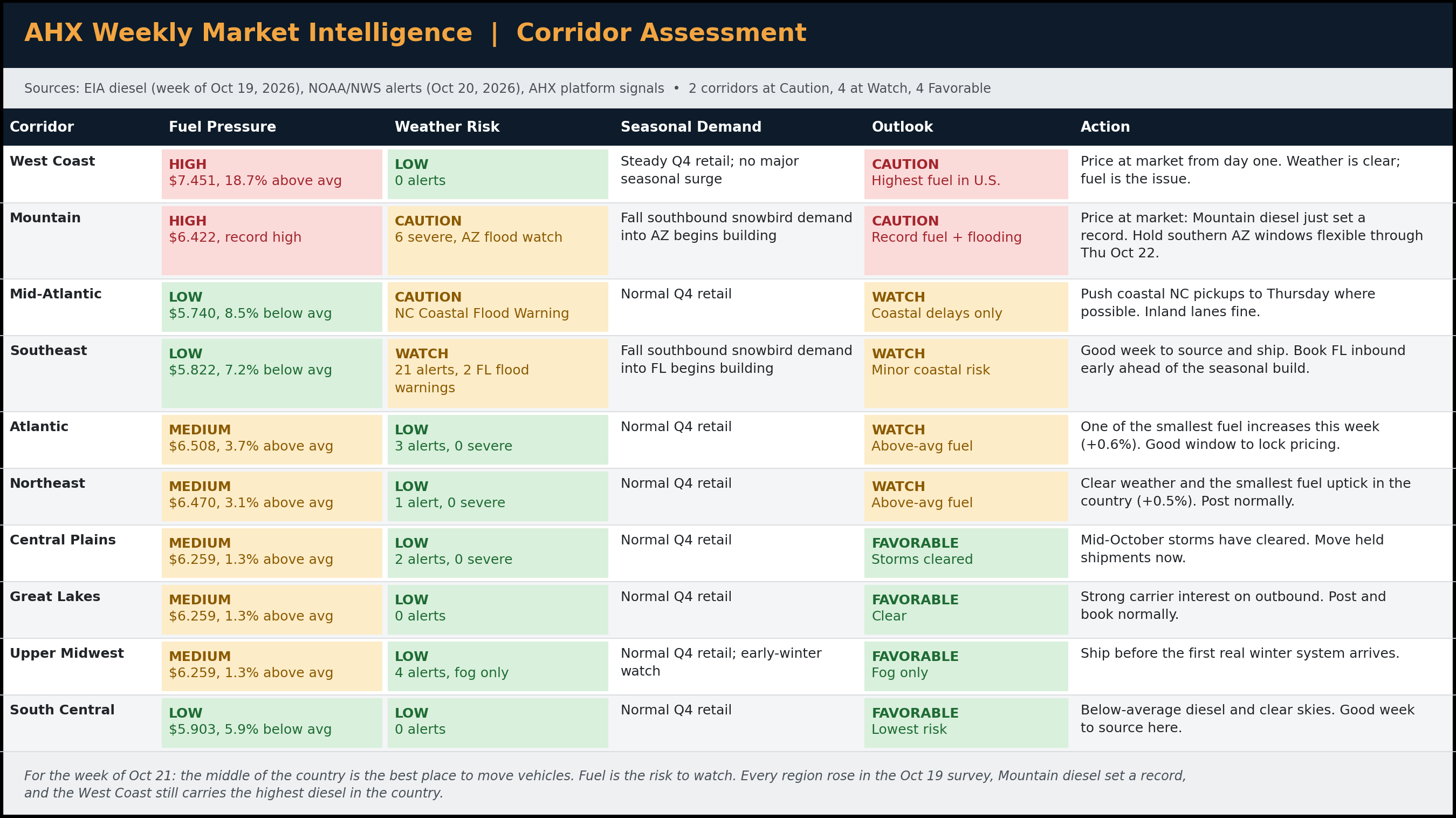
The best corridors this week run through the middle of the country. The Central Plains, Great Lakes, Upper Midwest, and South Central all pair clear weather with fuel at or below the national average. If you've had vehicles sitting in Kansas, Missouri, Ohio, Texas, or Oklahoma since the mid-October storms, move them now.
The corridors that need the most planning are the West Coast and Mountain. They posted the two biggest fuel increases this week and both have above-average diesel. Arizona also has active flood watches, so plan realistic timelines there.
The Northeast and Atlantic are steadier. Diesel there is above average but rose only about half a percent this week, and the weather is quiet.
Seasonal Context
Spring and summer seasonal factors are behind us. Two things are coming:
- Fall southbound snowbird shipments. Retirees moving vehicles from the Northeast and Midwest into Florida, Arizona, and the Carolinas typically build from late October through December. Expect more competition for southbound capacity over the coming weeks.
- Thanksgiving week (Nov. 23–27). The biggest carrier-availability dip of the year. It's five weeks away, and dealers who plan around it now avoid paying a premium later.
What We're Seeing on the AHX Platform
Carriers have held the leverage for the full two weeks. Shippers who post at market are getting booked, and shipments priced below market are sitting. Conditions have eased slightly since our last update but remain firmly carrier-favored, and the latest fuel bounce gives carriers less reason to soften.
Carrier coverage is healthy across the major lanes. It's deepest on Texas intrastate, California intrastate, and Florida-to-Georgia shipments.
- Strongest pickup markets: Georgia, Ohio, Connecticut, and Utah.
- Strongest delivery markets: Maryland, Tennessee, North Carolina, and Nebraska.
- Momentum: Outbound conditions from the Great Lakes are tightening, and South Central activity is picking up in both directions.
When you price at market, the average time from posting to carrier booking on AHX is one day. Our AI Pricing Engine automatically adjusts your posted price within the range you set, so you aren't manually chasing the market as fuel moves.
What Dealers Should Do This Week
- Stop waiting on fuel. Price shipments to today's market. Run every lane through the AHX Market Estimate Tool before you post.
- Price Mountain shipments at market. Mountain diesel just hit a record, and Arizona flood watches run through Thursday. Underpriced Mountain shipments will sit.
- Move Midwest and South Central inventory now. Clear skies, fuel near or below the national average, and active carrier coverage make this the cleanest operating window on the map this week.
- Price West Coast shipments at market from the first post. At $7.451/gal, West Coast carriers have the least room to absorb an underpriced shipment.
- Add a buffer day for southern Arizona. Flood watches run through Thursday.
- Shift coastal North Carolina pickups to Thursday if you can. The Coastal Flood Warning expires Wednesday evening.
- Get Thanksgiving week on the calendar. Plan November acquisitions and dealer trades so vehicles aren't stuck waiting during Nov. 23–27.
Frequently Asked Questions
Is diesel going back up? It turned up in the latest data. EIA's Oct 19 survey showed national diesel at $6.276/gal, up 9.7 cents after three straight weekly declines, and every region rose. That's a net 7.7 cents higher than two weeks ago. One week isn't a trend, but the national average has held above $6.00 for six straight weeks. Don't plan around further declines.
How far are diesel prices from their 2026 high? The national average is about $0.25 below the 2026 high of $6.529, set the week of Sept. 21. The West Coast is only $0.07 below its own 2026 high from the same week. Mountain diesel, at $6.422, is at the highest weekly price in EIA's Rocky Mountain records.
Why is West Coast diesel so much more expensive? At $7.451/gal, the West Coast runs 18.7% above the national average and more than $1.70 above the Mid-Atlantic. California's fuel blend requirements, taxes, and limited refinery supply keep the region structurally higher. For dealers, that means less margin for carriers on underpriced West Coast shipments.
Will this week's weather delay my shipment? Most likely not, unless it touches southern Arizona or the coasts of North Carolina or Florida. The West Coast, Central Plains, Great Lakes, South Central, and Northeast have no severe alerts. Arizona is the one area where you should build in extra time.
Is it a good time to ship vehicles out of Texas and the Midwest? Yes. The mid-October storms and flooding in Kansas, Missouri, Texas, and Oklahoma have cleared, fuel in those regions sits at or below the national average, and carrier coverage is healthy. It's the best combination on the map this week.
When does fall snowbird shipping pick up? Southbound snowbird shipments into Florida, Arizona, and the Carolinas typically build from late October through December. If you're shipping into those markets in November, book early.
How should I price shipments when fuel is moving? Start with the AHX Market Estimate Tool, then set a price range rather than a single number. The AI Pricing Engine adjusts your posted price within that range automatically, so your shipment stays competitive without constant manual updates.
The Bottom Line
In the two weeks since our last update, diesel's decline ran out and fuel turned back up in every region. Weather risk shifted from the middle of the country to its edges, and the middle is the best place to move vehicles this week. Carriers are booking shipments priced at market. With 5,500+ vetted carriers on the platform and real-time ELD tracking on all active shipments, AHX gives you visibility into both the market and your vehicles.
Sign up free at autohaulerexchange.com
Data sources: U.S. Energy Information Administration (EIA) weekly retail on-highway diesel prices, surveys of Oct 5, Oct 12, and Oct 19, 2026 (Oct 19 released Oct 20, 2026). 2026 highs and Rocky Mountain series history: EIA weekly series. NOAA/National Weather Service active alerts, Oct 6–20, 2026 (current as of Oct 20, 2026, 10:07 AM ET). AHX platform market signals as of Oct 20, 2026.