

At this year's NCM Clients & Friends event in Kansas City, Frank Zombo, VP of Sales at Auto Hauler Exchange, walked dealers through a number many of them have never actually calculated: how many days a vehicle sits between purchase and lot-ready.
Frank spent nine years in the NFL before spending the last four building vehicle logistics company, Auto Hauler Exchange. He opened by pointing to something dealers already suspect but rarely measure: transport spend is one of the most siloed line items in the business. Different salespeople use different brokers. When he asked dealers how much they spend a year on transportation while building his own pricing model, he found that almost none of them knew. It was scattered across the year, across people, across vendors, with no one number anyone could point to.
When Does the Clock Actually Start?
Every dealership tracks this differently. Frank described a friend who ran a store and tracked dwell by the hour, from purchase to recon to photos to live on the website. That same friend moved to a smaller, one-store dealership that tracked none of it.
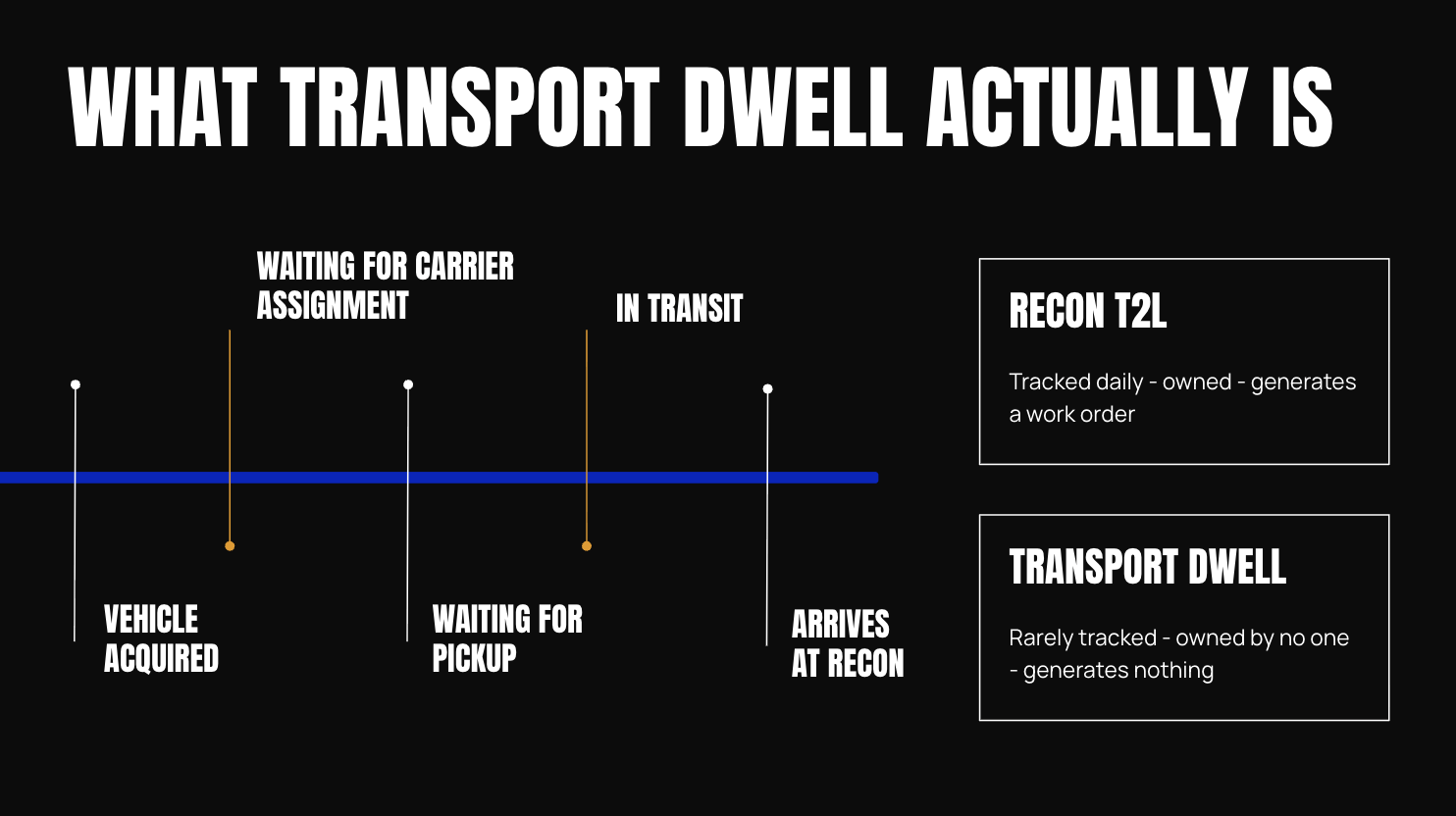
The specific starting point matters less than the habit of tracking it at all. The clock starts the moment you buy the vehicle, whether that's at auction, a trade with a dealership two hundred miles away, or another rooftop. Everything between that purchase and the vehicle showing up on your lot is transportation dwell, and it's the stage most dealers have never actually measured.
The Math Nobody's Doing
Floor plan cost alone runs around $8 a vehicle per day in 2025. That's before depreciation and insurance. Factor those in and a sitting vehicle can cost a dealership $25-30 a day.
Frank ran the numbers live: five wasted days at $25 a day is $225 per vehicle. Move a thousand vehicles a year and that's a quarter million dollars in leakage, money most dealers never see itemized anywhere.
The transit time itself, one to two days once a vehicle is picked up, isn't where dealers are losing money. The real cost sits in a stage Frank calls "waiting for carrier assignment". And that stage is broken by design. When a broker gives you a quote, they have every incentive to sit on it and farm it out to whoever gets them the biggest margin. Time works in the broker's favor, not the dealer's.
Frank's advice for Monday morning: go ask your used car manager or GM how long it actually takes from purchase to lot, and look specifically at that carrier-assignment gap. For a centrally located dealership, four to five days is the benchmark for purchase to delivery. If you're seeing ten, that's not a shipping problem. That's a business-model problem.
Three Things to Bring Back to Your Dealership
Fraud was the second half of Frank's talk, and he said it's at the highest level he's ever seen it. Three concrete steps:
- Verify before pickup. Whoever's releasing a vehicle should know the driver's name and company before they arrive, and should check ID on-site. No exceptions.
- Watch for paper tags. If a hauler shows up running paper DOT or MC numbers on the truck, that's a signal to go talk to your used car manager about who's actually moving your vehicles. Frank called it flatly: a no-no, and a common entry point for double brokering.
- Don't release gate passes early. Intercepted gate passes are one of the hardest fraud vectors to stop once they happen. Frank's recommendation: don't release a gate pass until the carrier physically arrives, and require GeoFence and ELD tracking so you're confirming the actual truck, not just a name on a screen.
Why the Timing Problem Isn't Going Away
Frank was direct about the industry shifting underneath dealers right now. Diesel prices have roughly doubled in the last year. New immigration enforcement has pushed drivers out of the space, which cuts both ways: less fraud risk from bad actors, but higher prices from the legal carriers who know they don't have to undercut anymore. The era of just chasing the cheapest quote is over.
The Takeaway
Transportation dwell isn't a shipping metric. It's a leak in the P&L that almost nobody's watching, sitting right between the moment you buy a vehicle and the moment it's ready to sell. Track it, multiply your dwell days by your real floor plan cost, and you'll likely find the number that funds the fix.
Auto Hauler Exchange built its model specifically to close that carrier-assignment gap, giving carriers what they need to book and move a load fast instead of leaving a broker to sit on your quote.
Learn how much your dealership could be leaking in transport by using AHX's Dealer Transport Cost Calculator.




.png)
