
Every vehicle that moves this week is moving on the most expensive diesel the country has ever recorded. National diesel closed out the week ending September 14 at roughly $6.29 a gallon. That's not just the highest price of 2026, it's the highest weekly average the U.S. Energy Information Administration has published in the more than three decades it has tracked retail diesel prices, surpassing the prior record of $5.810 set during the Ukraine-war fuel spike in June 2022.
For context, this week is also 11% above the previous 2026 high of $5.643, set the week of April 6 when this same conflict first pushed transport costs to what the industry has been calling "war-era" levels. That April spike, at the time, felt like the ceiling. It wasn't.
How we got here: last week's fuel spike
The week ending September 7 saw a sharp, broad fuel spike: seven of our ten tracked regions cleared a true 5%-or-greater weekly increase — a wider spike than even this week's — led by West Coast (+7.55%) and South Central (+7.35%). National diesel moved from roughly $5.60 to $5.97, up 6.6% in a single week.
This week's move to an all-time high is the direct continuation of that spike, not an isolated event: national diesel is up roughly 5.4% since last week, and the two weeks combined mark the sharpest back-to-back stretch this year. West Coast has now run above the national average for two consecutive weeks, a sustained premium rather than a one-week blip, and it has set its own all-time high right alongside the national number: EIA's West Coast (PADD 5) series hit $7.250 this week, above its prior record of $6.516 from June 2022. The Gulf Coast corridor, which roughly maps to our South Central region, crossed its own 2022 record the week before this one and has kept climbing since.
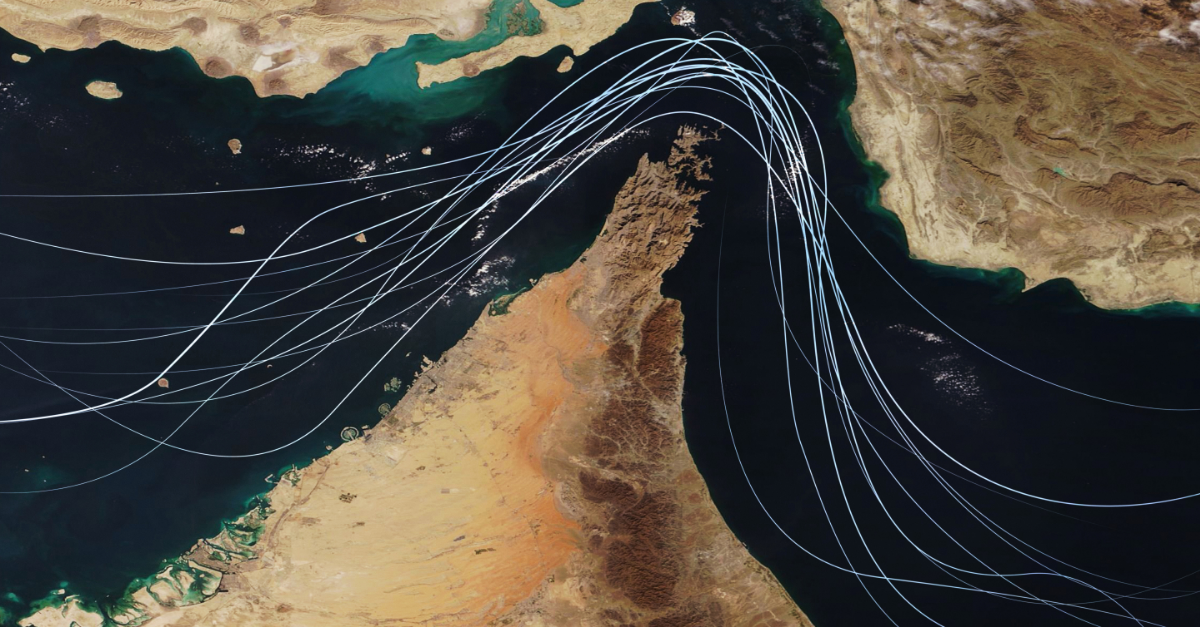
The driver behind it: the Iran war has escalated rather than settling into the stalemate we described back in April. National news outlets confirmed the $6/gallon milestone this month, tying it to Brent crude trading above $105 a barrel — up from roughly $70 before the war — amid tanker bottlenecks at the Strait of Hormuz.
Why this week is different from a normal fuel wobble
Diesel has moved before this year without it meaning much for dealers. This week is not that. Every one of the ten regions we track posted a week-over-week increase, month-over-month increases are running 12% to 17% across the board, and year-over-year comparisons sit between 57% and 78% higher. That last figure is partly a base effect (September 2025 diesel was unusually cheap), but the month-over-month number is the one that matters operationally: this is a real, broad, one-month acceleration, not a blip that reverses itself by Friday.
Diesel prices by region
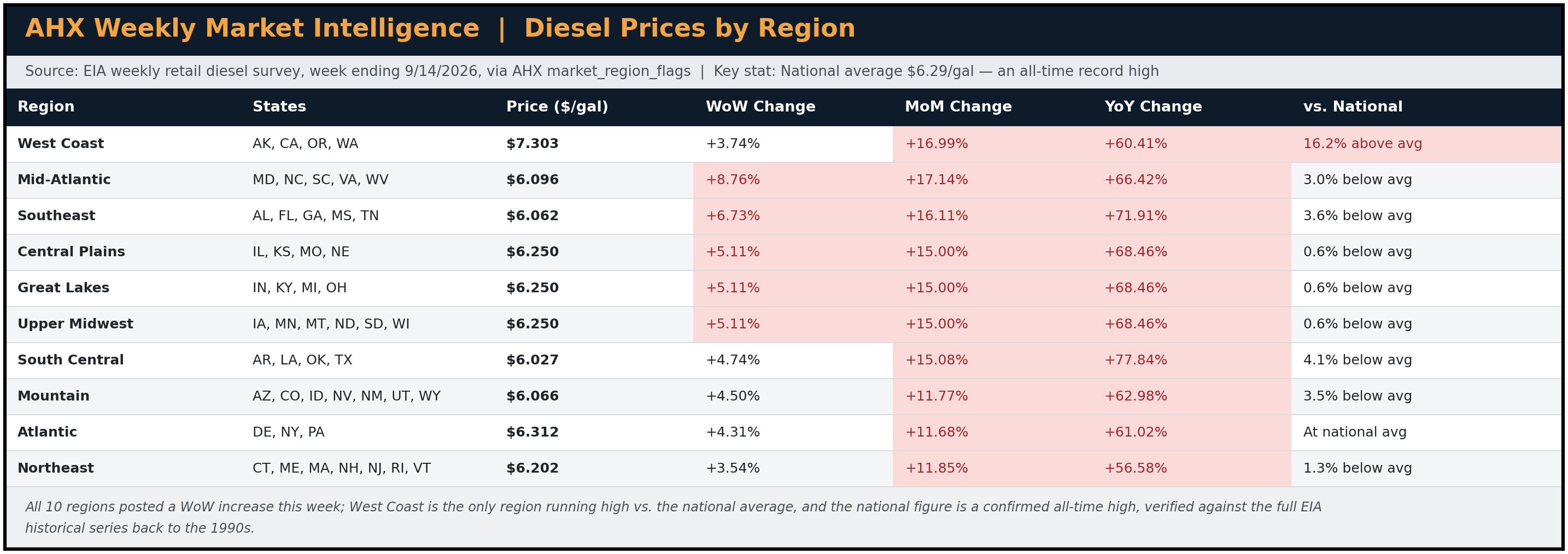
West Coast remains the only region running meaningfully above the national average, and it's not close: 16.2% above, at $7.303 a gallon. It's also the corridor with the clearest verified history here: EIA's own published West Coast (PADD 5) data shows this region has now broken its all-time high from June 2022 ($6.516), not just its 2026 high, and this week extends that further.
Mid-Atlantic posted the largest single-week move in the country, up 8.76%, followed by Southeast at 6.73%. A tight cluster of Central Plains, Great Lakes, and Upper Midwest all landed at almost exactly 5.11%. No region posted a decrease. That's worth noting on its own: a clean sweep of increases isn't rare in this market (it's happened seven times since May), but a sweep this broad, this soon after a monthly acceleration already in the double digits, is the signal to act on now rather than wait out.
Weather alert summary
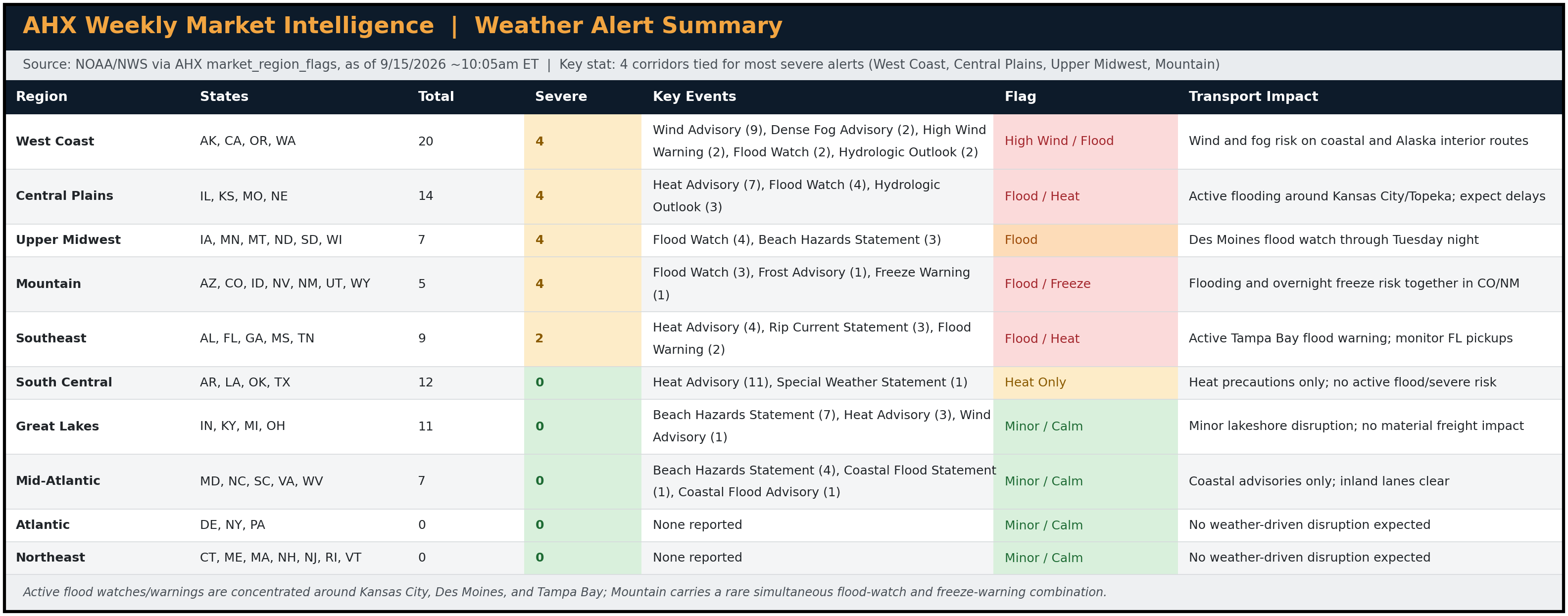
Four corridors are tied for the most severe alerts this week: West Coast, Central Plains, Upper Midwest, and Mountain. The most operationally relevant items are the active flood watches around Kansas City, Des Moines, and in Colorado/New Mexico, plus a flood warning specifically in the Tampa Bay area. Mountain is worth calling out on its own: it's carrying a flood watch and a frost/freeze warning at the same time, which means both wet-road and cold-weather handling conditions on the same lanes this week. Atlantic and Northeast are the calmest corridors on the board, with zero active alerts.
Corridor outlook
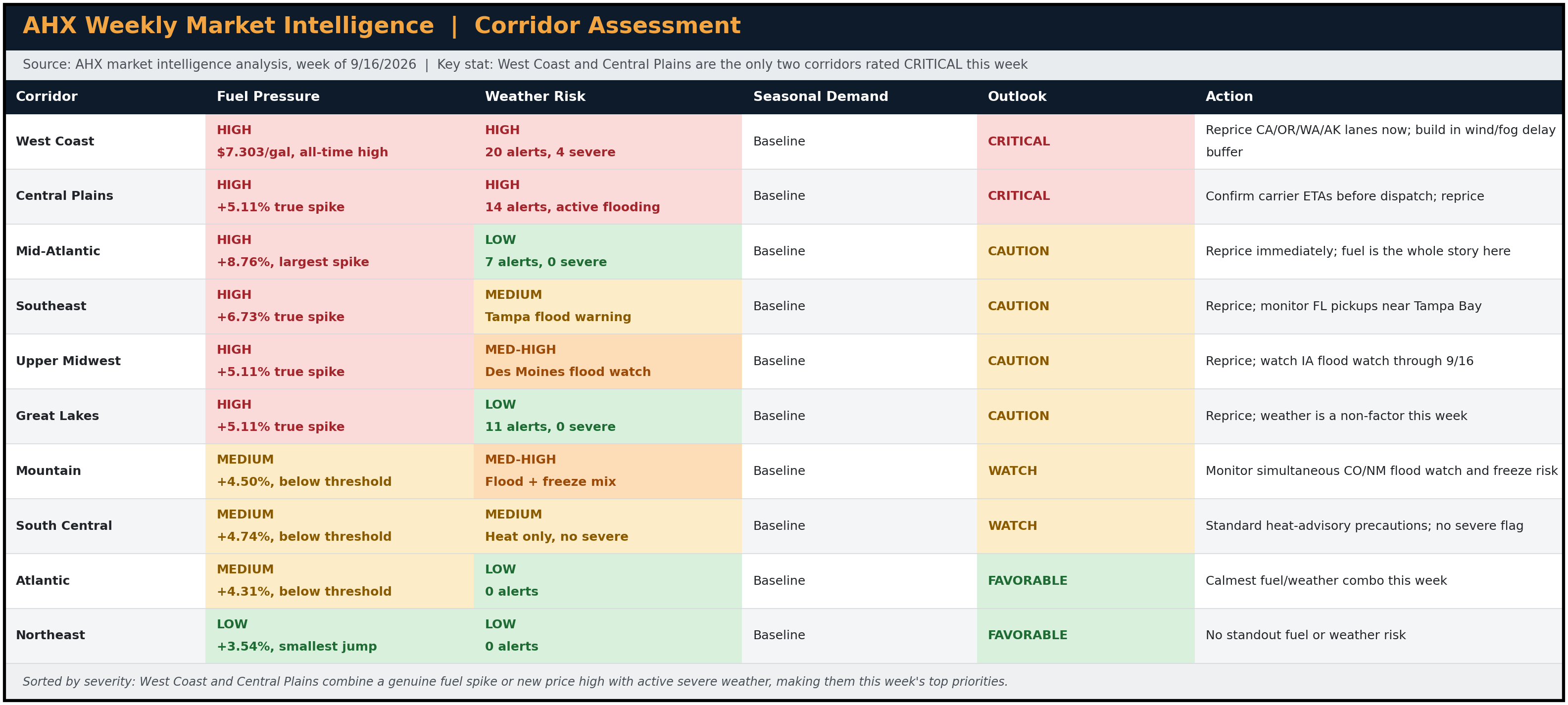
West Coast and Central Plains carry the most combined pressure this week — both a genuine fuel spike or a new price high, and active severe weather. Mid-Atlantic, Southeast, Great Lakes, and Upper Midwest all cleared a true fuel spike but without matching weather severity. Atlantic and Northeast are, for the moment, the calmest corridors in the country on both dimensions.
What we're seeing on the platform
Carriers are pricing in the higher cost of running this week, and shippers are following that lead: posted rates on AHX are moving up far more often than they're moving down right now. Carriers are being selective about which loads they'll actually bid on rather than taking anything that's posted. Coverage is healthy across most major lanes, but if your posted price hasn't caught up to this week's fuel reality, expect it to sit longer than it would have two weeks ago. The AHX Market Estimate Tool is built for exactly this moment: it reflects current market conditions rather than last week's number, which matters more than usual when fuel is moving this fast.
What dealers should do this week
- Reprice today on anything moving through Mid-Atlantic, Southeast, Central Plains, Great Lakes, or Upper Midwest.
- Expect West Coast to stay the most expensive corridor in the country; it's running 16% above the national average and just extended its own all-time high.
- Build in a delay buffer for anything touching Kansas City, Topeka, Des Moines, or the Tampa Bay area — active flooding is in play in all four.
- Don't bank on relief. No region posted a decrease this week, and nothing in the data points to a near-term pullback.
- Use the AHX Market Estimate Tool before every posting, not just this week's high-spike lanes, so pricing reflects current fuel cost rather than last week's number.
- Watch Mountain-region lanes for the combined flood-and-freeze conditions in Colorado and New Mexico; plan for both wet-road and cold-weather handling.
- Revisit any load that's been sitting more than a week without an offer — in a market where carriers are pricing selectively, an aging, underpriced load is the first thing to get passed over.
FAQ
Is $6.29 a gallon actually an all-time high, or just a high for 2026? It's a genuine all-time record. We checked EIA's full historical series, not just this year's data, and confirmed the prior all-time weekly high was $5.810, set the week of June 20, 2022, during the Ukraine-war fuel spike. This week's national average is roughly 8% above that record. It's also about 11% above the 2026 year-to-date high of $5.643, set in April.
Which region is the most expensive to ship out of or into right now? West Coast, at $7.303 a gallon, running 16.2% above the national average. It's the only region that clears our high-vs-national threshold this week.
Did every region get more expensive this week? Yes. All ten regions we track posted a week-over-week increase, ranging from 3.54% (Northeast, the smallest move) to 8.76% (Mid-Atlantic, the largest).
Is any region actually a true "spike" this week, or is it all just noise? Five regions cleared a genuine 5%-or-greater weekly increase: Mid-Atlantic, Southeast, Central Plains, Great Lakes, and Upper Midwest. The other five moved up too, just below that threshold.
Where's the weather risk concentrated this week? Active flooding around Kansas City/Topeka (Central Plains), Des Moines (Upper Midwest), coastal South Carolina/North Carolina (Mid-Atlantic), and the Tampa Bay area (Southeast), plus a flood watch paired with a freeze warning in Colorado and New Mexico (Mountain).
Is there any seasonal demand factor driving this, on top of fuel and weather? No. Tax season, snowbird migration, and spring auction season all concluded earlier this year, and Labor Day's carrier dip has already passed. This week's story is purely fuel and weather, not seasonal volume.
Should dealers expect prices to come back down soon? Nothing in this week's data supports that. Every region moved higher, month-over-month figures show a real acceleration, and the national and West Coast corridors have both broken all-time, independently verified records, not just 2026 highs. Plan for current pricing to hold, not to reverse.
What actually changed to cause this? Two things: an escalation in the Iran war (Brent crude above $105/barrel amid Strait of Hormuz disruptions, confirmed by national news coverage this month) and a broad, seven-region fuel spike the week ending September 7 that this week's record builds directly on. It's a two-week continuation, not a one-week event.
Has diesel ever been this expensive before? Not according to EIA's records, which go back to the 1990s. The prior all-time weekly high nationally was $5.810, set in June 2022 when the Ukraine war first disrupted global energy markets. This week's price surpasses that.
Sign up free at autohaulerexchange.com.
Data attribution: EIA weekly retail diesel survey, weeks ending September 7 and September 14, 2026 (cross-checked against full-year EIA series EMD_EPD2D_PTE_NUS_DPG, EMD_EPD2D_PTE_R50_DPG, and EMD_EPD2D_PTE_R30_DPG). NWS/NOAA weather alert data as of September 15, 2026, approximately 10:05am ET. Geopolitical context (Iran war escalation) drawn from national news coverage. No CDG or Autonews industry-context inputs were available for this run; that section has been omitted rather than fabricated.




.png)
