

Every region moved the same direction this week
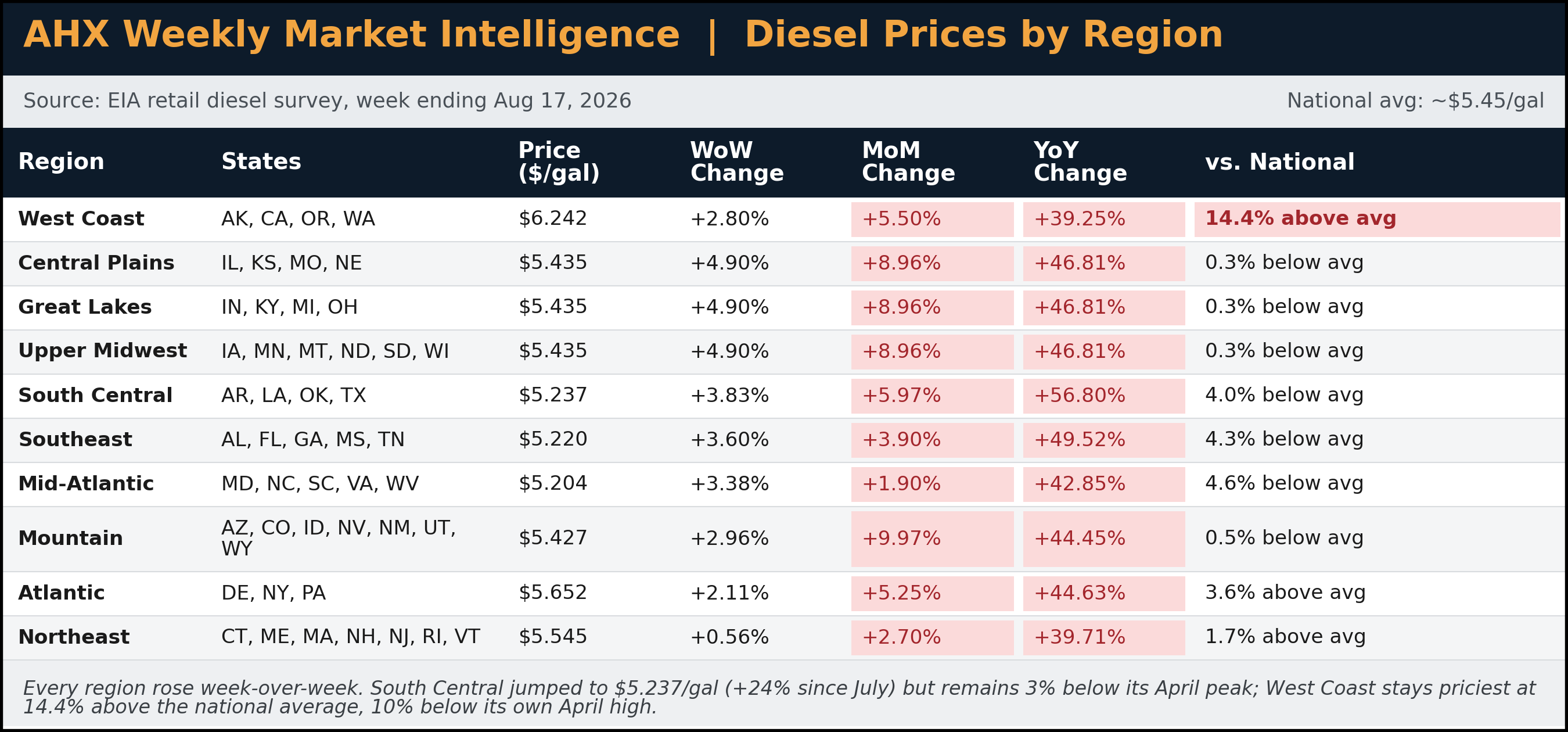
For the second time in the past seven weeks, all 10 of AHX's tracked diesel regions posted a week-over-week price increase. It's a broad move, but a modest one, nowhere near the magnitude of the three-week spike that ran from mid-July into early August. This week's biggest movers, the Central Plains, Great Lakes, and Upper Midwest, rose 4.90% WoW apiece, sitting right at the edge of spike territory without quite crossing it.
The number that matters most for South Central shippers: diesel there hit $5.237/gal, up a sharp 24% from its July low. We checked that against the full-year EIA record for the region, and it's still running about 3% below the region's true 2026 peak of $5.415/gal, set back in April. So this is a fast, real climb worth pricing for, just not a record.
Full diesel price breakdown by region
National average diesel sits at roughly $5.45/gal. West Coast remains the most expensive corridor at 14.4% above that average, and while it's the priciest corridor nationally, it's still about 10% below its own verified April 6 peak of $6.924/gal.
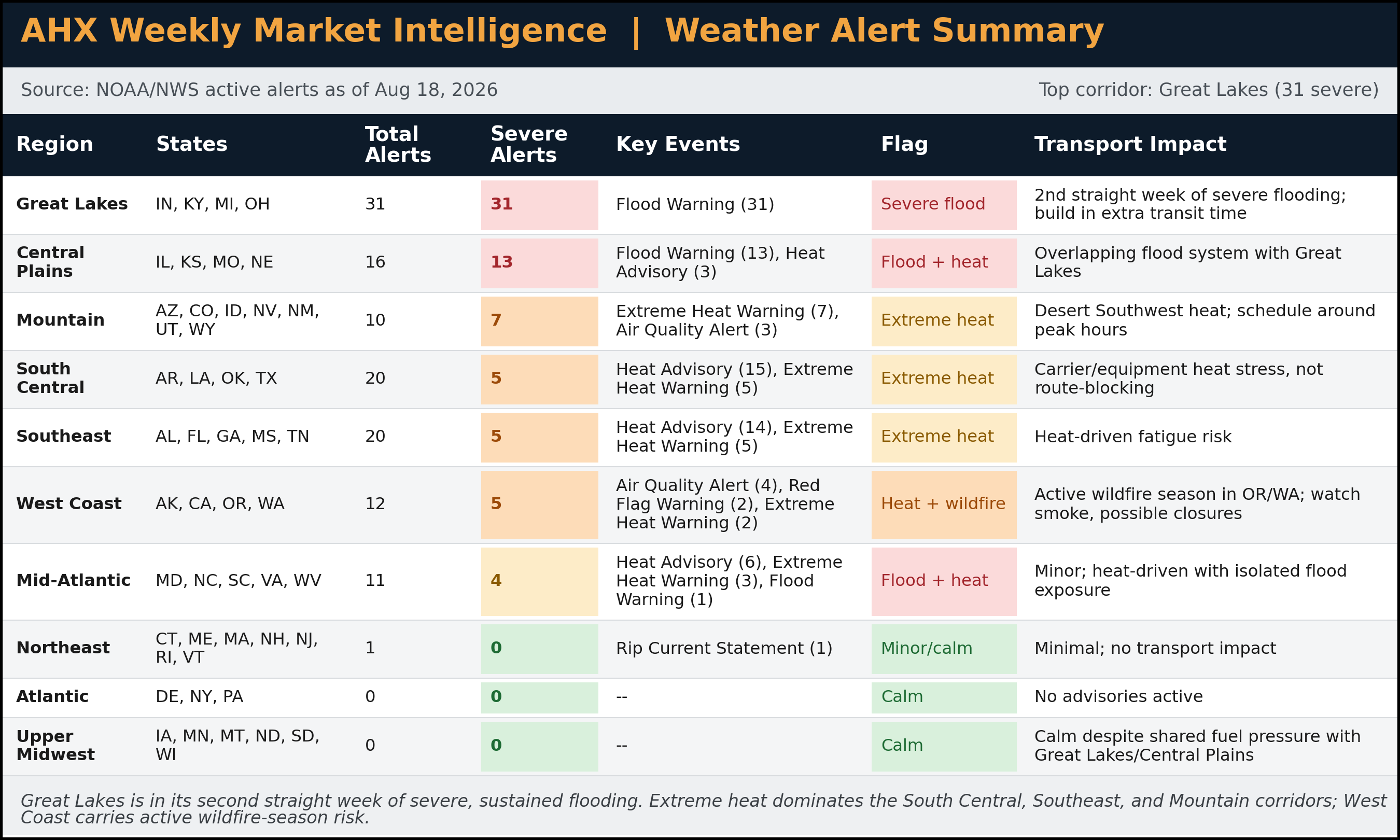
Full weather alert summary by region
Corridor-by-corridor outlook
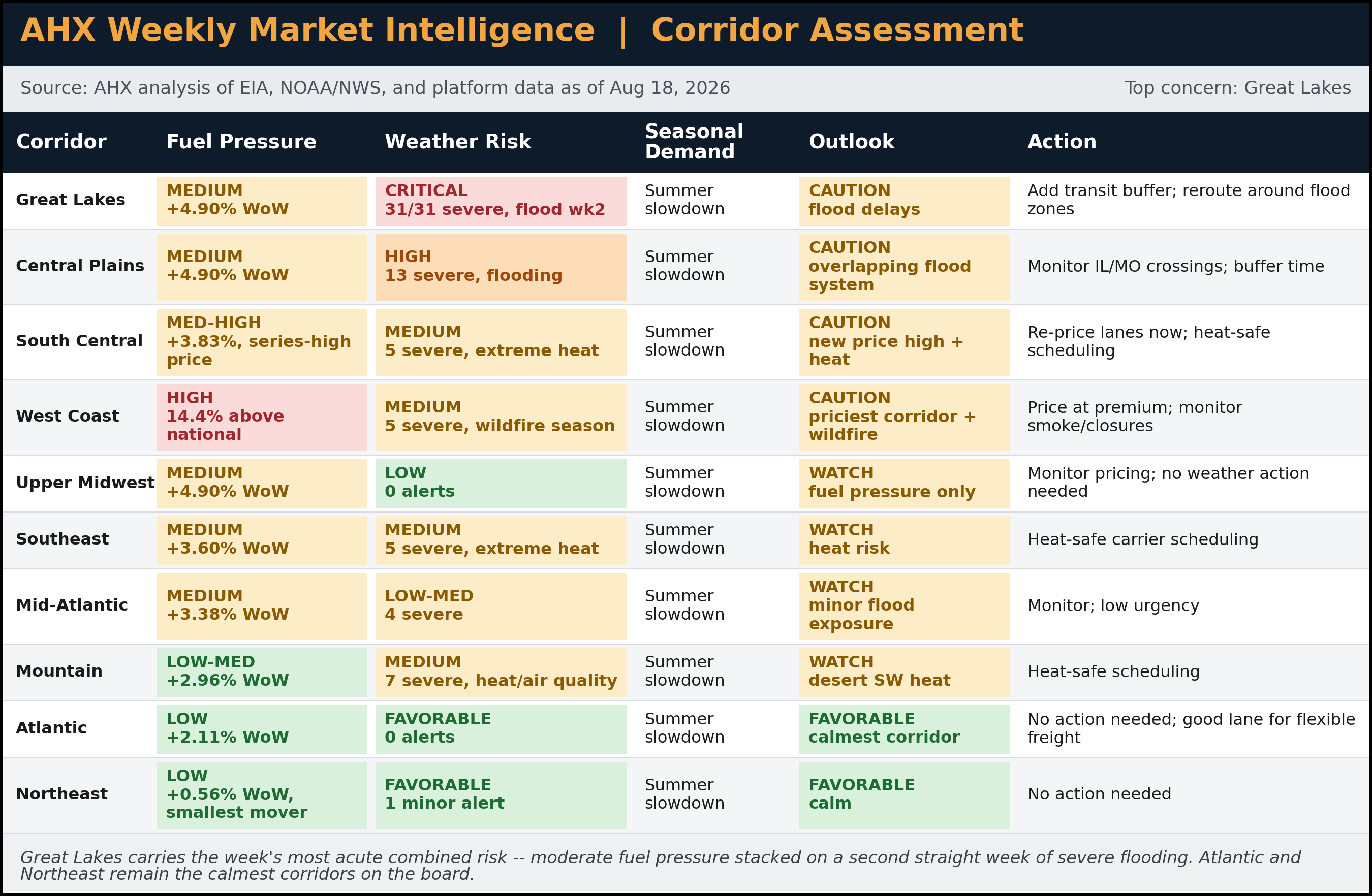
Fuel and weather don't move together everywhere, so treat each corridor on its own terms this week.
Great Lakes, highest combined risk on the board. Moderate fuel pressure (+4.90% WoW) stacked on top of a second straight week of severe, sustained flooding across Indiana, Kentucky, Michigan, and Ohio: 31 active alerts, every one of them rated severe. This is the corridor where you should be building real schedule slack, not just watching a number.
Central Plains, the overlap zone. Sharing the same 4.90% fuel move as Great Lakes, and now dealing with its own overlapping flood system (13 of 16 alerts rated severe) across Illinois, Kansas, Missouri, and Nebraska. Anything crossing both corridors this week is carrying double exposure.
Upper Midwest, fuel pressure without the weather. Same 4.90% WoW increase as its Great Lakes/Central Plains pricing cluster, but zero active weather alerts. A reminder that a shared EIA pricing series doesn't mean shared risk.
South Central, the fast mover. Diesel jumped 24% since its July low to $5.237/gal, and Extreme Heat Warnings are active across Arkansas, Louisiana, Oklahoma, and Texas (20 alerts, 5 severe). Still about 3% below its April peak, so not a record, but the combination of a sharp price climb and active heat stress makes it the corridor with the most real cost pressure building right now.
West Coast, priciest, and layering in wildfire risk. At $6.242/gal, West Coast is 14.4% above the national average, the only region above our high-vs-national threshold. Red Flag Warnings are active in Oregon and Washington on top of that price gap, though the region is still about 10% below its own April peak.
Southeast and Mid-Atlantic, heat-driven, not disruptive. Both regions posted moderate fuel increases (3.60% and 3.38% WoW) with heat advisories active. Fatigue and equipment risk, not route-blocking.
Mountain, desert Southwest heat. A smaller fuel move (+2.96% WoW) paired with the week's highest severe-alert ratio, Extreme Heat Warnings concentrated around the Phoenix and Las Vegas metros.
Atlantic and Northeast, the calm corridors. Smallest fuel moves on the board (2.11% and 0.56% WoW) and minimal-to-no weather disruption. The path of least resistance this week if you have scheduling flexibility.
What the vehicle transport market looks like right now
Fuel and weather are only half the picture, capacity and carrier behavior matter just as much for how a shipment actually prices and moves. Right now, the market still favors carriers: they continue to select the best-priced shipments first, and coverage remains healthy across AHX's major lanes nationwide. Shipment volume has stabilized over the past week after a softer month overall, and short-term market tension has actually eased relative to the medium-term trend, a sign the pressure of midsummer is letting off some steam rather than building further.
On the pickup side, Iowa, North Carolina, and Ohio are the strongest markets on the platform right now. Ohio, Nebraska, and Colorado lead on the delivery side. Meanwhile, Florida and Utah are both showing cooling delivery-side demand, the clearest capacity-loosening signals in the current data, and worth watching if you regularly ship into either state, since softening demand can translate into pricing leverage for shippers there.
Lane supply overall is healthy: most tracked lanes are running balanced to slightly loose, and nothing is flagged as critically short this week. The tightest, most competitively priced lane in the current data is Texas-to-Texas, notable given that Texas also sits inside this week's fastest-rising fuel corridor.
Seasonal factors to watch
The one active seasonal dynamic right now is the typical summer slowdown that runs July through August, with softer retail demand across the industry. Tax refund season, snowbird migration, and spring auction season are all out of window. Two calendar items worth watching: Ukrainian Independence Day falls on Monday, August 24, a meaningful share of U.S. auto transport carriers are Ukrainian, so expect a brief, narrow dip in availability among those carriers, the same dynamic we flag around Orthodox Easter. And Labor Day (September 1) historically brings a short carrier-availability dip around the holiday weekend.
What dealers should do this week
- Re-price South Central lanes now — diesel there has climbed 24% since July, even though it remains below April's peak.
- Build in extra transit time on Great Lakes routes; this is week two of severe flooding.
- Watch Florida and Utah for softening carrier interest on the delivery side.
- Lean on dynamic pricing via the AHX Market Estimate Tool rather than flat rates.
- Plan around peak heat hours for South Central, Southeast, Mid-Atlantic, and Mountain shipments.
- Note Ukrainian Independence Day on Monday, August 24 — a meaningful share of U.S. car-hauling carriers are Ukrainian, so expect a brief availability dip among those carriers, similar to what we track around Orthodox Easter.
- Take advantage of the calm in Atlantic and Northeast for flexible freight.
Frequently asked questions
Why did diesel rise in every region this week?
All 10 tracked regions posted a week-over-week increase, led by the Central Plains, Great Lakes, and Upper Midwest cluster at 4.90% each.
Is South Central diesel at an all-time high?
No. At $5.237/gal it's up sharply from July, but it's still about 3% below the region's verified 2026 peak of $5.415/gal, set on April 6.
How long has the Great Lakes flooding been going on?
This is the second consecutive week of severe flooding across Indiana, Kentucky, Michigan, and Ohio.
Which region is most affected by wildfire season right now?
West Coast, where Red Flag Warnings are active in Oregon and Washington.
Are any markets showing signs of loosening carrier capacity?
Yes. Florida and Utah both show cooling delivery-side signals this week.
What seasonal factors should I be planning around right now?
The typical summer slowdown is active. Two calendar items to watch: Ukrainian Independence Day on Monday, August 24, and Labor Day (September 1).
Data attribution: EIA retail diesel survey, week ending August 17, 2026, cross-checked against EIA's full-year weekly PADD series. NOAA/NWS active alerts as of August 18, 2026. AHX platform market data as of August 18, 2026.
Sign up free at autohaulerexchange.com.




.png)
