

If you're moving vehicles through Texas, Louisiana, Arkansas, or Oklahoma this week, read this one closely. A Hurricane Watch and a Tropical Storm Warning went into effect this morning for the Louisiana coast. South Central's severe weather alert count jumped from 2 last week to 22 this week, an eleven-fold increase in seven days. Fuel, meanwhile, had its quietest week in over two months. No region posted a sharp weekly jump for the first time since late June. Don't read that as relief. Diesel is still running roughly 49 to 51 percent above year-ago levels nationally, and South Central and the national average both quietly touched new highs for 2026 just last week.
Here's the full breakdown, region by region, plus what it means for how you price and schedule shipments this week.
This Week's Fuel Picture
For the first time since late June, not a single region posted a sharp week-over-week diesel jump. Atlantic, Central Plains, Great Lakes, Northeast, South Central, Southeast, Upper Midwest, and West Coast all saw a notable weekly jump as recently as August 24. The network cooled off heading into September.
Here's the part that matters more than the quiet week. This isn't a market that's cooling off. It's a market holding near the top of its range. National average diesel hasn't dropped below $4.55/gal in a single week since the spike that began in early March, 25 straight weeks now, and it's currently running roughly 49-51% above where it was this time last year. A calm week on weekly moves doesn't change that backdrop, and it shouldn't change how you're budgeting shipments.
South Central saw the largest move of the week, a 2.21% decline to $5.36/gal. That looks like relief on paper. It isn't. It's a pullback from a brand-new high, not an old one. South Central's diesel price actually touched $5.481/gal just last week, on August 24, a genuine 2026 high for that corridor and higher than the widely-referenced spring spike. South Central is now running roughly 60-65% above year-ago levels.
West Coast remains the region to watch on fuel. At $6.545/gal, it's up 1.48% week-over-week and running 16.9% above the national average, the only region running meaningfully above the national average this week. West Coast diesel has climbed in most weeks since bottoming out at $5.469/gal on July 6. It's currently about 5.5% below the region's 2026 high, set in April, and up roughly 44-46% year-over-year. If you priced a West Coast shipment based on the dip that ran through most of June, check that number again. If you're waiting for West Coast fuel costs to come down meaningfully, this week's data doesn't support that expectation.
Diesel Prices by Region
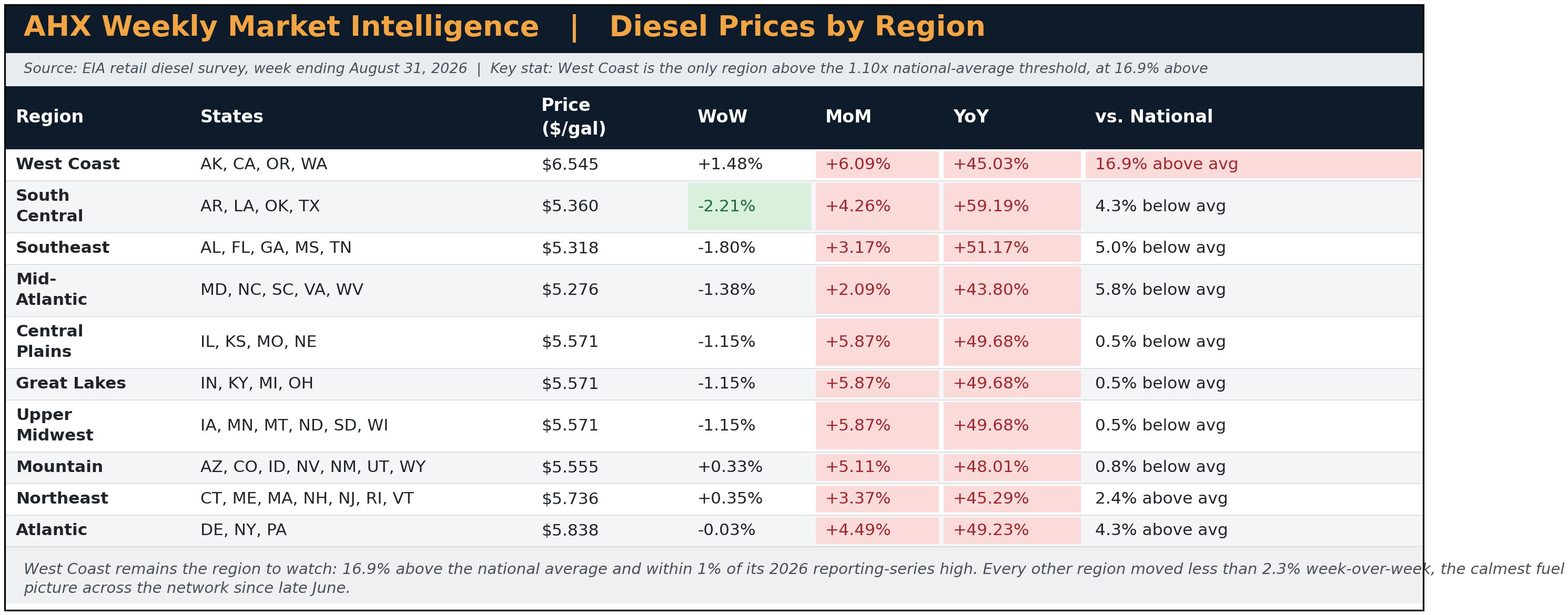
Every region remains well above where it was a year ago. YoY comparisons range from roughly 44% to 59% higher across the network. That's a structural, network-wide reading, not a single-region story, and it's the backdrop against which every regional move this week should be read.
This Week's Weather Picture
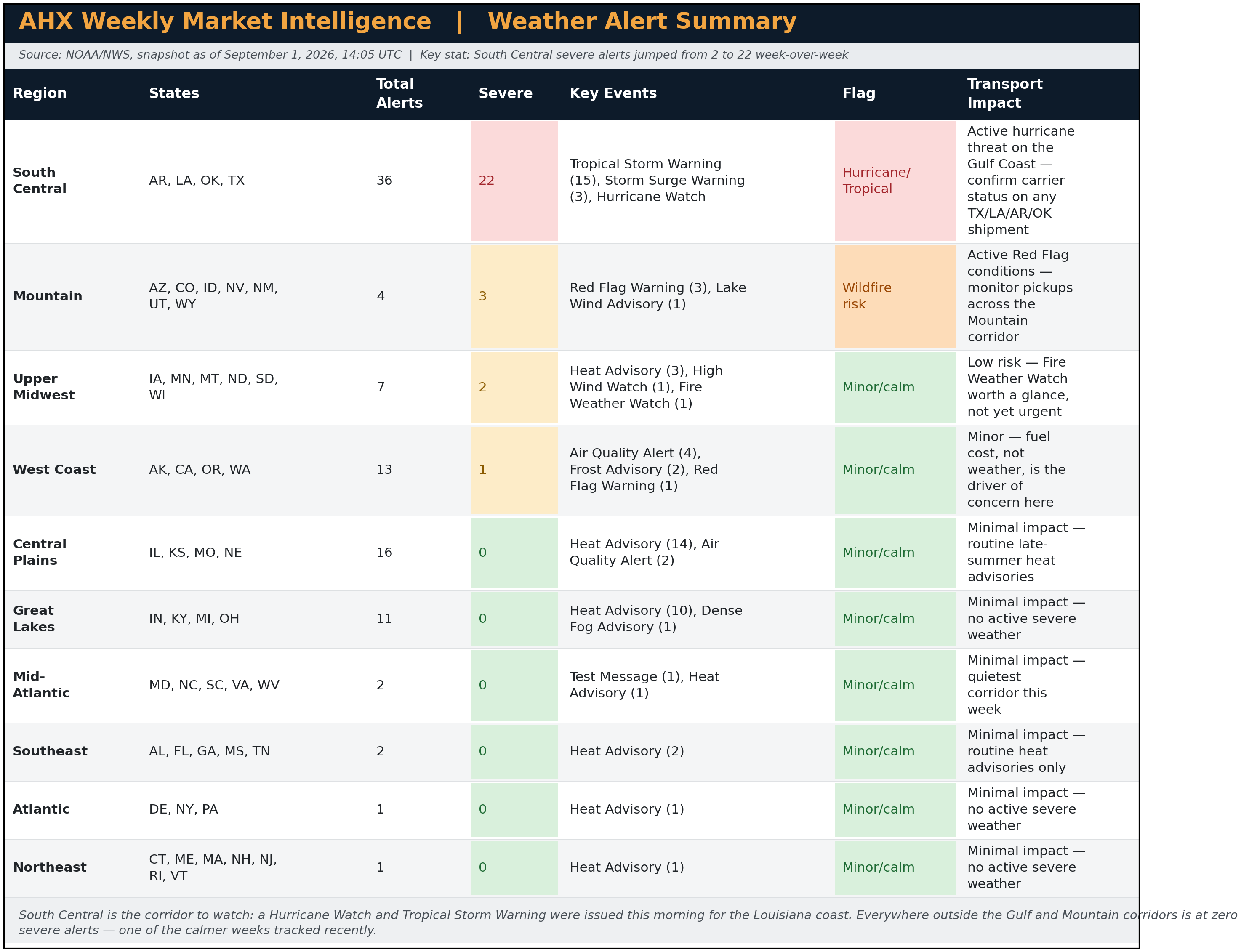
The big story this week isn't a nationwide pattern. It's a single corridor going from calm to critical in seven days.
South Central went from 2 severe alerts last week to 22 this week. A Hurricane Watch and a Tropical Storm Warning were both issued this morning by the National Weather Service office in Lake Charles, Louisiana, alongside a Storm Surge Warning for the coast. Total alerts in the corridor rose from 22 to 36. If you have anything routed through the Gulf Coast this week, treat this as an active, developing situation. It is not a lingering heat pattern.
Outside the Gulf, the network is notably calmer than it's been in recent weeks. Atlantic, Central Plains, Great Lakes, Mid-Atlantic, Northeast, and Southeast all show zero severe alerts this week. That's a real change from mid-August, when Great Lakes carried 10 severe alerts out of 31 total on August 17 and Central Plains carried 9 of 16 on August 24.
Two corridors deserve a second look. The Mountain region has the highest severe-to-total ratio of the week. Three of its four active alerts are Red Flag Warnings, signaling real wildfire risk across Idaho and Nevada. Upper Midwest is carrying a Fire Weather Watch and a High Wind Watch alongside more typical late-summer heat advisories.
Weather Alert Summary
Corridor Outlook
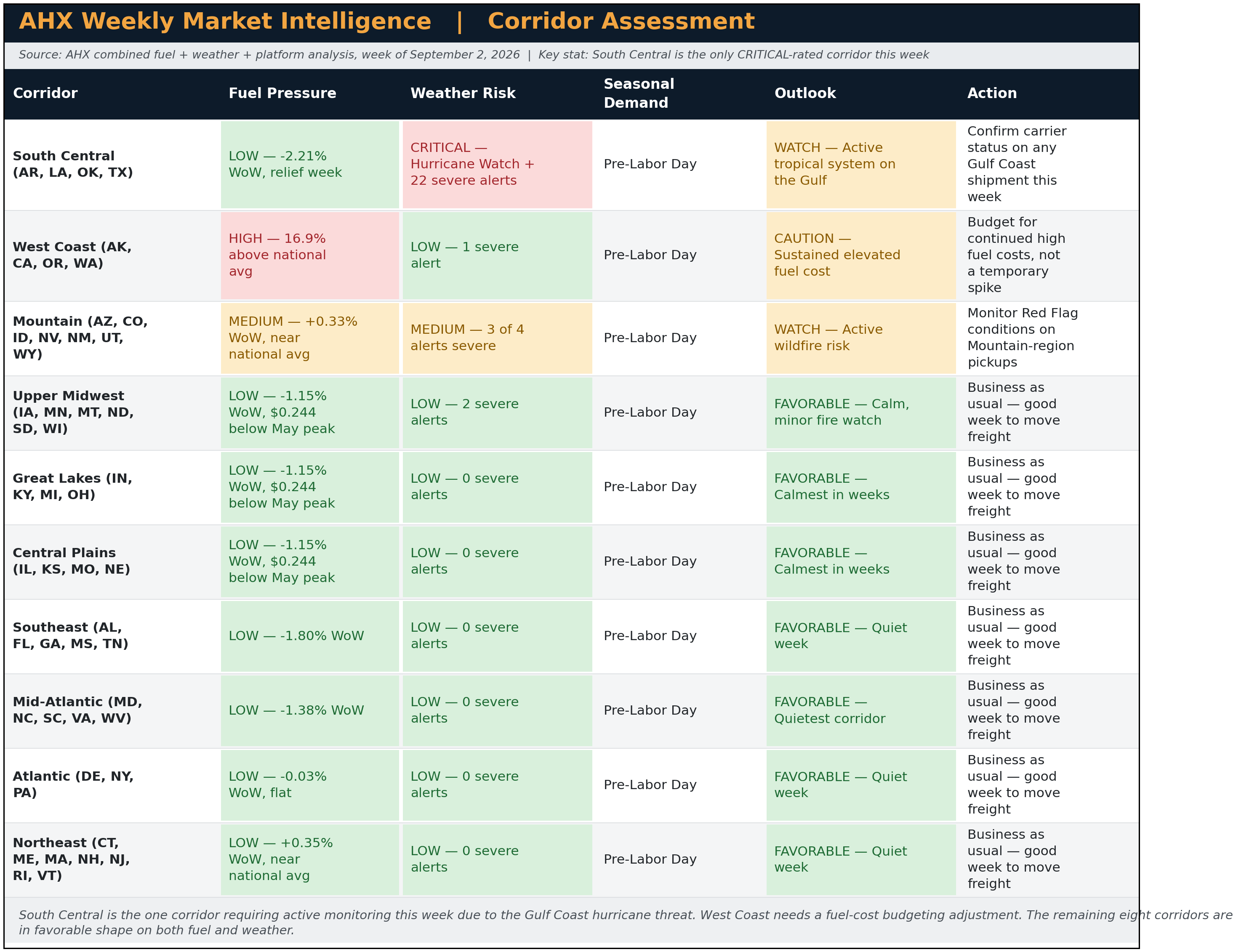
Put fuel pressure and weather risk together and the corridors split into two clear groups this week: the ones that need attention, and the ones that don't.
South Central is the corridor to watch. Fuel pressure is actually easing there, but the active Hurricane Watch means "wait and see" isn't the right posture. Confirm your carrier's status directly if you have anything moving through Louisiana, Texas, Arkansas, or Oklahoma this week.
West Coast is the corridor to budget for. There's no weather emergency, but fuel costs are sustained and elevated with no sign of easing. If you're pricing shipments out of California, Oregon, Washington, or Alaska, build the 16.9% national premium into your expectations. Don't treat it as temporary.
Mountain deserves a watchful eye. Active Red Flag Warnings mean real wildfire risk, though it's not yet at a level that should change how you're pricing or scheduling.
The rest of the network is in favorable shape on both fuel and weather this week: Atlantic, Central Plains, Great Lakes, Mid-Atlantic, Northeast, Southeast, and Upper Midwest. If you've been holding off on shipments due to weather concerns in the Midwest or Northeast, this is a good week to move.
What We're Seeing on the AHX Platform
Carriers remain in control of the market. AHX's Carrier Market conditions have held steady for weeks, which means carriers continue to select the best-priced shipments first rather than taking whatever's posted. Georgia and Virginia are the strongest pickup markets on the platform right now. Illinois and Kentucky are pulling the most volume on the delivery side. Carrier coverage stays healthy across all major lanes.
What Dealers Should Do This Week
- Confirm carrier status on anything routed through the Gulf Coast. If you have a shipment moving through Texas, Louisiana, Arkansas, or Oklahoma, don't assume it's unaffected by the Hurricane Watch. Check directly.
- Budget for a sustained elevated-cost environment, not just West Coast. National diesel hasn't dropped below $4.55/gal in 25 straight weeks, and it's still running roughly 49-51% above year-ago levels. West Coast is the most extreme case, 16.9% above the national average and up 44-46% year-over-year, but every region in this week's table is elevated. Price accordingly across the board.
- Post Gulf Coast and West Coast shipments early in the week to give carriers maximum routing flexibility around active weather.
- Run every shipment through the AHX Market Estimate Tool before you price it. The spread between regions is wide enough right now, nearly 17 points between South Central and West Coast on the national-average scale, that a flat national number will miss the mark in either direction.
- Plan around the approaching Labor Day weekend. The holiday falls on September 7 this year. Expect a short carrier-availability dip in the day or two around it, and post early if you have anything time-sensitive.
- Take advantage of the calm outside the Gulf and Mountain corridors. Most of the network, especially the Midwest and Northeast, is in about as favorable a weather window as we've tracked in weeks.
- Don't let the quiet fuel week create complacency. No spike flags doesn't mean prices are heading down. MoM changes are still positive in every region. South Central and the national average just touched new highs for 2026 last week. YoY comparisons remain elevated roughly 44-65% across the network depending on region.
Frequently Asked Questions
Is it safe to ship a vehicle through Louisiana or Texas this week?
There's an active Hurricane Watch and Tropical Storm Warning for the Louisiana coast as of this morning. It's not a reason to stop shipping. It is a reason to confirm your carrier's routing and timeline directly rather than assuming business as usual. Storm systems can shift quickly in either direction over the next few days.
Why is West Coast diesel so much higher than everywhere else?
West Coast diesel is running 16.9% above the national average this week at $6.545/gal, and it's been the most consistently elevated region in the country all year. It's currently about 5.5% below the region's 2026 high, set in April, and up roughly 44-46% year-over-year. There's no single-week explanation. It reflects sustained regional fuel market dynamics rather than a temporary event.
Did diesel prices go up or down this week overall, and does that mean costs are coming down?
Prices eased modestly in most of the network. South Central led with a 2.21% decline, and seven of ten regions posted week-over-week decreases. That's not the same as costs coming down. South Central's decline was a pullback from a brand-new 2026 high it touched just the week before, and the national average diesel price hasn't dropped below $4.55/gal in 25 consecutive weeks. Every region remains 44% or more above year-ago levels. Treat a quiet week as "not getting worse," not as "getting cheaper."
What does "vs. national average" mean in your diesel table?
It's how each region's diesel price compares to the U.S. national average for the week. A region above 100% is paying more than the national average. Below 100% is paying less. We flag a region as notably high when it crosses 110%. West Coast, at 116.9%, is the only region past that line this week.
Is now a good time to ship out of the Midwest or Northeast?
Based on this week's data, yes. Atlantic, Central Plains, Great Lakes, Mid-Atlantic, Northeast, and Southeast all show zero severe weather alerts and modest fuel declines. It's one of the calmer weeks we've tracked for those corridors recently.
How does AHX help me manage a week like this, with a hurricane in one region and elevated fuel costs in another?
This is exactly the kind of week where broker-based transport falls short. A broker isn't tracking region-by-region fuel and weather data for you in real time. AHX combines that visibility with 5,500+ vetted carriers, real-time ELD tracking on all active shipments, and an AI Pricing Engine that automatically adjusts posted prices within your set range. You're not manually re-pricing every shipment as conditions shift.
Ready to Ship Smarter This Week?
Whether you're navigating an active hurricane watch on the Gulf Coast or budgeting for elevated West Coast fuel costs, AHX gives you the pricing transparency and carrier accountability to make the right call. You don't have to wait on a broker to tell you what's already in this article.
Sign up free at autohaulerexchange.com.
Data sources: EIA retail diesel price survey, week ending August 31, 2026 (published September 1, 2026), cross-checked against full 2026 EIA weekly history for National, Gulf Coast (PADD 3), and West Coast (PADD 5) diesel prices. NOAA/National Weather Service alert data as of September 1, 2026, 14:05 UTC. AHX platform market data as of September 1, 2026, 09:01 UTC. CDG and Autonews industry context was not available for this week's report.




.png)
