

South Central diesel just did something it hasn't done all year: it topped its previous high. At $5.481/gal, this week's price is 1.2% above the region's prior 2026 peak of $5.415/gal, set back on April 6. If you're shipping in or out of Texas, Louisiana, Oklahoma, or Arkansas, this is the number to budget around going forward.
That's not the only story this week. Every one of the 10 regions we track posted a week-over-week diesel price increase, and the West Coast is dealing with a genuinely severe weather week — extreme heat and active wildfire risk stacked on top of the country's highest fuel price. Here's the full breakdown: diesel by region, weather risk by corridor, what it means for transport timing and cost, and what we'd do differently this week if we were sitting in your seat.
This Week's Top Story: South Central Sets a New 2026 High
South Central posted the largest week-over-week increase of any region this week, +4.66%, and that move pushed the corridor's price past its prior year-to-date high. That series peaked at $5.415/gal on April 6, 2026; this week's South Central price of $5.481/gal is 1.2% above that. South Central diesel is now more expensive than it's been at any point in 2026.
The rest of the country moved up too, from Mountain's modest +2.03% to South Central's +4.66%. All 10 regions moving the same direction in the same week has happened three other times in the last four months, so the uniformity itself isn't rare — but South Central breaking its own 2026 record is the number that matters most this week.
Why Transport Costs Are Up: It's the Diesel Market
If moving a vehicle feels more expensive than it did a year ago, that's because it is — for everyone. Every single region we track is up both month-over-month and year-over-year right now, with no exceptions.
Month-over-month increases range from +1.81% to +8.47% (average roughly 5.9%). Year-over-year increases range from +43.71% to +64.69% (average roughly 52%) — diesel costs a third to two-thirds more than it did a year ago, everywhere.
The national average is $5.652/gal this week versus roughly $3.708/gal during the same week last year — a 52.4% year-over-year increase.
The takeaway for dealers: rising transport costs right now reflect the diesel market. Every carrier, on every platform, is paying more to fuel a truck than they were last year — that shows up in what they're willing to haul a vehicle for, regardless of where the shipment is posted. AHX is making that reality visible and priced accurately in real time through the AHX Market Estimate Tool, rather than buried inside a broker's black-box quote.
Diesel Prices by Region
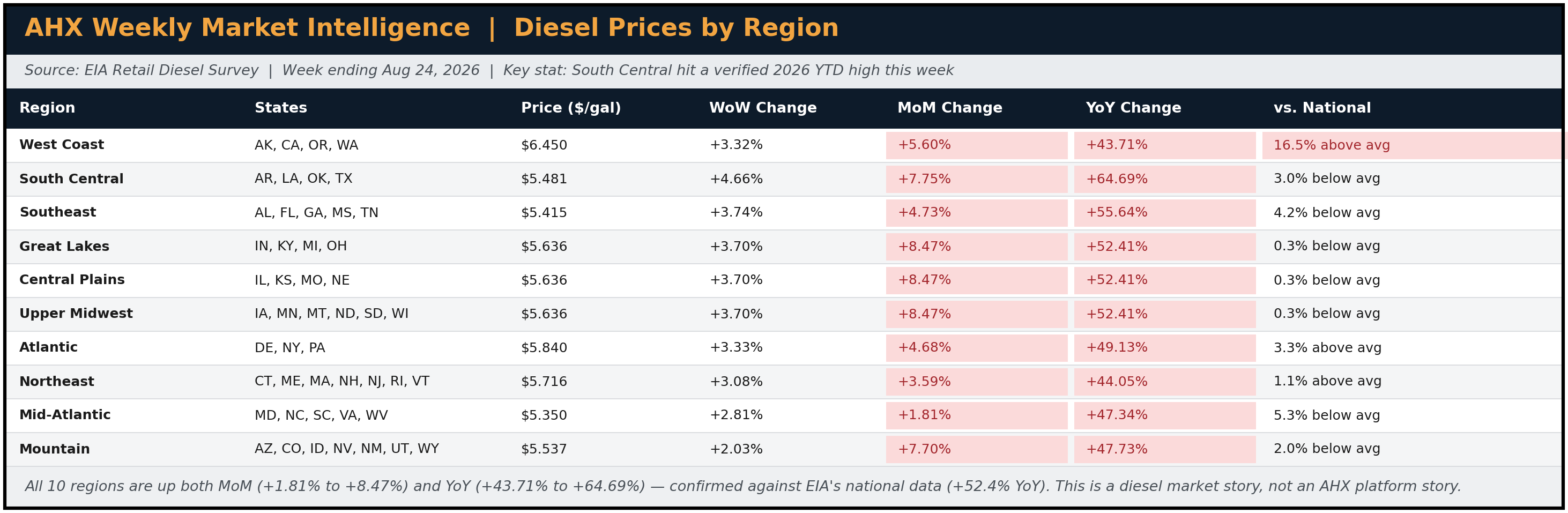
West Coast remains the one region running meaningfully hot versus the national average — worth noting, though, that its current 16.5%-above-average reading is actually the mildest gap we've recorded there all summer. The premium is real; it isn't getting worse week over week, and West Coast itself remains well below its own April 2026 peak.
Month-over-month tells a sharper story than week-over-week: Great Lakes, Central Plains, and Upper Midwest are all up 8.47% on the month, and Mountain is up 7.7%. If you're budgeting transport costs for the next few weeks in the Midwest, plan around continued firmness, not a pullback.
Weather Alert Summary
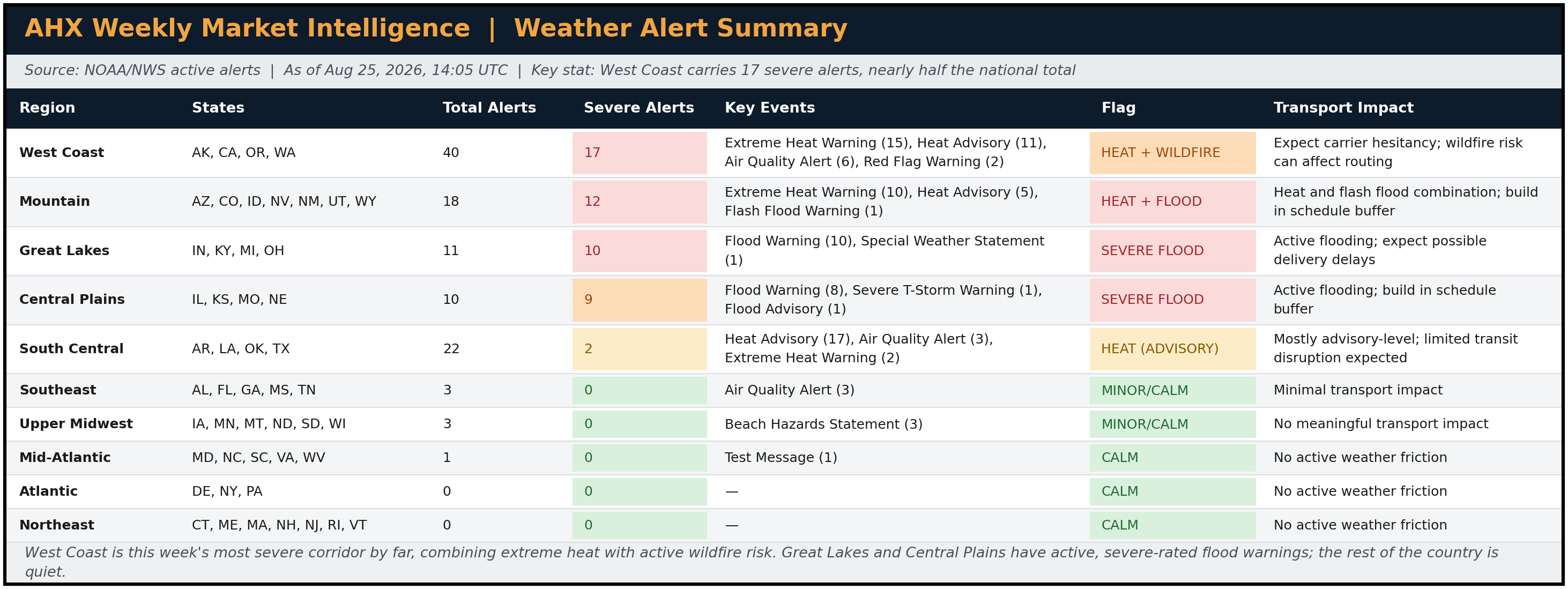
The West Coast is carrying both the week's highest fuel price and its most severe weather load — 17 severe alerts, nearly half the national total, driven by an extreme heat and active wildfire combination across California, Oregon, and Washington. That's a corridor where we'd expect carriers to be more selective about which loads they take, and where posting at a market-accurate price matters more than usual.
Don't be misled by South Central's raw alert count of 22 — only 2 of those are severe-rated. Heat Advisories are a lower-tier NWS product than the Extreme Heat Warnings and Flood Warnings driving the numbers in West Coast, Mountain, Great Lakes, and Central Plains.
Corridor Outlook
What's Happening on the AHX Platform
Carrier-market conditions held steady again this week — carriers continue to have the pick of available freight, which is typical heading into late summer. Posted volume softened slightly over the past seven days, consistent with the seasonal slowdown that runs through August, though the trailing month has held roughly flat rather than trending down sharply.
On specific lanes, we're seeing carrier interest build notably around Alabama and Georgia pickups, and Nebraska and Connecticut deliveries — those markets are tightening and worth prioritizing if flexibility allows. Coverage on major Texas and Florida/Georgia corridors remains deep, which is good news if you're shipping in or out of those states this week.
Carrier Capacity: Brake Safety Week Adds a Second Squeeze
Fuel isn't the only thing putting pressure on this week's market. CVSA's Brake Safety Week is running August 23–29, and we're seeing rate and capacity pressure in multiple regions that looks a lot like what we'd expect during a DOT Blitz. Roadside inspections pull trucks off the road for the day, and any carrier placed out of service is removed from the available pool entirely until it's cleared.
For scale, here's what last year's event looked like nationally (2025 results — the most recent published; 2026 figures won't be final until after Friday):
- 15,175 commercial vehicles inspected
- 2,296 vehicles placed out of service — a 15.1% out-of-service rate
- 1,199 violations tied to the 20% defective brake criterion
- 113 brake drum and rotor violations
- 25 vehicles placed out of service after failing performance-based brake testing
That's a meaningful chunk of national capacity temporarily off the road at the same time diesel is at a 2026 high in multiple corridors. If a shipment is taking longer than usual to get picked up this week, or a carrier response feels slower than normal, this is a legitimate factor — not just fuel, and not a platform issue.
What Dealers Should Do This Week
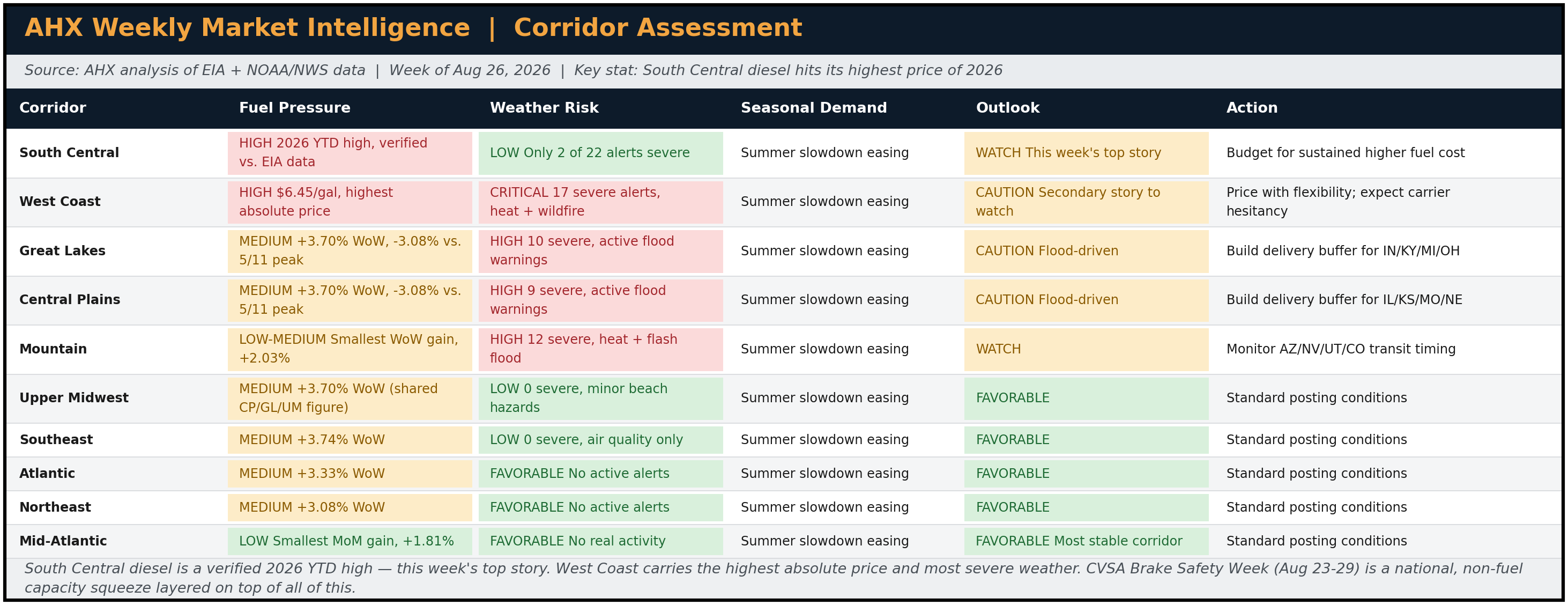
- Budget South Central lanes around a new normal, not a blip. This week's $5.481/gal is a verified 2026 year-to-date high for the corridor. Build that level into your Texas, Louisiana, Oklahoma, and Arkansas transport planning going forward.
- Price West Coast shipments with flexibility built in. The combination of the region's highest absolute fuel cost and active wildfire risk is exactly the setup that makes carriers hold out for a better rate — run your West Coast lanes through the AHX Market Estimate Tool before posting rather than relying on last week's number.
- Build a delivery buffer into Great Lakes and Central Plains lanes. Active, severe-rated flood warnings are in effect across Indiana, Kentucky, Michigan, Ohio, Illinois, Kansas, Missouri, and Nebraska — don't promise a tight delivery window this week.
- Post Labor Day-window shipments early. Anything you need picked up or delivered between September 5 and 7 (Labor Day falls on Monday, September 7 this year) should go up now — the holiday weekend typically brings a carrier availability dip, and it's landing on top of an already-slower summer.
- Lean into the tighter markets. Alabama and Georgia pickups, and Nebraska and Connecticut deliveries, are trending toward tighter carrier availability — if you have flexibility on timing, these are good markets to prioritize this week.
- Don't overreact to South Central's high alert count. Twenty-two weather alerts sounds alarming, but only two are severe-rated. Treat it as a normal-risk corridor for transit purposes.
- Re-check pricing mid-week if a load sits. With fuel moving in every region simultaneously, a price that was market-accurate on Monday may not be by Thursday. The AHX AI Pricing Engine adjusts automatically within your set range, but it's worth a manual glance on anything posted before this week's fuel data came in.
- Build in extra patience through Friday. CVSA Brake Safety Week (Aug 23–29) is temporarily thinning carrier availability nationally. Slower response times this week are likely tied to that, not to pricing or platform issues.
FAQ
Is South Central diesel really the highest it's been all year?
Yes — verified, not estimated. At $5.481/gal, South Central is now 1.2% above its prior 2026 peak of $5.415/gal (set April 6), confirmed against the EIA's full public historical series for the Gulf Coast region, which goes back to 1994. This is the highest South Central diesel has been at any point in 2026.
Did diesel prices spike this week?
Not by our definition — no region moved more than 5% week-over-week (South Central came closest at +4.66%). What's notable is that all 10 regions moved up simultaneously, which has happened three other times since May, so the uniformity itself isn't rare — South Central setting a new 2026 high is the more significant fact.
Which region has the highest diesel price right now, South Central or West Coast?
West Coast has the highest absolute price ($6.450/gal) and is the only region currently priced meaningfully above the national average. South Central, at $5.481/gal, is lower in absolute terms but is the region making genuine year-to-date history — it's never been more expensive to move a vehicle through that corridor in 2026.
Is West Coast's fuel premium getting worse?
No. West Coast has been flagged as running above the national average every week since this reporting series began in May, but this week's gap is actually the smallest we've recorded there — the premium is real but stable, not widening.
Why does transport cost so much more than it did a year ago?
Diesel is up 43.71% to 64.69% year-over-year across every region we track — confirmed independently against EIA's national diesel data, which shows the national average up 52.4% over the same period. That's a fuel market story affecting every carrier on every platform.
Which corridors have the worst weather risk this week?
West Coast (17 severe alerts, heat and active wildfire risk) and Mountain (12 severe alerts, heat and flash flooding) carry the most severe-rated weather. Great Lakes and Central Plains have active, severe flood warnings as well.
Should I expect delivery delays in the Midwest this week?
Build in a buffer for Great Lakes and Central Plains deliveries — active flood warnings are in effect across multiple states in both corridors. Upper Midwest, despite sharing the same fuel pricing as those two regions, has no significant weather activity this week.
What should I do differently when I post a shipment this week?
Check pricing against the AHX Market Estimate Tool before posting, especially on West Coast and South Central lanes, and post any Labor Day-window shipments now rather than waiting until closer to the holiday.
Why do carrier response times feel slower this week?
CVSA's Brake Safety Week is running August 23–29 nationally. Inspections and out-of-service orders are temporarily pulling carriers off the road — last year's event put 15.1% of inspected vehicles out of service. It's a real, event-driven capacity squeeze on top of this week's fuel picture, and it should ease once the event concludes Friday.
The Bottom Line
This week isn't a crisis week — it's a “new normal” week for South Central, where diesel just became more expensive than it's been at any point in 2026. The West Coast adds a second layer of risk, combining the nation's highest absolute fuel price with a severe weather week, CVSA Brake Safety Week is temporarily thinning carrier capacity nationally through Friday, and the Midwest flood corridor needs a delivery buffer. Everywhere else, conditions are stable to favorable heading into the Labor Day weekend (Monday, September 7).
Sign up free at autohaulerexchange.com.
Data sources: EIA retail diesel survey, week ending August 24, 2026 (published by EIA the following Monday), cross-checked against EIA's full public historical series by region (PADD-level data, eia.gov). NWS/NOAA active weather alerts as of August 25, 2026, 14:05 UTC. AHX platform data as of August 25, 2026. No CDG or Automotive News industry context was available for this week's report.



.png)
