
If you moved a vehicle last week and it cost more than you expected, you weren't imagining it. Every region we track posted a week-over-week diesel increase this week — not one hot corridor carrying the story, but all ten at once. And in the two corridors carrying the sharpest increases, a named tropical storm is now sitting directly on top of them.
This week's brief covers both: the broadest diesel move we've seen in months, and Tropical Storm Bertha's developing threat to Gulf Coast vehicle transport.
The Fuel Picture: A Nationwide Move, Not a Regional One
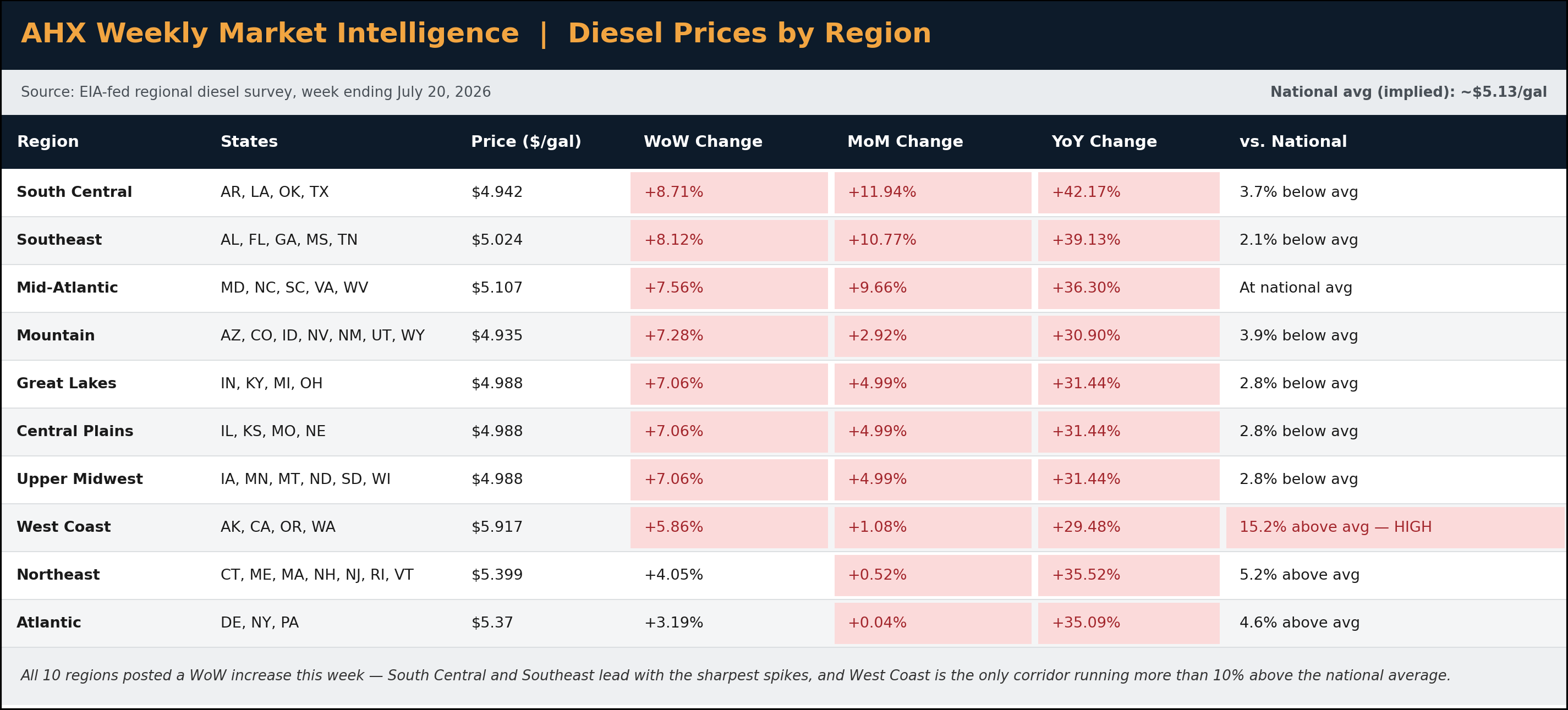
Three things stand out here. First, South Central and Southeast are running the steepest increases on every timeframe we track — week-over-week, month-over-month, and year-over-year. South Central is up 8.71% for the week and a striking 42.17% year-over-year. Second, West Coast is the only corridor running more than 10% above the national average — at 15.2% above, it also carries the highest absolute price on the map at $5.917 a gallon. Third, and maybe most notable: every single region is up between 29% and 42% year-over-year. That's a tight band across a huge geography, which tells us this week's pressure is systemic rather than local.
There's a silver lining for dealers in the Midwest. The Great Lakes, Central Plains, and Upper Midwest cluster peaked at $5.815/gal on May 11 (confirmed against EIA's full-year diesel history) and is still running $0.83 a gallon below that peak (-14.2%) this week. This week's increase is real, but it's climbing back up from a lower floor rather than setting a new high.
West Coast and South Central are further from their own spring highs than it might feel this week, too. Both peaked on April 6 — West Coast at $6.924/gal and South Central at $5.415/gal — and are now running $1.01/gal (-14.5%) and $0.47/gal (-8.7%) below those respective peaks. The national average tells the same story: it peaked at $5.643/gal on April 6 and sits $0.51/gal (-9.0%) below that today.
The Weather Picture: Two Corridors Carrying Double Trouble
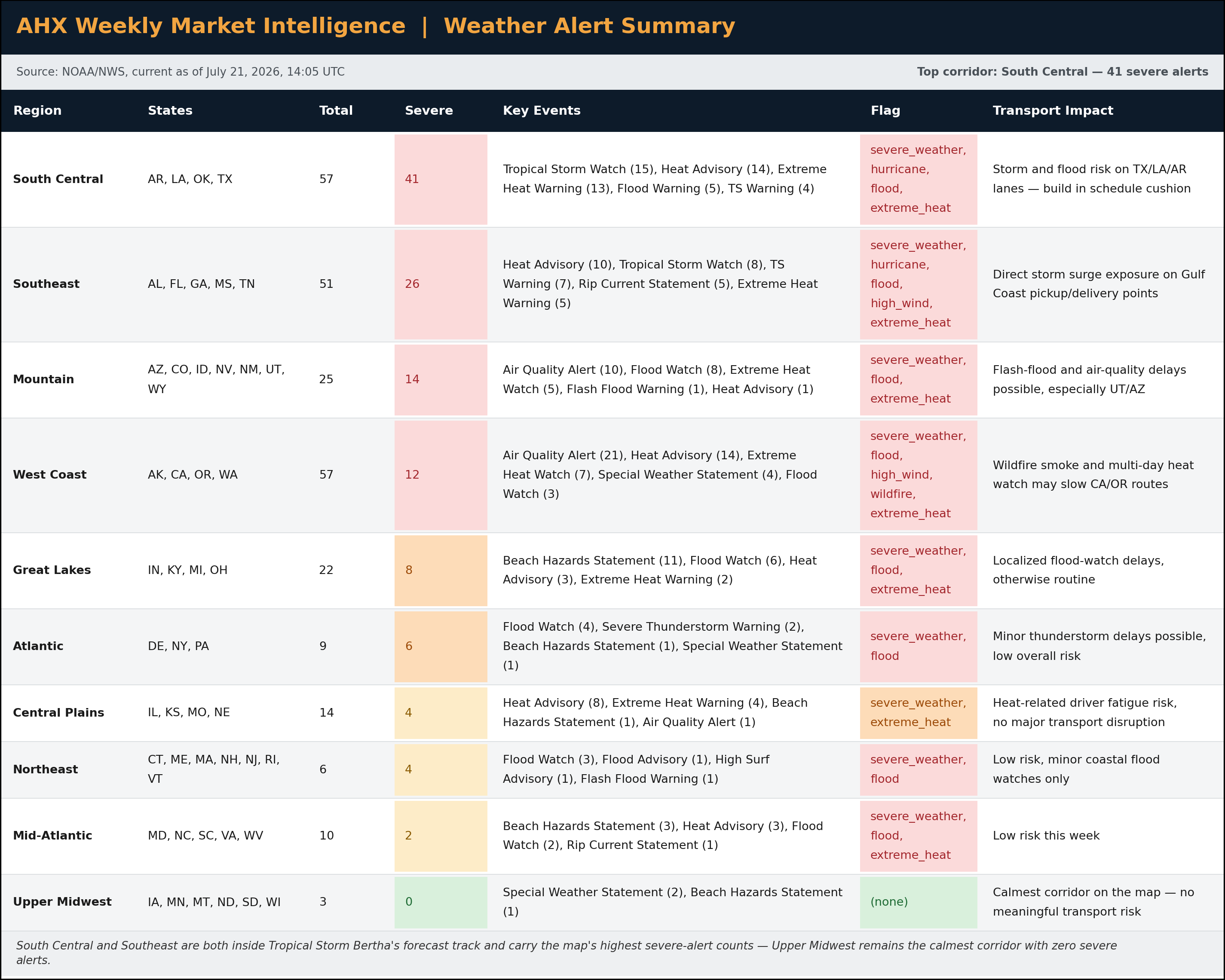
South Central and Southeast aren't just carrying the week's biggest fuel spikes — they're also carrying its worst weather, with 41 and 26 severe alerts respectively. That's not a coincidence. Both corridors sit inside the forecast track of this week's named storm.
Tropical Storm Bertha: What Dealers Need to Know
Tropical Storm Bertha formed in the northeastern Gulf of Mexico and, as of Tuesday, July 21, had sustained winds near 50 mph and was located roughly 110 miles south of Panama City, Florida, moving slowly toward the Florida Panhandle and Alabama coast. A storm surge watch is in effect from the Alabama/Florida border to the mouth of the Mississippi River, with potentially life-threatening storm surge up to 4 feet possible across parts of Louisiana, Alabama, and Florida.
Current forecasts have Bertha lingering near the northern Gulf Coast through the week, dropping heavy rain on coastal Florida, Alabama, Mississippi, and Louisiana, before pushing west toward Texas — a track that lines up directly with the flood warnings already posted for Austin and San Antonio in this week's South Central weather data. Forecast confidence should sharpen over the next 24–48 hours as the National Hurricane Center gets more data.
For dealers moving vehicles along the Gulf Coast this week, the practical takeaway is straightforward: this is not a "wait and see" storm from a scheduling standpoint. Between the surge risk on the coast and the flood risk already showing up inland in Texas, any pickup or delivery along the Alabama-to-Texas stretch of the Gulf Coast should carry extra schedule cushion starting now.
Corridor Outlook
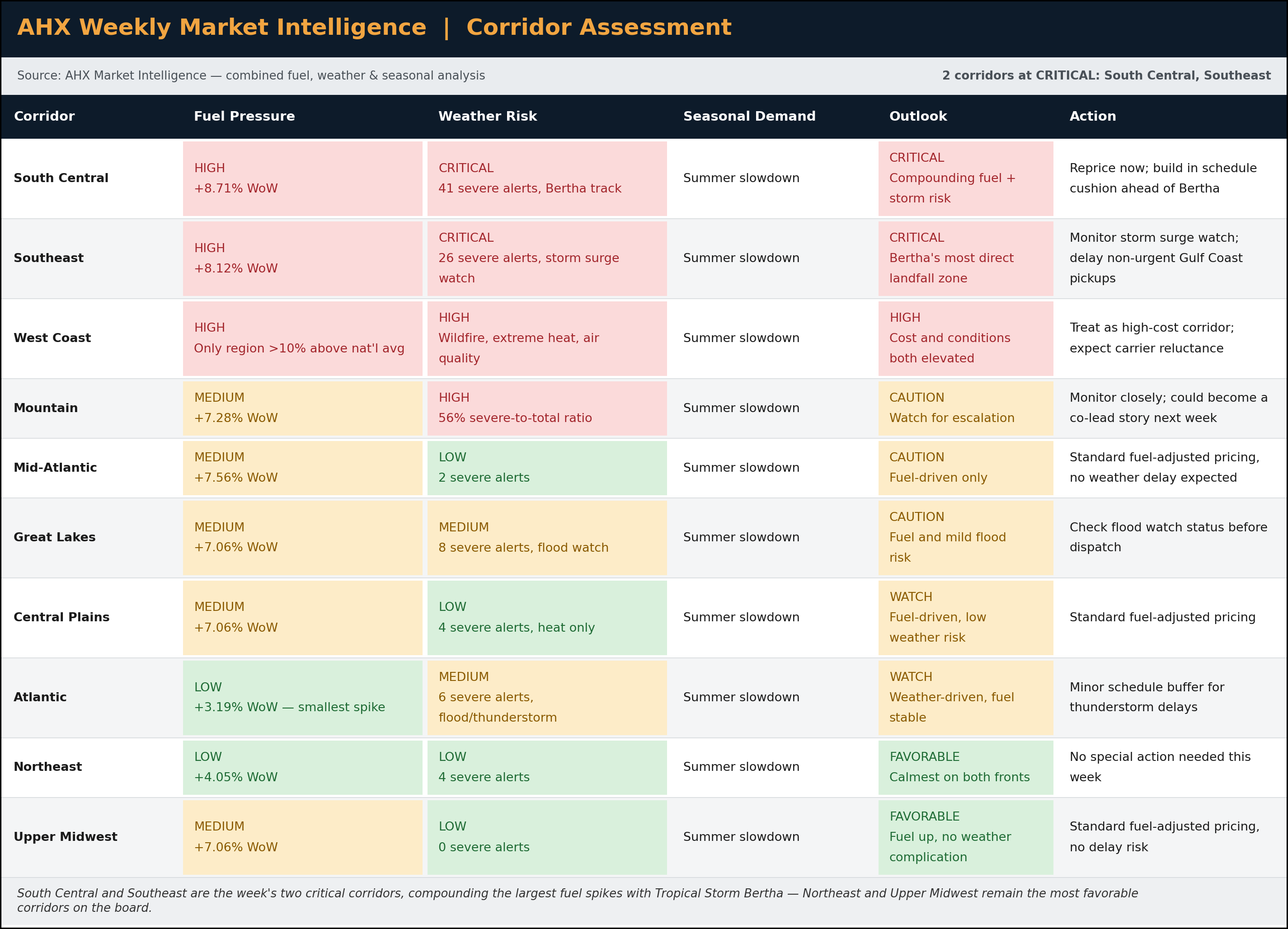
We're in the summer slowdown window (July–August), which typically means softer retail demand and a little more scheduling flexibility. That's a helpful cushion this week, given how much is moving at once between the fuel spike and Bertha — but it shouldn't be read as a reason to ignore either.
What Dealers Should Do This Week
- Reprice any Gulf Coast shipment before Bertha's next move, not after. South Central and Southeast are carrying this week's largest fuel spikes and worst weather at the same time. Carriers will factor storm risk into their pricing whether shippers do or not.
- Run Gulf Coast and Southeast shipments through the AHX Market Estimate Tool before posting. A market-aligned price today is still your best shot at a fast match once road and port conditions start reflecting Bertha's approach.
- Build extra transit time into any vehicle moving through Louisiana, Mississippi, Alabama, or the Florida Panhandle for the rest of this week.
- Treat West Coast as a high-cost, high-friction corridor. It's the only region running more than 10% above the national diesel average, and wildfire smoke plus an extreme heat watch running through July 27 add operational friction on top of price.
- Watch Mountain even though it isn't making headlines yet. Its severe-to-total alert ratio is the highest on the map (56%), driven by air quality, flood watch, and extreme heat conditions.
- Don't assume the summer slowdown means lower costs. Retail demand is softer this time of year, but this week's diesel move is real and nationwide — factor it into any quote regardless of season.
- Lean on real-time ELD tracking for anything moving through the Gulf Coast this week so you have visibility if a shipment needs to be rerouted or delayed.
FAQ
Why did diesel prices rise in every region at once this week, instead of just one or two corridors? This week's data shows a genuinely national move — every tracked region posted a positive week-over-week change, and year-over-year increases across all ten regions sit in a tight 29–42% band. That breadth is unusual compared to recent weeks, when spikes tended to concentrate in one or two corridors.
Is Tropical Storm Bertha expected to make landfall, and where? As of Tuesday, July 21, Bertha was moving slowly toward the Florida Panhandle and Alabama coast with 50 mph sustained winds. A storm surge watch covers the Alabama/Florida border to the mouth of the Mississippi River. Forecasts have it lingering near the northern Gulf Coast before tracking west toward Texas; confirm the latest position with the National Hurricane Center before finalizing any Gulf Coast pickup or delivery this week.
Which region has the highest diesel price right now, and is it a fuel-cost concern? West Coast, at $5.917/gal — 15.2% above the implied national average and the only region to clear the 1.10x-above-national threshold this week.
Is the Midwest diesel spike as bad as it was in the spring? No. Despite this week's 7.06% weekly increase, the Great Lakes/Central Plains/Upper Midwest cluster remains $0.83/gal (-14.2%) below its verified May 11 peak of $5.815/gal.
Which corridor is calmest this week? Upper Midwest, with zero severe weather alerts — though its diesel price still moved with the rest of the Midwest cluster.
How should dealers price shipments differently this week given both stories? Lean on the AHX Market Estimate Tool, especially for Gulf Coast and Southeast lanes, so pricing reflects both this week's fuel spike and Bertha's developing storm risk rather than last week's baseline.
Sign up free at autohaulerexchange.com.
Data attribution: Diesel price data from EIA-fed regional survey, week ending July 20, 2026, cross-checked against EIA's published weekly retail diesel history (psw18vwall.xls, Data 1, All Types). Weather alert data from NOAA/NWS, current as of July 21, 2026, 14:05 UTC. Tropical Storm Bertha reporting verified via KBTX (kbtx.com), Houston Public Media (houstonpublicmedia.org), and Washington Times (washingtontimes.com), accessed July 21, 2026.