
.png)
Auto Transport Companies That Are Not Brokers
For decades, freight brokers served as the default option for moving vehicles. Whether transferring inventory between lots, clearing auction wins, or delivering to retail customers, shippers relied on brokers to bridge logistics gaps. That legacy model solved an initial problem: brokers maintained carrier lists, understood lane dynamics, and managed coordination.
Today, commercial shippers have direct paths to motor carriers, the companies physically hauling the units. Shippers can contract directly with carriers, post loads to open boards, or leverage direct-to-carrier digital marketplaces like Auto Hauler Exchange (AHX).
The critical differentiator isn't just broker elimination. It's operational control. Success hinges on who vets the carrier, who manages payment, how much rate visibility you receive, and how much administrative burden remains on your team.
Key Takeaways
- Motor carriers physically haul vehicles; brokers arrange transport through motor carriers. Because companies can hold both authorities, always verify which role a provider executes on your specific load.
- You can move vehicles without hiring a broker by working with carriers directly, using a load board, or using a direct-to-carrier marketplace.
- Self-posting on a load board eliminates broker fees, but your team retains full responsibility for carrier selection, credential vetting, payment, and dispatch management.
- AHX operates as a direct-to-carrier marketplace. You set the rate, vetted carriers accept or counter, and AHX automates vetting, monitoring, payment processing, tracking, and US-based support for a transparent, flat platform fee.
- Bypassing brokers doesn't automatically lower total cost. Evaluate true landed cost, including labor, floor plan interest, transit delays, and risk, rather than carrier rates alone.
What's The Difference Between a Carrier and a Broker?
Under FMCSA regulations, the divide is distinct. A motor carrier operates commercial motor vehicles to transport property for compensation. A broker arranges transportation by a motor carrier, but does not physically move property in its broker capacity.
Carriers can operate owned or leased equipment and utilize owner-operators. The ultimate test is operating authority: who holds legal liability for moving the asset versus who is brokering the shipment?
Because many logistics entities hold dual authority (carrier and broker), a company name alone will not reveal how your load is handled.
Carriers' Role in Vehicle Transportation
- Operate commercial motor vehicles under active motor-carrier authority.
- Manage drivers, equipment, pickup windows, and delivery execution directly.
- Maintain required cargo insurance and assume direct legal liability for transport.
- Control physical routing, load scheduling, vehicle handling, and transit execution.
Direct carrier contracting establishes clear operational visibility, allowing direct communication with the company physically transporting your assets.
Brokers' Role in Vehicle Transportation
- Build and manage carrier relationships across many lanes.
- Arrange transportation as an intermediary without executing physical haulage.
- Quote shippers an all-inclusive rate, then source a carrier at a lower rate to capture the margin.
- Provide outsourced carrier sourcing, communication, vetting, and dispute management.
Broker margins are traditionally bundled into a single quote, masking true carrier costs and intermediary compensation.
Industry data underscores the demand for clarity. According to The State of Transparency in Vehicle Transportation report by AHX, 42% of surveyed shippers demand greater visibility into carrier identity, while 44% cite a need for transparent carrier performance reviews.
How to Tell What Role a Transport Company Is Playing
To check whether a company is acting as a carrier or broker on your shipment, ask two questions:
- Ask directly: "Will your company physically haul this load under your own motor-carrier authority, or subcontract to another carrier?" Subcontracting for compensation constitutes broker activity under FMCSA guidelines.
- Verify FMCSA credentials: Cross-reference legal business names, USDOT numbers, and MC numbers in FMCSA SAFER records to verify active operating authority and entity type. Note that dual authority allows brokering even if carrier authority remains active.
How to Ship Vehicles Without a Broker
Shippers can bypass traditional broker channels through three primary direct-access models, each with distinct operational tradeoffs.
Work Directly With an Auto Transport Carrier
Direct carrier relationships eliminate middleman markups by establishing direct contracts and rates with motor carriers.
For predictable lanes and carriers you already trust, direct contracts can work well at a rate both sides accept. A carrier may not have capacity when you buy vehicles on a new route.
Advantages of Working Directly With a Carrier
- Direct line of communication: Engage directly with the carrier executing haulage.
- No intermediary markup: Pay rates directly to the service provider.
- Accountability: Maintain direct operational oversight with the hauling carrier.
Challenges of Working Directly With a Carrier
- Geographic limitations: Individual carriers operate within restricted lanes and equipment capabilities.
- Compliance overhead: Your staff must verify insurance, safety scores, authority, and identity.
- Scalability constraints: Managing dozens of individual carrier contracts drives up administrative costs.
- Capacity exposure: When preferred carriers lack availability, shippers must scramble for fallback capacity.
Use Load Boards to Find Carriers
Load boards expand carrier reach by allowing shippers to post loads to an open network. Shippers review market rates, evaluate carrier responses, and dispatch directly.
Advantages of Using a Load Board
- Expansive reach: Access thousands of carriers beyond local contact lists.
- Pricing elasticity: Adjust offered rates based on lane volume and real-time market conditions.
- Direct dispatch: Select and contract directly with responding carriers.
Limitations of Using a Load Board
- Vetting burden remains internal: While boards may surface FMCSA data and ratings, your team bears full legal liability for carrier validation before release.
- Manual workflow: Payment processing, status tracking, and issue resolution remain entirely in-house.
- Broker co-existence: Open load boards allow brokers to post and bid, requiring vigilance to ensure true direct-carrier transactions.
- Elevated fraud risk: Static profiles and unmonitored credentials leave open boards vulnerable to double-brokering and identity theft.
Central Dispatch offers broad reach, market data, and electronic dispatch tools. Your team still selects and checks the carrier, arranges payment, and follows up on the shipment. See our Auto Hauler Exchange vs. Central Dispatch comparison.
Use Auto Hauler Exchange to Connect Directly With Carriers
Auto Hauler Exchange operates as a closed, direct-to-carrier marketplace. Shippers post loads and define pricing. Fully vetted carriers can instant-book at the posted rate or submit competitive counteroffers.
AHX replaces hidden markups with total transparency: a disclosed flat platform fee per load listed alongside the exact carrier rate.
What Makes AHX Different
- Pre-vetted carrier network: AHX verifies operating authority, safety records, and insurance coverage before granting platform access, backed by continuous automated monitoring.
- Direct carrier visibility: Complete transparency into carrier credentials, contact details, and performance metrics upon booking.
- Rate control: Shippers set initial pricing, maintain full control over bids, and eliminate undisclosed middleman margins.
- End-to-end infrastructure: Integrated payment processing, real-time tracking, electronic documentation, and dedicated US-based support.
What AHX Handles For You
- Automated carrier vetting and ongoing compliance tracking
- Centralized payment settlement directly to carriers
- Real-time GPS shipment tracking
- Digital Bill of Lading (eBOL) and gate documentation
- Live US-based support for exception management
- Enterprise analytics and account reporting
While AHX manages technical and administrative workflows, physical loading, gate protocols, and transit remain under the direct control of the hauling carrier.
The Three Broker-Free Models Side by Side
Auto Transport Companies That Are Not Brokers
Searching for "auto transport companies that are not brokers" leads to two distinct categories: independent motor carriers physically moving freight, and technology platforms enabling direct carrier engagement. Differentiating these operating models is essential to structuring your logistics strategy.
Carriers
The following list highlights independent motor carriers operating in vehicle transport. Prior to dispatching or publishing loads, shippers must independently verify active operating authority, insurance coverage, and compliance in FMCSA records:
- Taurus Auto Group
- MP Team Inc
- TGS Carriers LLC
- Lisi Logistics
- 1MD Express Inc
- First Class Carriers
- Alien Corporation
- Global Auto Carriers LLC
- Onixe Express Inc
Motor carriers derive revenue strictly from physical transportation under active carrier authority. Rather than relying solely on directory listings, always confirm real-time credentials, insurance coverage, and driver assignment before releasing inventory.
Broker-Free Platforms & Software Tools
Beyond contracting with carriers one-by-one, enterprise shippers utilize digital platforms to scale direct carrier access across nationwide networks. These software solutions act as digital infrastructure that enables self-dispatch, direct rate negotiation, and automated logistics management without middleman brokerage.
To help you evaluate these broker-free options, the matrix below compares the top platforms, detailing their operating models, broker rules, carrier vetting standards, and support features.
Platform Details
Auto Hauler Exchange
AHX is a dedicated direct-to-carrier marketplace where freight brokers are strictly prohibited. Shippers set load pricing, pre-vetted carriers book or counter, and AHX handles automated vetting, continuous compliance monitoring, payments, real-time tracking, digital documentation, and live US-based support for a transparent, flat platform fee.
Central Dispatch
Central Dispatch is an open load board connecting shippers, brokers, and carriers. While it offers expansive reach and market data, open participation means shippers must independently vet carriers, negotiate terms, process payments, and manage shipment tracking manually.
Super Dispatch
Super Dispatch integrates a load board with a Transportation Management System (TMS) serving shippers, carriers, and brokers. It provides pre-booking verification tools, automated compliance tracking, and in-app payment workflows.
Why Choose a Non-Broker Model
The core advantage of eliminating brokers is total transaction visibility. Direct carrier contracting, load board posting, and digital marketplaces eliminate middleman opacity, giving you full control over carrier relationships and operational execution.
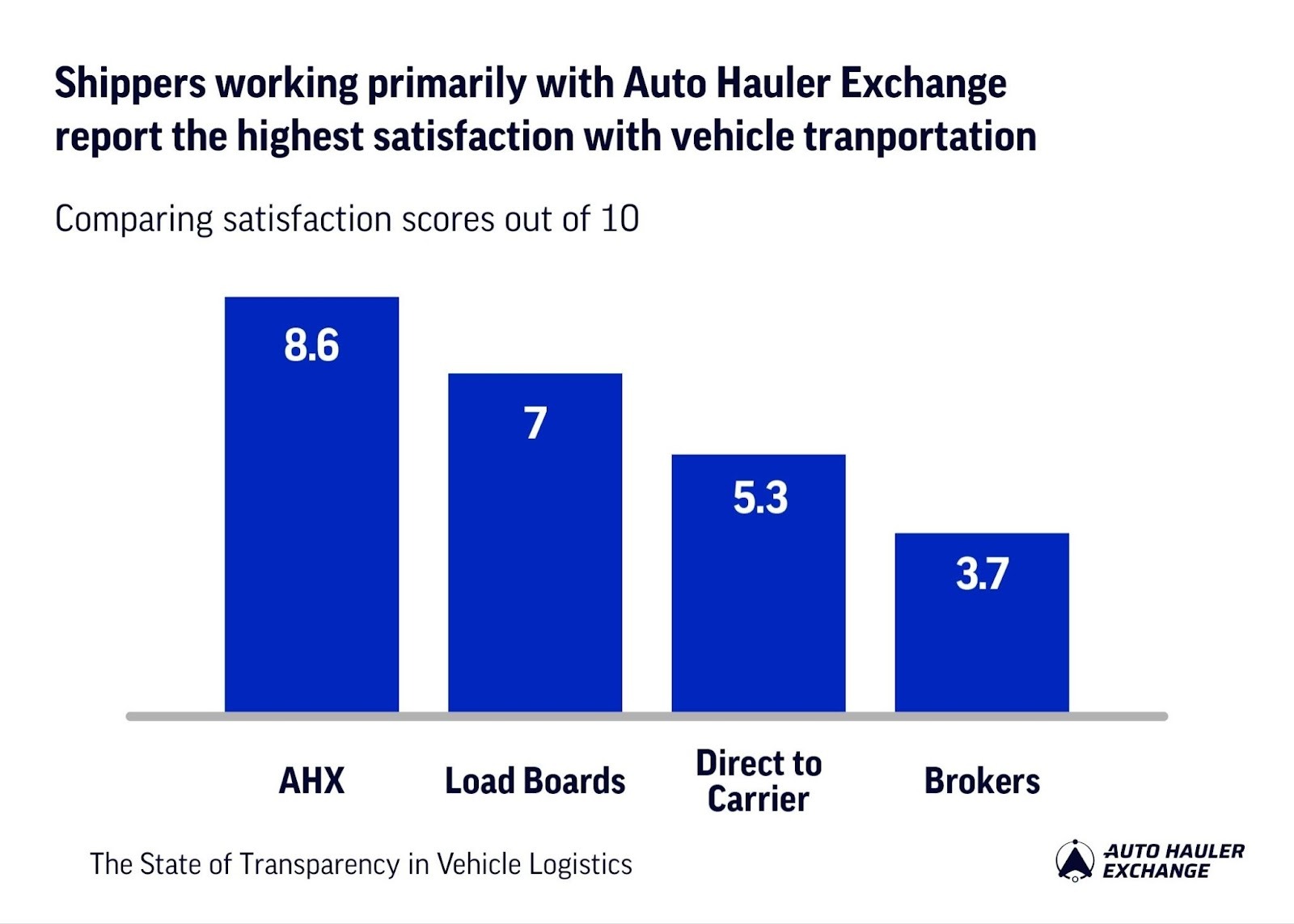
Data from AHX's State of Transparency in Vehicle Transportation study reveals that shippers utilizing AHX reported the highest overall satisfaction across a sample of 59 commercial shippers. Furthermore, 46% of respondents identified sourcing reliable carrier capacity as their primary operational bottleneck.
- Complete price transparency: Unbundle rates from platform costs. On AHX, carrier pay and platform fees are explicitly itemized.
- Carrier accountability: Identify the exact motor carrier hauling your assets rather than dealing with an anonymous intermediary.
- Operational control: Direct-contract and load-board users select carriers directly, while AHX shippers maintain complete authority over rate settings and carrier communications.
- Measurable ROI: Accurately evaluate true landed cost by weighing rates against labor, floor plan holding costs, and administrative time.
What the Broker Layer Can Cost
Traditional broker quotes carry substantial, unitemized margins. On typical lanes analyzed by AHX, an $850 broker quote frequently breaks down into $637 for the carrier and $213 in broker gross margin (~25%). While brokers perform coordination work for this margin, shippers remain in the dark regarding true carrier pay.
See where a vehicle transport quote actually goes
Things to Keep in Mind If You're Not Using a Broker
If you contract with carriers yourself or use a load board, your team handles carrier checks, payments, and shipment follow-up. Compare that work alongside the price.
- Compliance management: Independently verify active operating authority, insurance coverage, and safety records before releasing vehicles.
- Lane coverage variation: Dedicated carriers excel on core lanes but may lack capacity for unpredictable acquisition routes.
- Administrative burden: In-house staff must absorb payment processing, auditing, eBOL management, and exception handling.
- Structural fraud defense: Verifying static paperwork is insufficient; continuous identity verification is required to prevent double-brokering.
- Landed cost focus: Internal labor, floor plan interest, transit delays, and claims easily offset minor price differences.
Going Without a Broker Does Not Remove Fraud Risk
Bypassing brokers does not make your operation immune to fraud. Carrier identity theft, double-brokering, ghost fleets, and fraudulent pickups actively target shippers relying on basic document checks.
AHX research indicates that 29% of surveyed shippers fell victim to vehicle transport fraud over a three-year period. Crucially, shippers utilizing traditional brokers or unmonitored load boards reported 72% higher fraud incidence than those leveraging direct carriers or vetted marketplaces. Rigorous, continuous carrier vetting is non-negotiable.
When managing direct carrier relationships or utilizing open load boards, robust gate verification procedures are mandatory. While AHX automates pre-booking vetting and continuous compliance tracking, multi-layered security remains best practice across all channels.
See the AHX Fight Fraud Series
The benefits of not working with a broker
Shippers working with brokers report the lowest levels of satisfaction with vehicle transportation.
'No Broker' Doesn't Automatically Mean Lower Cost
Direct carrier quotes or low load-board subscription fees do not instantly translate into bottom-line savings. True cost efficiency is measured by total landed cost per unit.
Calculate true lane performance using total landed cost factors:
- Carrier rate
- Platform or subscription fees
- Staff time spent sourcing and verifying the carrier
- Payment and document administration
- Days the unit is unavailable to sell
- Floor plan interest and storage
- Failed pickups, claims, fraud exposure, and the time needed to resolve problems
A $50 reduction in rate is erased if inefficient workflows add days of floor plan interest, staff overhead, or holding fees. Evaluate total landed cost, not just initial quote figures.
What It Looks Like at Dealer-Group Volume
Baxter and Cable Dahmer reported savings after moving shipments from brokers to AHX.
Baxter Auto Group (a 20-store group) saved over $55,000, nearly $200 per vehicle, in its first four months of regional rollout by transitioning from brokers to AHX.
Cable Dahmer (an 8-rooftop group) reported more than $500,000 in transport savings in its first year on AHX. Its vehicles moved from auction to dealership in about 4 days on average, compared with waits of more than 14 days with brokers.
These results are specific to the two dealer groups. Compare your own broker invoices and delivery times.
FAQ
Can you ship vehicles without using a broker?
Yes. Commercial shippers can contract directly with motor carriers, post shipments to open load boards, or leverage direct-to-carrier digital marketplaces like Auto Hauler Exchange.
How do I know if an auto transport company is acting as a broker?
Request confirmation on whether the company will physically transport the unit under its own motor-carrier authority or subcontract the load. Verify USDOT/MC numbers, legal names, and active operating status via FMCSA SAFER records. Always confirm dual-authority status before dispatching.
Does using a load board mean I am paying a broker?
No. If you post a load and contract directly with the fulfilling motor carrier, no broker is involved.
Do load boards vet carriers for me?
Most load boards provide raw FMCSA data, identity checks, and user ratings, but leave validation liability on the shipper. In contrast, AHX executes pre-booking carrier approval and automated compliance monitoring.
Are auto transport companies that aren't brokers cheaper?
Not automatically. Cost effectiveness is determined by landed cost, factoring in rates, platform subscription fees, labor overhead, floor plan interest, and transit speeds.
Does Auto Hauler Exchange charge a fee?
Yes. AHX charges a transparent, flat platform fee per transaction. Platform fees are itemized separately from carrier rates, with zero monthly subscription fees for shippers.
How does booking work on AHX?
Shippers list loads and establish target rates. Approved carriers can instant-book at the target price or submit counter-bids for shipper approval.
Is working directly with a carrier safe?
Direct access is safe when supported by rigorous verification. Always confirm active operating authority, insurance coverage, carrier identity, and safety history prior to vehicle release. Utilizing vetted marketplaces like AHX adds automated compliance layers to protect your inventory.
Get Moving Without a Broker
Brokers are no longer the mandatory gatekeepers of vehicle logistics. Direct carrier contracting, open load boards, and direct-to-carrier marketplaces offer distinct strategies for modern vehicle transport.
If you maintain established carrier relationships on fixed lanes, direct contracting works well. If you have the internal bandwidth to vet and manage dispatching across open networks, load boards offer broad reach. If you want direct carrier access paired with automated vetting, integrated payments, real-time tracking, and live US support, AHX provides the complete solution.
Evaluate the impact on your operational bottom line using your actual lane volume and transport data.
Moving a personal vehicle rather than business inventory? AHX Direct is built for personal vehicle moves.


.png)
