
June 9, 2026 | EIA Data: Week Ending June 8, 2026 | NWS Data: June 9, 2026 | AHX Platform Data: June 9, 2026
Two weeks ago, diesel fell across every U.S. region for the first time in months. Last week we said it wasn't a trend yet — one week doesn't make a trend. This week it is. For the second consecutive week, every single diesel region posted a price decline. The national average is at its lowest point since the spring escalation began. The spring fuel crisis that drove transport costs to multi-year highs is unwinding.
The market is moving. That's the energy this week.
But while fuel cooperates, the weather has gotten complicated. The flooding story from last week is still running in the Midwest — now worse. And this week brought a new threat: wildfire season opened across the Mountain corridor with 21 Red Flag Warnings in a single week. Three distinct weather threat types are simultaneously active across different parts of the country.
Here's everything you need to know.
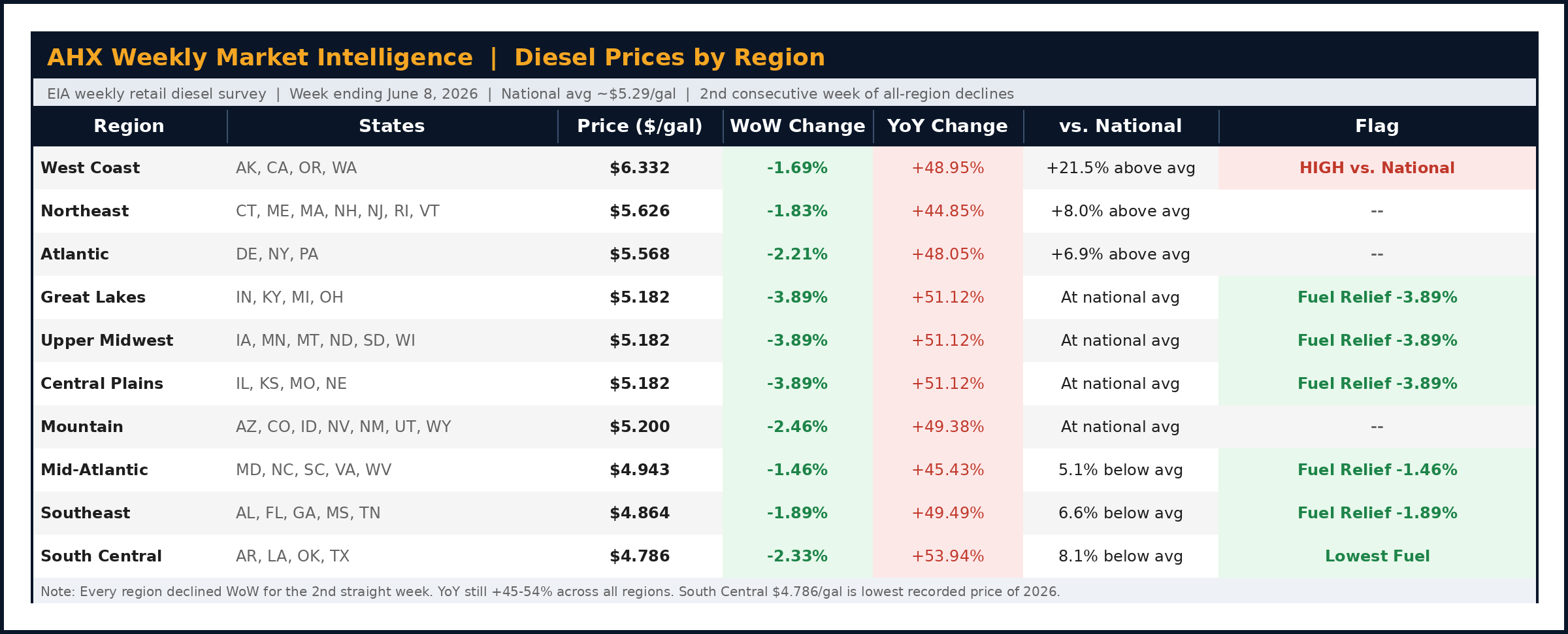
Diesel Prices by Region — Week Ending June 8, 2026
Two Consecutive Weeks of Fuel Relief: What It Means
Two straight weeks of declines across every region is meaningful. The table tells the story: Midwest diesel has dropped from the May 5 spike high of $5.742 to this week’s $5.182 — a cumulative $0.56/gal decline in two weeks. South Central at $4.786/gal is at its lowest point since the spring escalation began.
The West Coast, stubbornly elevated all spring, has now dropped $0.109 in a single week and $0.219 over two weeks. Still at $6.332/gal — still 21.5% above the national average — but the direction is the right one.
Here’s the context that matters: YoY, every region is still 45–54% above last June. The Great Lakes at $5.182 is up 51.12% from June 2025. South Central at $4.786 is up 53.94%. The structural fuel cost environment that has defined this market for over a year hasn’t reversed — it has simply stopped getting worse. When you’re building your Q3 transport budget or evaluating a lane estimate, anchor to where the market is now, not where it was in April at the peak.
The practical implication for dealers: two weeks of fuel relief means lane pricing on the AHX Market Estimate Tool has been adjusting downward in real time. If you pulled a market estimate two weeks ago and haven’t re-checked, the current figure may be more favorable. Run it fresh before every post.
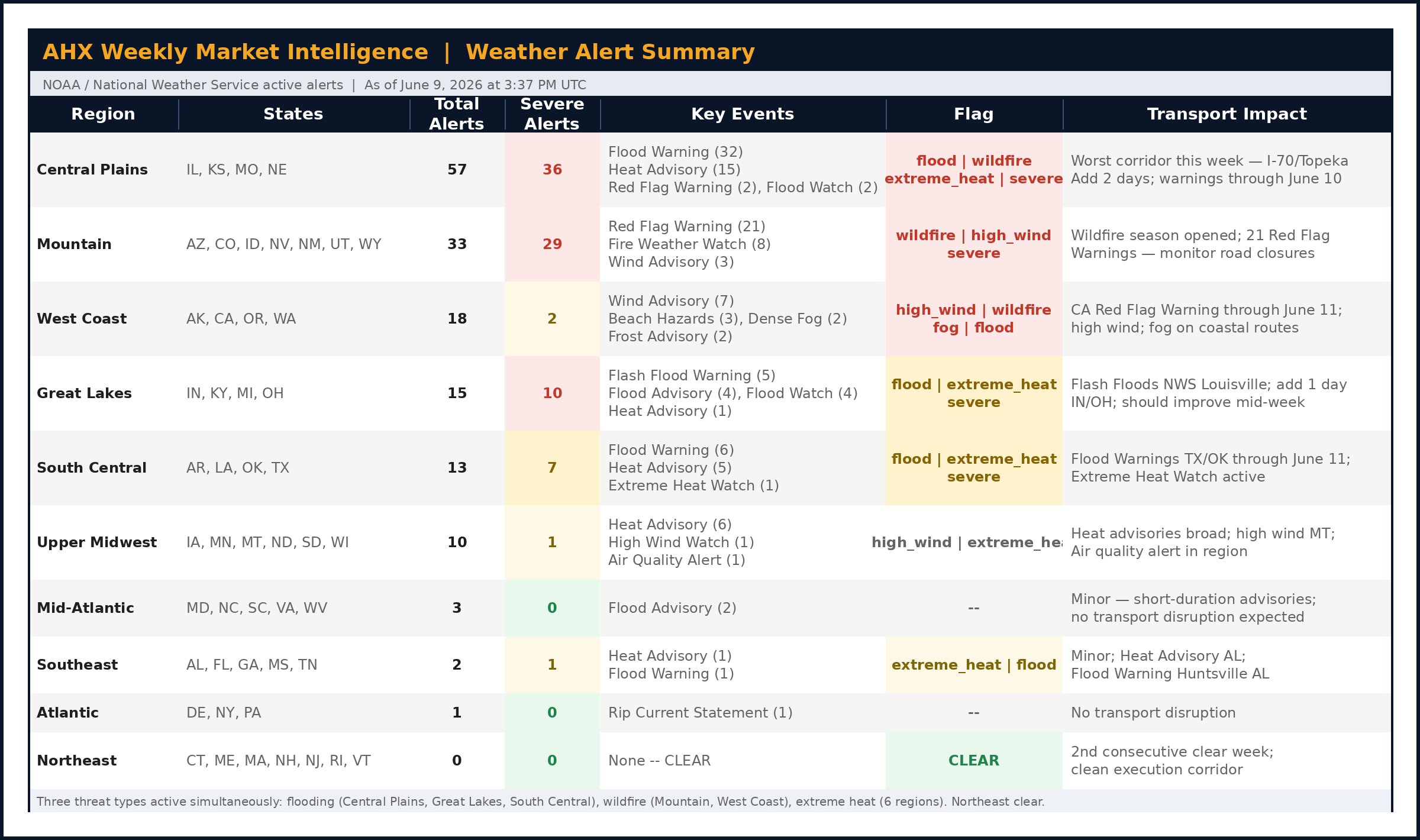
Weather Alert Summary — June 9, 2026
Three Threat Types, Three Different Corridors
This week’s weather story isn’t one event — it’s three distinct threat types hitting different parts of the country simultaneously.
Central Plains: The Worst Single-Corridor Weather Picture of the Season
Missouri, Kansas, Illinois, and Nebraska are carrying the country’s heaviest weather load this week: 57 total alerts and 36 rated severe. For context — last week this region had 5 total alerts. This week represents a 10x escalation in a single week.
What’s driving it: NWS Topeka issued Flood Warnings running through June 9–10, with over 30 active across the region. Simultaneously, 15 Heat Advisories and 2 Red Flag fire weather warnings are in effect. The I-70 corridor from Kansas City through Topeka and westward is the most affected transport route. If you have vehicles routing through Central Missouri, Central Kansas, or the Springfield–Kansas City stretch this week, you need to add two days to your delivery estimate and communicate that downstream.
The Hydrologic Outlook advisories in this region signal that the flood picture may not clear quickly — NWS uses those when conditions are expected to persist beyond the standard warning window.
Mountain Corridor: Wildfire Season Opened This Week
Last week the Mountain region had 2 weather alerts. This week it has 33, with 29 rated severe — the biggest single-week weather escalation anywhere in this week’s data. The driver: 21 Red Flag Warnings and 8 Fire Weather Watches across Arizona, Colorado, Idaho, New Mexico, Utah, Wyoming, and the Dakotas.
Red Flag conditions mean low humidity, high wind, and dry vegetation — the trifecta for rapid fire spread. NWS Sacramento issued a Red Flag Warning running through June 11. NWS Rapid City and NWS Goodland (Kansas border) have active warnings as well.
For vehicle transport specifically: Red Flag Warnings don’t always close roads, but when fires ignite under these conditions they can — quickly and without much warning. Carriers operating through this corridor should monitor active fire maps. For high-value or enclosed-carrier shipments, this week adds meaningful risk. Open-carrier vehicles in smoke-heavy areas may arrive with surface residue — worth noting at pickup.
Great Lakes: Flash Flood Escalation
Indiana and Ohio moved from standard Flood Warnings (last week) to Flash Flood Warnings this week — NWS Louisville issued 5 of them, with additional Flood Watches and Flood Advisories bringing the Great Lakes total to 15 alerts, 10 severe. Flash Flood Warnings are more time-sensitive than standard warnings — they indicate flooding can happen in minutes, not hours, which means road closures with little advance notice.
The good news: most of the Louisville Flash Flood Warnings were issued for same-day clearing on June 9. The picture should improve through mid-week. Add a day to any IN/OH delivery, monitor NWS Louisville, and confirm routing with your carrier before departure.
The Heat Wave
Six regions now carry active Heat Advisories or Extreme Heat Watches: Central Plains, Great Lakes, South Central, Southeast, Upper Midwest, and West Coast. This is a significant expansion from last week when only the West Coast had a Heat Advisory.
For dealers shipping high-value or condition-sensitive vehicles: note that heat can affect battery systems (especially EVs and hybrids), interior surfaces, and electronics in transit. Request condition photos at pickup on open-carrier moves during heat advisory windows. The Extreme Heat Watch in South Central (TX/OK) is the most intense designation — carriers in that market are managing real heat stress.
What the AHX Platform Is Showing This Week
The market is healthy and active. After the spring compression period, the AHX platform data reflects a market that has stabilized into a productive summer rhythm.
The platform has been in a Carrier Market state for 14+ consecutive days — consistent and stable. What’s notable is that market tension has eased meaningfully. Carriers are active and selecting shipments, but the frantic competition dynamic of the spring peak has quieted.
Platform directional signals this week:
Georgia is running the strongest pickup trend score on the platform right now. Dealers sourcing vehicles from Georgia or using Georgia-origin auction lanes are operating in a favorable carrier availability environment.
California pickup activity is accelerating — up meaningfully week-over-week and over the past 7 days. CA-origin lanes have active carrier coverage for shipments priced at market.
Ohio delivery activity is showing the strongest positive momentum of any major delivery state, with activity tracking up notably. Dealers receiving inventory in Ohio should see good execution right now.
Florida is showing the first signs of inbound delivery normalization. After weeks of the FL market running heavily outbound with very little inbound demand, delivery activity is beginning to turn. Southbound carrier flow is filling in as carriers return from their snowbird-season northbound runs.
The platform is seeing volume that is stable at the 30-day and 60-day level, and surging at the 90-day view. This is a market with genuine throughput.
Use the AHX Market Estimate Tool before every post — with two consecutive weeks of fuel relief, lane estimates are adjusting in real time. The AI Pricing Engine will work within your range to attract carriers automatically, but the range itself needs to reflect where the market is today.
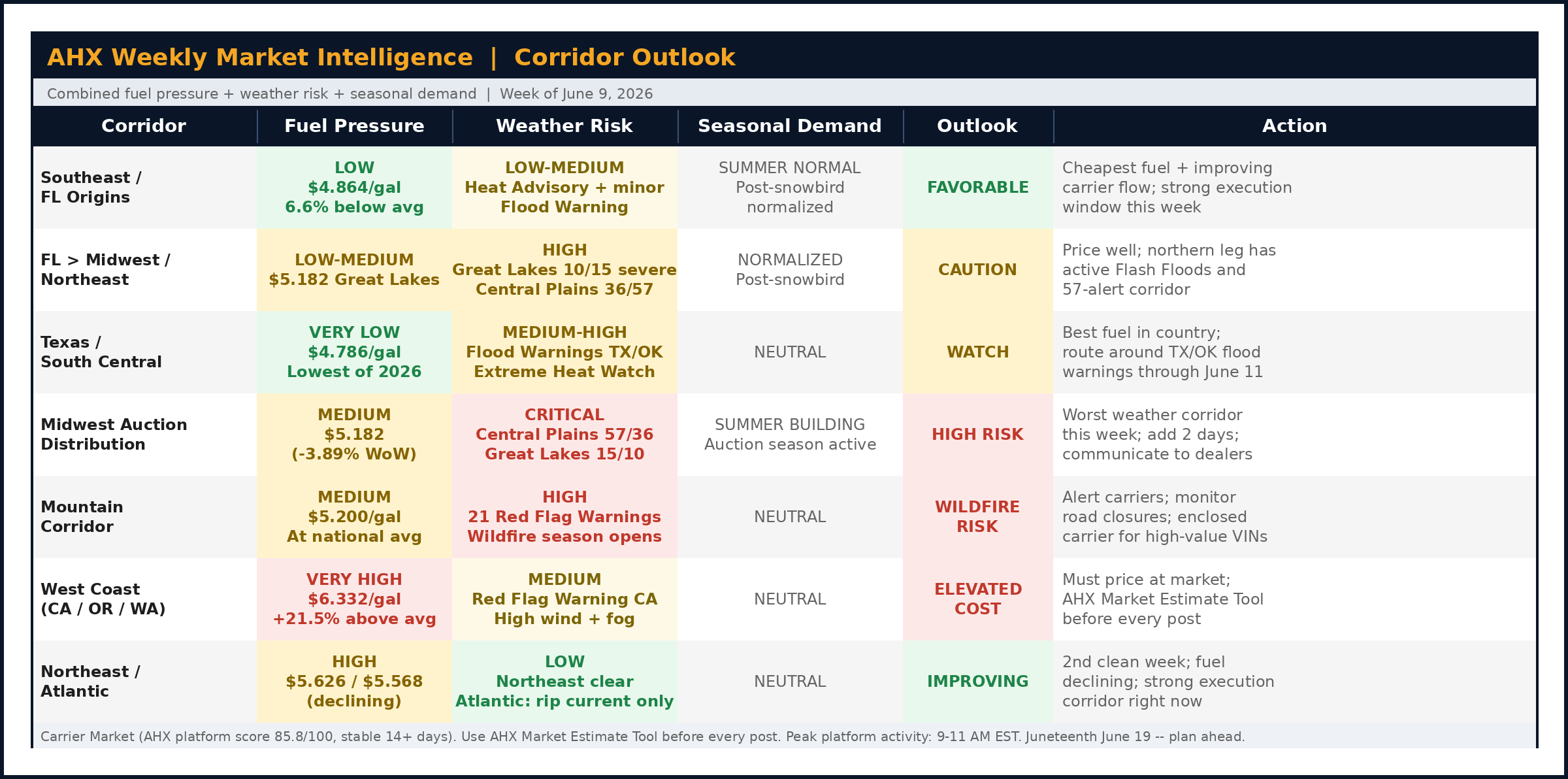
Corridor Outlook for the Week
Southeast / Florida Origins The Southeast is operating in the best conditions of any corridor right now — low fuel ($4.86), light weather, and improving carrier flow. FL inbound is normalizing. If you’re shipping vehicles from Florida or sourcing in the Southeast, this is a favorable week for clean execution.
Texas / South Central The cheapest fuel in the country at $4.786/gal, but active Flood Warnings (TX, OK) running through June 11 and an Extreme Heat Watch. Price is excellent; routing and timing need attention. TX to MO, TX to GA, and TX to KS have strong carrier availability on the platform.
Midwest Auction Distribution This is the high-risk corridor this week. Central Plains (57 alerts) and Great Lakes (15 alerts, 10 severe) together create the most compromised routing in the country. Vehicles moving between major Midwest auction hubs need two-day buffers and proactive communication. The good news: fuel is at $5.18, down from the May high.
Mountain Corridor Wildfire risk elevated. Not a routing closure yet — but Red Flag conditions through June 11 in multiple Mountain states warrant carrier alerts and monitoring. AZ→MO and CO→KS have solid carrier depth on the platform for shipments priced at market.
West Coast Still the most expensive fuel corridor at $6.332/gal. High wind and wildfire weather conditions add complexity, particularly in California (Red Flag Warning through June 11 per NWS Sacramento). Always run the AHX Market Estimate Tool before posting West Coast lanes. The AI Pricing Engine will handle adjustments within your range.
Northeast Clear weather, second consecutive clean week. Fuel elevated at $5.63 but declining. Solid execution corridor for the third week running.
Calendar Alert: Juneteenth Is 10 Days Away
Juneteenth (June 19) is a federal holiday. Carrier operations and dispatch staffing are reduced around this date, similar to other federal holidays. If you have time-sensitive deliveries or auction pickups scheduled the week of June 16–20, post them early in the week and confirm carrier booking before the holiday weekend.
Independence Day (July 4) is three and a half weeks out. Begin factoring it into Q3 transport planning — historically one of the two largest carrier availability dips of the year.
What Dealers Should Do This Week
1. Route around the Central Plains. 57 active weather alerts with 36 severe make this the highest-risk routing corridor in the country this week. Any vehicle routing through Kansas, Missouri, or Illinois needs a two-day buffer and confirmed routing from your carrier. Target June 10–11 for the Flood Warning expiration windows.
2. Alert your carrier on Mountain corridor shipments. If you have vehicles routing through AZ, CO, NM, or UT, notify your carrier about the Red Flag Warning conditions. Request a check-in at pickup and delivery. High-value vehicles in this corridor should consider enclosed carrier options this week.
3. Re-run your market estimates. Two weeks of consecutive fuel relief means lane pricing has adjusted. If you set a price or MOST ceiling more than a week ago, it may be off. Open the AHX Market Estimate Tool, run current lane data, and update your pricing.
4. Take advantage of Southeast and South Central lanes. Both regions have the cheapest fuel in the country, improving carrier availability, and relatively clean weather. If you have pending acquisitions in Florida, Georgia, Texas, or Tennessee — this is a favorable execution window.
Frequently Asked Questions
Q: Diesel has been falling for two weeks now. When should I expect to see transport rates come down?
A: Fuel relief does feed into transport rates, but with a lag — typically two to four weeks behind fuel movements, and never a 1:1 translation since fuel is only one component of what carriers price. The AHX Market Estimate Tool reflects real transacted lane data that adjusts faster than industry averages. The most practical advice: run a fresh market estimate before every post this week.
Q: What exactly is a Red Flag Warning and should I be worried about my vehicle in transit?
A: A Red Flag Warning is issued by NWS when a combination of low relative humidity (typically under 25%), high winds, and dry fuel (vegetation) creates extreme fire risk. For vehicle transport, the direct concern is road closures if a fire breaks out along a carrier’s route. Red Flag conditions don’t mean fires are burning — they mean conditions are favorable for rapid fire spread if one starts. For high-value or condition-sensitive vehicles routing through the Mountain corridor this week, an enclosed carrier is worth considering.
Q: The Central Plains had 57 weather alerts this week. Why is that region getting hit so hard?
A: The Central Plains — Kansas, Missouri, Illinois, Nebraska — sits at the geographic intersection of where Gulf moisture collides with drier air from the Rockies. June is historically the peak of severe weather season in this corridor. This week’s picture is especially heavy because flooding from earlier in the season hasn’t fully cleared, and now heat and dry conditions in the western part of the region are driving fire weather watches simultaneously.
Q: I have vehicles coming out of Florida. Is the market improving for those lanes?
A: Yes, meaningfully. Snowbird season is over, carrier flow is normalizing, and the Florida market is beginning to see inbound delivery activity pick back up. Southbound carrier flow is returning as carriers rebalance from their spring northbound runs. FL→GA, FL→MI, FL→NY all have strong carrier availability on the platform. Price at market and shipments should move cleanly this week.
Q: Should I be worried about heat affecting my vehicle during transport?
A: For standard road vehicles, heat advisories are not a major concern unless it’s a specialty, collector, or high-value vehicle with temperature-sensitive systems. For EVs and plug-in hybrids, extended heat exposure can affect battery systems — if shipping a high-value EV through the Central Plains or South Central this week, consider an enclosed carrier and request a condition inspection at pickup.
Sign up free at autohaulerexchange.com
Data Attribution
- Diesel price data: U.S. Energy Information Administration (EIA) weekly retail diesel survey, week ending June 8, 2026.
- Weather alert data: NOAA/National Weather Service active alerts as of June 9, 2026 at 3:37 PM UTC.
- YoY comparisons reflect EIA regional diesel price data for the comparable week in 2025.
- AHX platform market environment data: Auto Hauler Exchange internal analytics, June 9, 2026.