

June 16, 2026 | EIA Data: Week Ending June 15, 2026 | NWS Data: June 16, 2026 | AHX Platform Data: June 16, 2026
Three consecutive weeks. Every region. Every single week. Diesel down across the board.
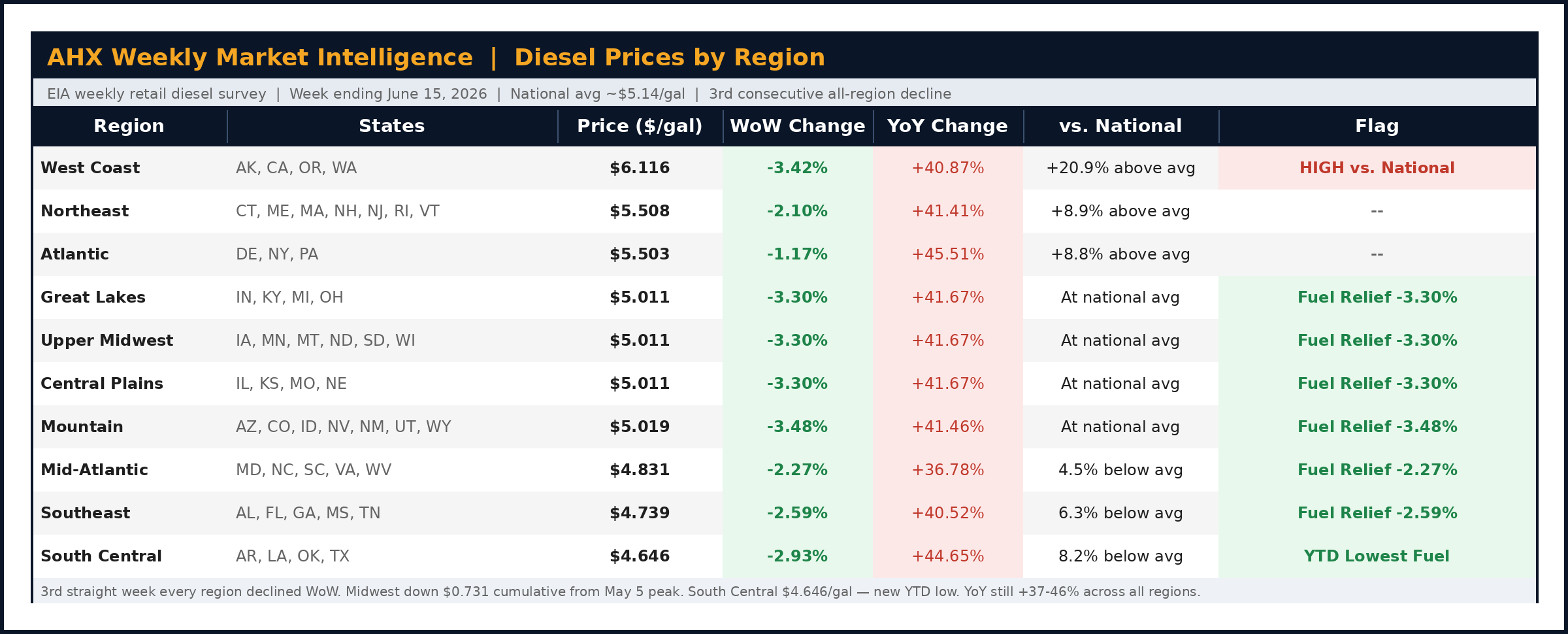
At this point it’s not a trend to watch — it’s a fact to work with. The spring fuel crisis that pushed the national average to multi-year highs is over. The Midwest has recovered $0.73/gal from the May 5 spike peak over three weeks. The national average sits around $5.14/gal — the lowest since the spring escalation began in early March. South Central at $4.646/gal is the cheapest diesel market in the country. The West Coast broke below $6.20, down $0.325 over the past three weeks.
The fuel environment is the best it’s been since the spring escalation began. That changes how you should price your shipments this week.
But while fuel cooperates, the Gulf corridor is running active Tornado Warnings this morning alongside Flash Flood conditions, wildfire risk in the Mountain corridor has reached its highest level of the season, and the Central Plains is entering its fourth consecutive week of severe flood warnings.
Here’s everything you need to know.
Diesel Prices by Region — Week Ending June 15, 2026
Three Straight Weeks Down: What It Means for Your Transport Costs
The spring fuel crisis — driven by Iran conflict premium, refinery disruptions, and compounding demand pressure — has fully unwound. Three consecutive weeks of declines across every U.S. region is not a noise event. It is a structural reversal.
The cumulative picture: from the Midwest spike high of $5.742 on May 5, the Great Lakes, Upper Midwest, and Central Plains have recovered $0.731/gal over three weeks — a -12.7% cumulative decline. South Central at $4.646/gal is at its lowest point since the March spike began — down 14% from the April peak. The West Coast, which was above $6.44 as recently as June 2, has now dropped $0.325 in three weeks — its most sustained decline since the spring escalation.
The practical implication is direct: lane pricing on the AHX Market Estimate Tool has been adjusting downward for three consecutive weeks. If you pulled a lane estimate in May and haven’t refreshed it, you’re working with outdated numbers that may be meaningfully higher than today’s market. Run a fresh estimate before every post this week.
The YoY context still matters for budget conversations. Mid-Atlantic at +36.78% YoY represents the best year-over-year comparison in the country. South Central at +44.65% — cheapest region, still nearly 45% above last June. Every region is still substantially elevated versus 2025 pricing. When explaining transport costs to your controller or CFO, this structural baseline is the right anchor.
Weather Alert Summary — June 16, 2026
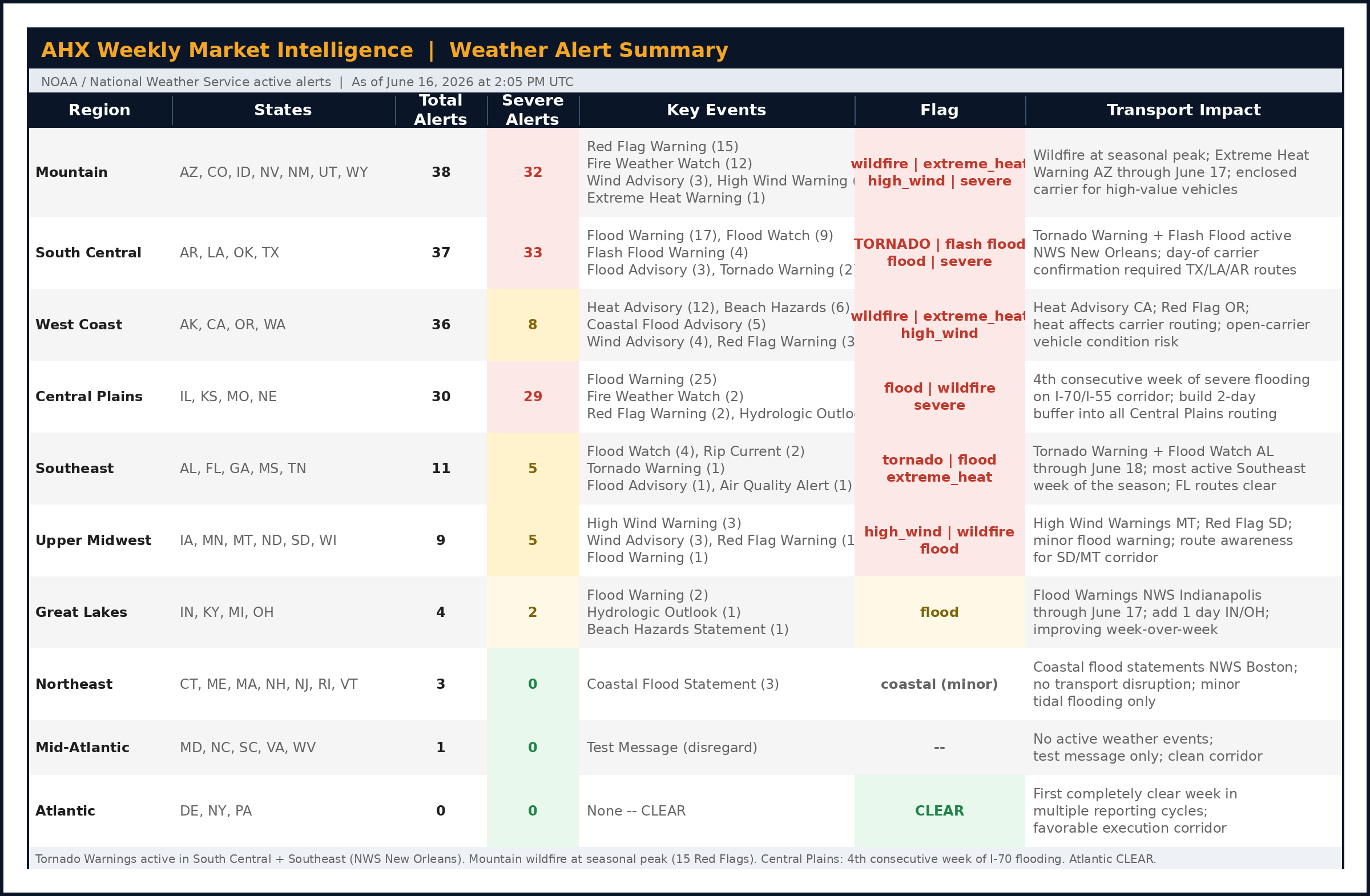
The Weather Picture This Week: Four Threats, Four Corridors
South Central: Tornadoes and Flash Floods Simultaneously
The Gulf corridor has been dealing with flooding for weeks. This week added tornadoes. NWS New Orleans issued a Tornado Warning on June 16, covering the same geographic zone where Flash Flood Warnings have been running near Lake Charles, LA. Two Tornado Warnings are active in the region alongside four Flash Flood Warnings, 17 standard Flood Warnings, and 9 Flood Watches across TX, OK, AR, and LA.
This is the most severe acute weather risk of the season — not because of the total alert count, but because of the combination. Tornado conditions and flash flooding at the same time on the same corridor means road hazards can materialize with effectively no warning. Any carrier routing through South Louisiana or Southeast Texas today needs day-of confirmation. Post-storm window: the tornado threat is typically short-duration; the flooding picture in TX/OK/AR runs through mid-week.
Mountain: Wildfire Season Peaks
The Mountain corridor has now reached its highest wildfire risk level of the season. This week: 15 Red Flag Warnings, 12 Fire Weather Watches, 3 High Wind Warnings across Arizona, Colorado, Idaho, New Mexico, Utah, and Wyoming. NWS Flagstaff issued an Extreme Heat Warning through June 17 — one step above an Advisory, reserved for genuinely dangerous heat conditions.
For vehicle transport, the concerns are practical: Red Flag and Fire Weather conditions mean fires can ignite and spread rapidly, potentially closing highways with little notice. Interstate 40 (AZ/NM), I-25 (NM/CO), and I-70 (CO) are the most likely routes to be affected. Carriers operating in this corridor should be monitoring NWS fire weather maps actively. For high-value vehicles or collector vehicles routing through Arizona or New Mexico this week, enclosed carrier is the right call.
Central Plains: The Fourth Week
The flooding in Central Plains — Kansas, Missouri, Illinois, Nebraska — is now in its fourth consecutive week. This week: 30 alerts, 29 severe, including 25 Flood Warnings from NWS Lincoln, IL. The Hydrologic Outlook advisory signals NWS expects the pattern to persist beyond the current warning window.
Four weeks of continuous flood warnings on the I-70 and I-55 corridors is not a temporary disruption — it’s a persistent routing constraint that needs to be baked into delivery estimates rather than treated as an exception. Build two days into any routing through this region.
Southeast: Tornado Warning + Flood Watch
Alabama is carrying the most weather risk in the Southeast this week: a Tornado Warning issued by NWS New Orleans (which covers the Mobile AL area), a Flood Watch through June 18 issued by NWS Mobile, and an Air Quality Alert. FL routes are clear; AL-origin or AL-destination shipments need attention.
West Coast and Atlantic: Mixed
The West Coast has 36 alerts but only 8 severe — the bulk are Heat Advisories (12) and Beach Hazard Statements (6). Three Red Flag Warnings in Oregon add wildfire risk on the Pacific Northwest end. The Atlantic (DE, NY, PA) is completely clear — the first clean week in multiple reporting cycles. This is a favorable execution corridor right now.
What the AHX Platform Is Showing
The platform has been in a Carrier Market state for 21 consecutive days — consistent, controlled, and gradually easing. The 90-day view shows the market has grown over the quarter.
What the geographic data is telling us:
Georgia continues to lead every pickup trend metric — the hottest pickup market on the platform for three consecutive weeks. Dealers sourcing in Georgia or using Georgia auction lanes are operating in a high carrier availability environment. California pickup activity is building, up meaningfully over the past month. Maryland and Virginia are showing strong pickup signals — those Mid-Atlantic to Midwest lanes have solid carrier coverage right now.
On the delivery side, Virginia and Michigan are the two strongest delivery markets on the platform, with Virginia improving across every time horizon (30d, 60d, 90d). Ohio delivery is accelerating with strong positive momentum. Texas delivery activity is the fastest-moving this week.
The AHX Market Estimate Tool reflects these real-time shifts. Three weeks of fuel decline means lane pricing has adjusted. Use it before every post, and let the AI Pricing Engine work within your range.
Calendar Note: Juneteenth June 19
Juneteenth is this Friday. It’s a federal holiday but not expected to meaningfully affect carrier operations — most carriers will be running normally. Worth a brief heads-up to your team if you have Friday support needs, but no special planning required.
Independence Day (July 4) is 2.5 weeks out — the larger summer carrier availability event. Begin factoring it into late-June scheduling.
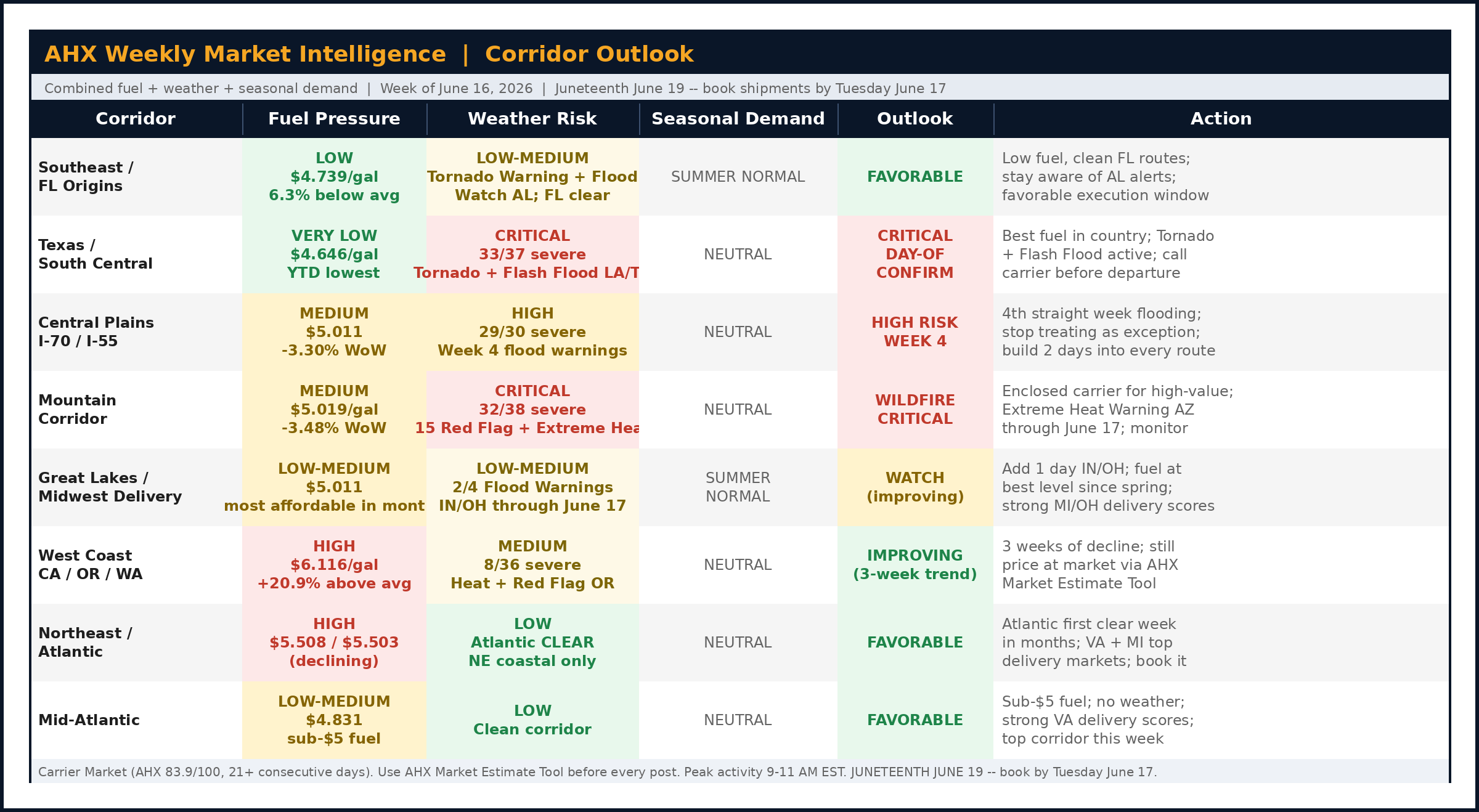
Corridor Outlook for the Week
Southeast and Florida Origins: Low fuel, improving carrier flow, mostly clear weather (FL routes unaffected by AL alerts). Favorable execution corridor this week for FL, GA, TN, and MS origins.
Texas and South Central: Cheapest fuel in the country at $4.646/gal — down 14% from the April peak. But the tornado and flash flood conditions in South Louisiana and Southeast Texas require day-of carrier confirmation. TX→MO and TX→GA routes are clear. TX→LA and TX→AR routes need active monitoring today.
Central Plains: Four consecutive weeks of severe flooding. Build two days in. This is no longer an exception to manage — it’s the operating baseline for routing through KS/MO/IL.
Mountain Corridor: Wildfire conditions at seasonal peak. AZ and NM have the most acute risk (Extreme Heat Warning + Red Flag). For standard open-carrier moves, use the AHX Market Estimate Tool. For high-value or collector vehicles: enclosed carrier this week.
West Coast: Three straight weeks of fuel decline have brought CA diesel to $6.116 — still 20.9% above national average, but $0.325 lower than three weeks ago. Heat advisories affect carrier routing on CA lanes. Always run the AHX Market Estimate Tool before posting West Coast shipments.
Northeast and Atlantic: Atlantic is clear for the first time in weeks. Northeast has minor coastal flood statements with no transport impact. Fuel is declining ($5.508 NE, $5.503 Atlantic). Strong delivery trend scores in VA and MI make Northeast→Midwest lanes favorable right now.
What Dealers Should Do This Week
1. Get day-of confirmation on South Louisiana and Southeast Texas routes. Tornado Warnings and Flash Flood Warnings are active on the Gulf corridor. Call or message your carrier to confirm they’ve departed safely before assuming the route is live.
2. Enclosed carrier for high-value vehicles through Arizona and New Mexico. Extreme Heat Warning and 15 Red Flag Warnings make this the highest-risk week of the season in the Mountain corridor.
3. Run a fresh market estimate — three weeks of relief have moved the number. If you’re posting based on May pricing, you may be over-market by a meaningful amount. The AHX Market Estimate Tool reflects three weeks of downward fuel adjustment.
4. Take advantage of the Mid-Atlantic and Atlantic corridor. Sub-$5 fuel in the Mid-Atlantic, clear weather in the Atlantic, and strong delivery trend scores in Virginia and Michigan.
Frequently Asked Questions
Q: Diesel has now fallen three weeks in a row. Is the spring fuel crisis officially over?
A: Yes — three consecutive all-region declines confirms the reversal. The Midwest has recovered $0.73/gal from the May peak in three weeks. That said, “over” doesn’t mean “cheap.” Year-over-year, every region is still 37–46% above last June. The acute escalation is done; the structural elevated baseline remains. Price your Q3 transport budget for the current market, not the pre-2025 baseline.
Q: What should I do if I have a shipment routing through South Louisiana or Southeast Texas today?
A: Get day-of confirmation from your carrier before assuming the route is active. Tornado Warnings and Flash Flood Warnings are running simultaneously in that corridor. The tornado threat is typically short-duration — conditions should clear through the afternoon. The flooding picture persists through mid-week.
Q: Is it safe to ship through Arizona this week given the wildfire warnings?
A: For standard vehicles on open carriers, it’s manageable — but warrant a carrier check-in. Red Flag Warnings don’t close roads on their own; they create the conditions for rapid fire spread if ignition occurs. For high-value vehicles, collector vehicles, or EVs: enclosed carrier this week removes the risk entirely.
Q: Why does Georgia keep showing up as the top pickup market?
A: Georgia has a combination of factors that make it consistently the highest-activity pickup market: the Atlanta metro area is one of the largest vehicle auction and wholesale hubs in the Southeast, there’s high dealer density with active acquisition programs, and the Southeast’s low fuel cost makes GA-origin lanes economically attractive for carriers. The platform data has shown Georgia at the top of the pickup trend rankings for three consecutive weeks.
Q: With three weeks of fuel declines, how quickly should I expect to see transport rates adjust?
A: Fuel relief feeds into lane rates, but with a lag — typically two to four weeks, and never a 1:1 relationship since fuel is just one component of carrier pricing. The AHX Market Estimate Tool reflects real transacted lane data that adjusts faster than industry averages. Gulf Coast diesel is down 14% from its April peak — that’s been flowing into lane rates, and you’ll see it if you check current figures rather than relying on estimates from May.
Q: The AHX platform shows a “Carrier Market” — what does that mean for my pricing strategy?
A: A Carrier Market means carriers have enough active options that they’re being selective. They prioritize shipments that are (1) priced at or above the current lane rate, (2) straightforward to schedule, and (3) posted with clean pickup/delivery details. Run the AHX Market Estimate Tool to get the current lane rate, post at or within a competitive range, and let the AI Pricing Engine work within your set range to attract the right carrier.
Sign up free at autohaulerexchange.com
Data Attribution
- Diesel price data: U.S. Energy Information Administration (EIA) weekly retail diesel survey, week ending June 15, 2026.
- Weather alert data: NOAA/National Weather Service active alerts as of June 16, 2026 at 2:05 PM UTC.
- YoY comparisons reflect EIA regional diesel price data for the comparable week in 2025.
- AHX platform market environment data: Auto Hauler Exchange internal analytics, June 16, 2026.




.png)
