
.png)
July 1, 2026 | EIA Data: Week Ending June 29, 2026 | NWS Data: June 30, 2026 | AHX Platform Data: June 30, 2026
Five consecutive weeks of fuel relief. Every region in the country. And the West Coast just posted its largest single-week decline of the entire recovery.
The fuel story keeps improving. The weather story has shifted to extreme heat — active in seven of ten regions, including a watch in the Northeast that runs straight through the July 4th holiday. And with Independence Day three days away, carrier availability is entering its tightest window of the summer.
Here's everything you need to know.
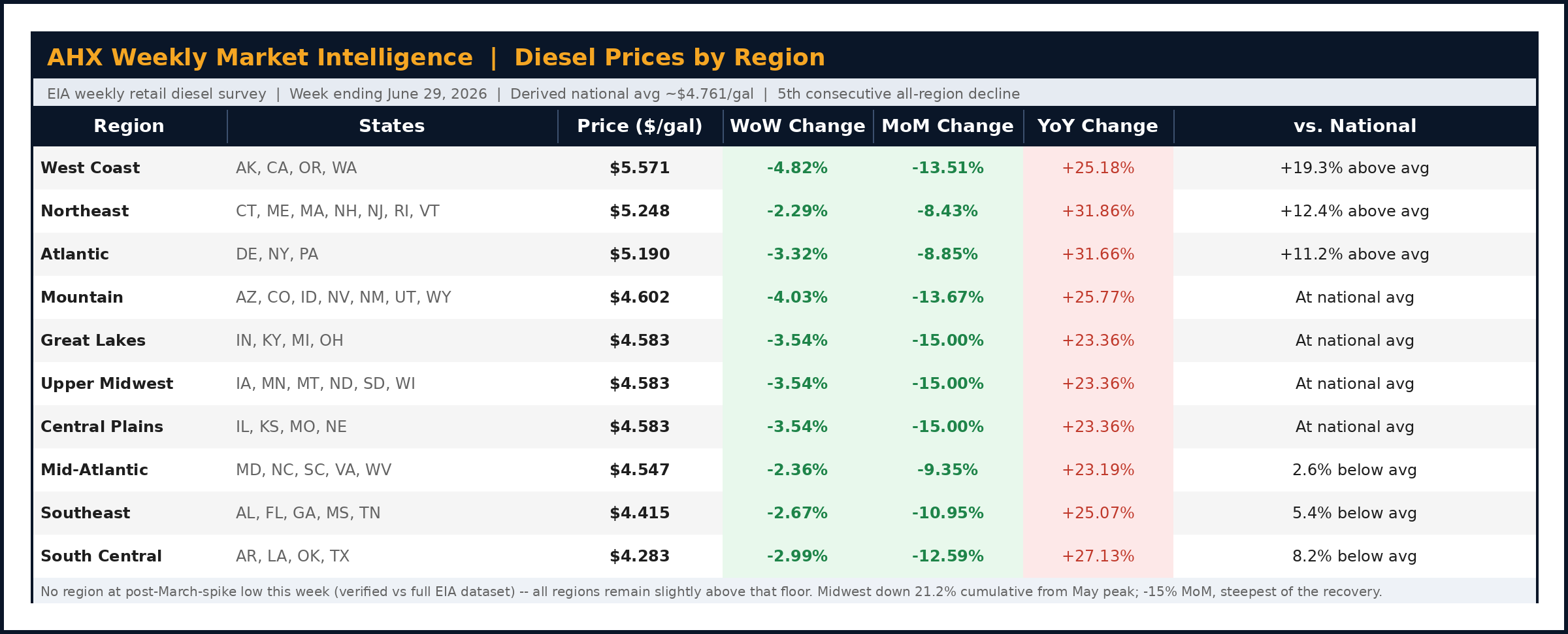
Diesel Prices by Region — Week Ending June 29, 2026
Five Weeks Down: The Decline Is Accelerating, Not Just Continuing
This is the fifth consecutive week every U.S. region has posted a price decline. What's notable this week is the acceleration — the West Coast fell -4.82% WoW, its largest single-week move of the entire recovery period. Month-over-month figures are now showing -15.00% in the Great Lakes, Central Plains, and Upper Midwest, the steepest monthly decline we've tracked.
The cumulative picture from the peaks: Midwest diesel has fallen $1.232/gal, a 21.2% decline, from the May 11 high of $5.815. The West Coast has dropped $1.353/gal, a 19.5% decline, from its April 6 peak of $6.924.
An important accuracy note: Before publishing fuel price claims, we verify every region against the full-year EIA dataset rather than relying solely on rolling weekly comparisons. This week, no region is at its lowest point since the March 9 spike — every region remains slightly above the floor it hit in the immediate aftermath of that spike. The West Coast comes closest, within two cents of matching its post-spike low, but hasn't crossed below it. This doesn't diminish the recovery — a 21% cumulative decline from peak is a substantial move — but it's worth being precise about. We're recovering toward the spike-era floor, not yet below it.
The YoY trend continues to compress meaningfully. Most regions are now in the +23–32% range, a significant improvement from the +47–59% readings we saw in late May. The Great Lakes, Central Plains, Upper Midwest, and Mid-Atlantic are all now under +24% YoY — the best year-over-year comparisons of the entire series.
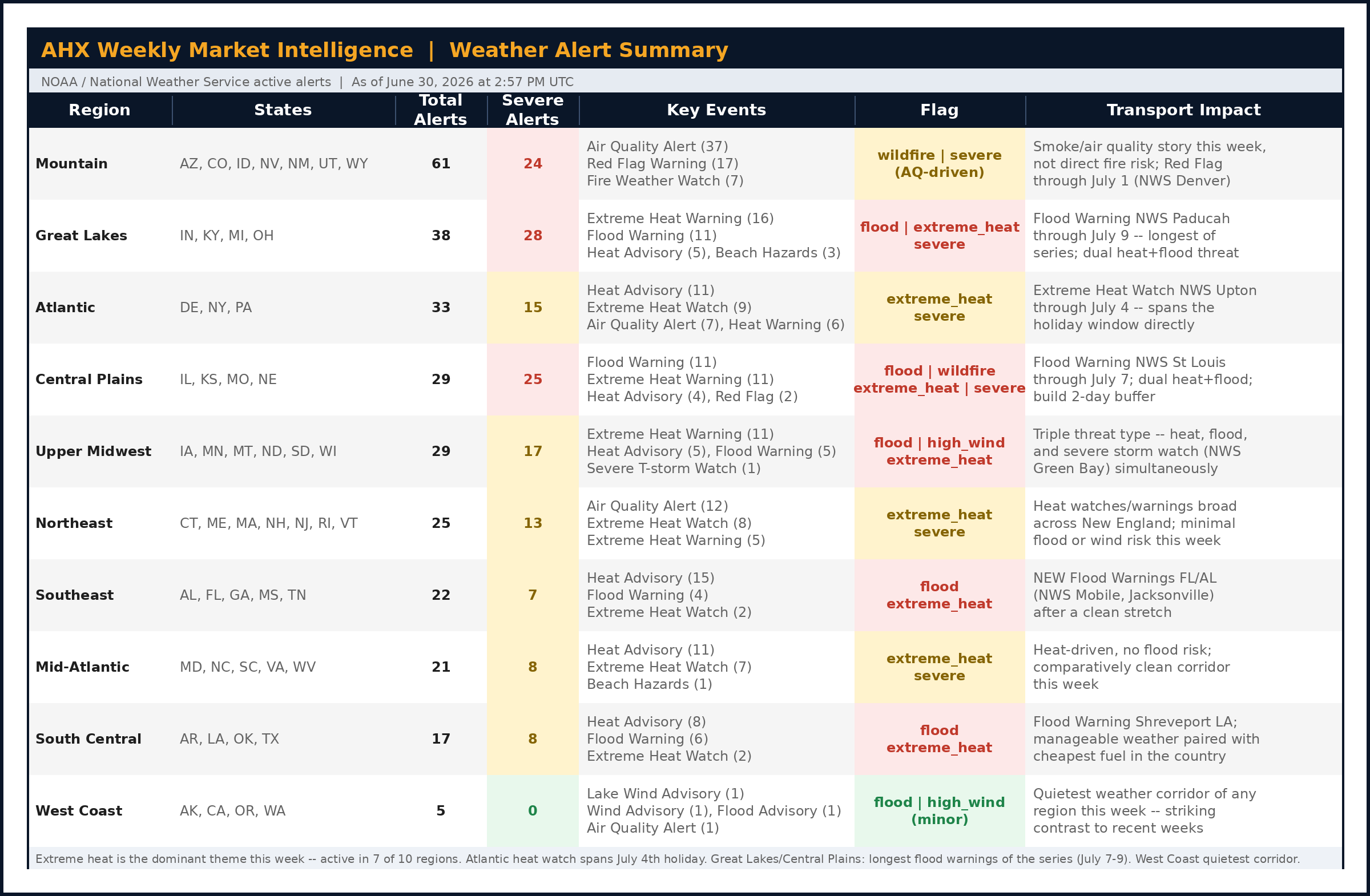
Weather Alert Summary — June 30, 2026
The Weather Story: Extreme Heat Takes the Lead
This week's weather pattern is fundamentally different from recent weeks. Extreme heat — not flooding, not wildfire — is the dominant national theme.
Coast-to-Coast Heat: Seven Regions Affected
Extreme Heat Watches or Warnings are active in the Atlantic, Northeast, Great Lakes, Central Plains, Upper Midwest, Mid-Atlantic, and Southeast. The most consequential single alert: NWS Upton, NY issued an Extreme Heat Watch running through July 4th — meaning the holiday itself falls entirely within the active heat window. Any holiday-week shipments in the New York metro corridor or broader Northeast should account for both reduced carrier availability and active heat conditions at the same time.
Mountain: An Air Quality Story This Week, Not a Direct Fire Risk Story
The Mountain corridor carries the highest total alert count at 61, but the composition tells a different story than in prior weeks. Thirty-seven of the 61 alerts are Air Quality Alerts — smoke transport from regional wildfire activity affecting air quality across the corridor, distinct from the direct fire-spread risk that dominated earlier weeks. Seventeen Red Flag Warnings and seven Fire Weather Watches were active (NWS Denver, previously through July 1 — confirm current status), so fire risk hasn't disappeared, but air quality is now the primary alert driver. For vehicle transport: extended highway exposure in heavy smoke conditions can leave residue on open-carrier vehicles, worth noting at delivery inspection.
Great Lakes and Central Plains: The Longest Flood Warnings of the Series
Both regions are managing extreme heat and flooding simultaneously, and the flood warnings themselves have unusual duration. NWS Paducah, KY issued a Flood Warning running through July 9 in the Great Lakes — the longest single warning we have tracked in this entire series. NWS St. Louis has a Flood Warning through July 7 in Central Plains. Combined with Extreme Heat Warnings active in both regions, carriers operating in IN, KY, MI, OH, IL, KS, MO, and NE are navigating two distinct, simultaneous stressors that will persist well past this week.
Southeast: New Flood Warnings After a Clean Stretch
NWS Mobile (Alabama) and NWS Jacksonville (Florida) both issued Flood Warnings yesterday — a return of flood risk to the Southeast after several relatively clean weeks. FL and AL routes that have been reliable in recent weeks need a fresh look this week.
West Coast: The Quietest Corridor in the Country
Just five total alerts, zero severe. This is the lightest weather week any region has posted in this entire series — a striking contrast to earlier weeks when the West Coast carried both the highest fuel price and significant heat/wildfire risk simultaneously.
What the AHX Platform Is Showing
The Carrier Market has now held steady for two full weeks, and conditions remain healthy heading into the holiday.
The 7-day volume reading shows the expected pre-holiday plateau — a -33.91% reading that mirrors the pattern we saw before Juneteenth. This is not a structural signal; it's the typical pullback in posting and booking activity that happens in the days immediately before a major holiday. Expect a rebound the week of July 6.
Georgia remains the #1 pickup market on the platform for the sixth consecutive week. Ohio holds the #2 pickup position, with North Carolina and Kansas continuing to build. On the delivery side, Michigan, Minnesota, and Pennsylvania lead the rankings.
Lane supply data shows broad, healthy coverage across the network. No corridor shows a supply factor below 0.95, meaning there's no meaningful capacity constraint anywhere on the platform heading into the holiday.
Use the AHX Market Estimate Tool before every post this week. With five weeks of fuel decline and -15% MoM readings in several regions, lane pricing has moved materially since late May.
"Posting a shipment takes seconds. Seeing a carrier grab it in one minute shows how efficient AHX is." — Scott Moore, General Sales Manager, Suburban Volvo Cars
July 4th Is 3 Days Away
Independence Day is the largest single carrier availability event of the summer, and it's just days away. Platform data already shows the pre-holiday volume plateau beginning. Based on the pattern from prior holidays, expect carrier availability to tighten meaningfully from today, Wednesday July 1, through Sunday July 5, with normalization the week of July 6.
The practical planning window: Post and confirm any time-sensitive shipment today, July 1, before the holiday window tightens further. If your delivery timing has flexibility, plan for execution the week of July 6 rather than fighting the holiday window directly.
Corridor Outlook for the Week
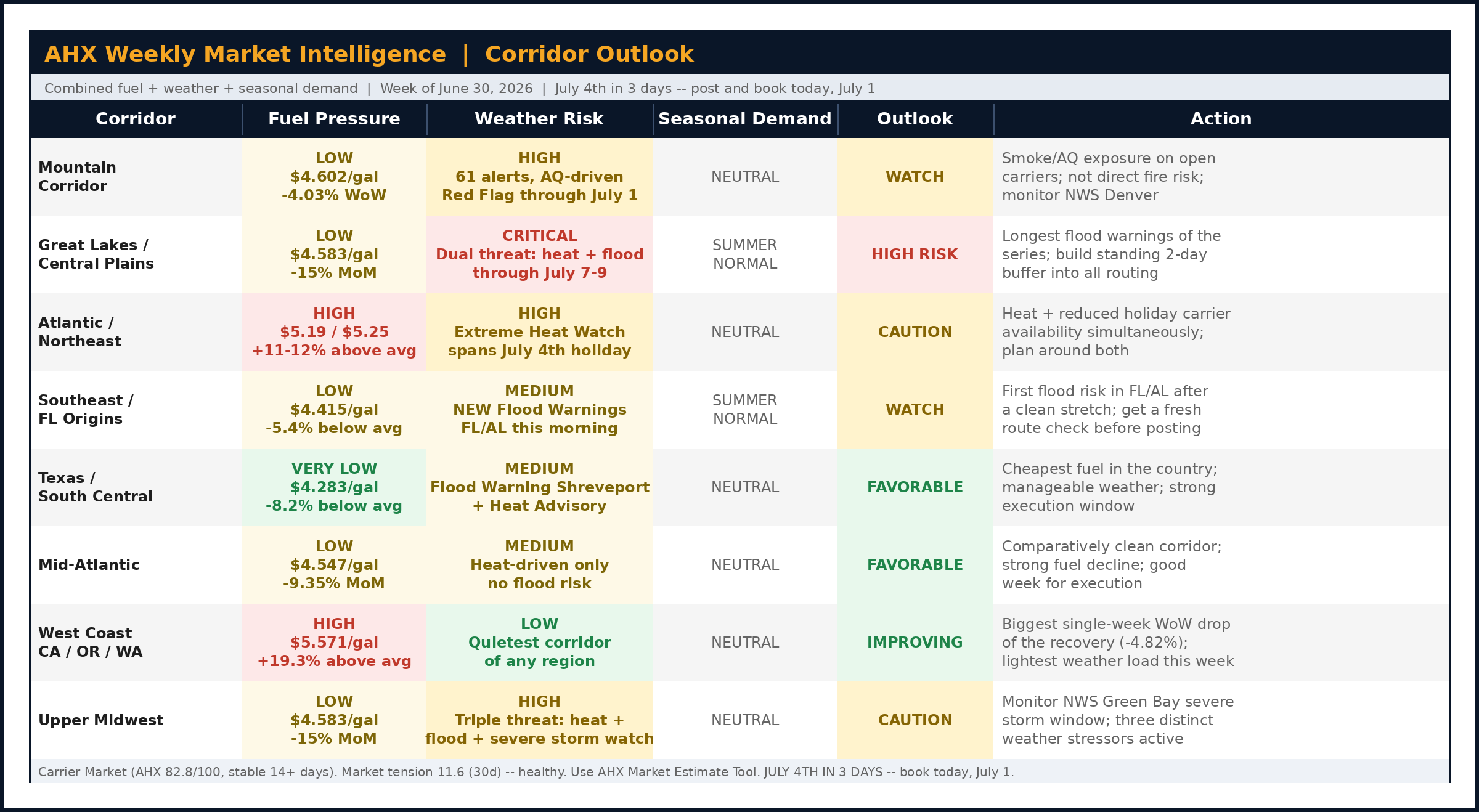
Mountain Corridor: Air quality alerts dominate this week rather than direct fire risk, though Red Flag Warnings were active through July 1 — check current NWS Denver alerts for the latest status.
Great Lakes / Central Plains: The longest-duration flood warnings of the series — July 7 and July 9 expirations respectively. Build a standing two-day buffer into any routing through this corridor.
Atlantic / Northeast: Extreme heat conditions span the July 4th holiday directly. Plan for both reduced carrier availability and active heat conditions simultaneously.
Southeast / Florida: New Flood Warnings in FL and AL after a clean stretch. Get a fresh read on routing before assuming these lanes are clear.
Texas / South Central: The cheapest fuel in the country at $4.283/gal. Weather is manageable — a Flood Warning in Shreveport and standard Heat Advisories.
Mid-Atlantic: Strong fuel decline (-9.35% MoM) paired with comparatively clean weather. One of the more favorable corridors for execution this week.
West Coast: The largest single-week fuel decline of the entire recovery, paired with the lightest weather load of any region.
What Dealers Should Do This Week
1. Post and confirm today, July 1, before the holiday window tightens further. Carrier availability tightens through the holiday weekend.
2. Build a standing buffer into Great Lakes and Central Plains routing. These flood warnings now run through July 7–9, the longest duration we've tracked.
3. Account for extreme heat through July 4th in the Northeast. The Atlantic's heat watch spans the entire holiday window.
4. Re-run your market estimate. Five weeks of decline and -15% MoM readings mean lane pricing has moved substantially since late May.
5. Take advantage of the West Coast's quiet week. The largest fuel decline of the recovery paired with the lightest weather load makes this an unusually favorable window.
Frequently Asked Questions
Q: Diesel has fallen for five straight weeks. Is this now the lowest it's been since the spring spike?
A: Not quite, though it's close in some regions. We verify every fuel claim against the full-year EIA dataset before publishing, and as of this week, no region has crossed below its post-March-9-spike floor. The West Coast comes closest, within two cents. The accurate framing is "down sharply from the peak" (Midwest is down 21.2% from its May high) rather than "lowest since the spike."
Q: Why is extreme heat suddenly the main weather story instead of flooding or wildfire?
A: Late June into July is peak summer heat season across most of the country, and this week's pattern reflects a broad heat dome affecting the Atlantic, Northeast, and much of the Midwest simultaneously. Flooding and wildfire risk haven't disappeared — but the geographic breadth of the heat event makes it this week's defining story.
Q: Should I be concerned about my vehicle's condition if it's transported through a region with an Air Quality Alert?
A: For standard vehicles, the primary consideration is cosmetic — extended exposure to smoke-affected air on an open carrier can leave a fine residue that typically washes off without issue. For high-value or recently detailed vehicles, an enclosed carrier avoids this entirely.
Q: How should I plan shipments around the July 4th holiday this year?
A: Post and confirm booking today, July 1, before the holiday window tightens further. Expect tighter carrier availability through the weekend, with normal activity resuming the week of July 6.
Q: The Great Lakes flood warning runs through July 9 — does that mean the whole region is impassable until then?
A: No. A Flood Warning of this duration typically reflects an extended hydrological event rather than continuous, widespread road closures. The practical guidance is to build in a buffer and confirm with your carrier before departure.
Sign up free at autohaulerexchange.com
Data Attribution
- Diesel price data: U.S. Energy Information Administration (EIA) weekly retail diesel survey, week ending June 29, 2026.
- Weather alert data: NOAA/National Weather Service active alerts as of June 30, 2026 at 2:57 PM UTC.
- YoY comparisons reflect EIA regional diesel price data for the comparable week in 2025.
- AHX platform market environment data: Auto Hauler Exchange internal analytics, June 30, 2026.



.png)
