

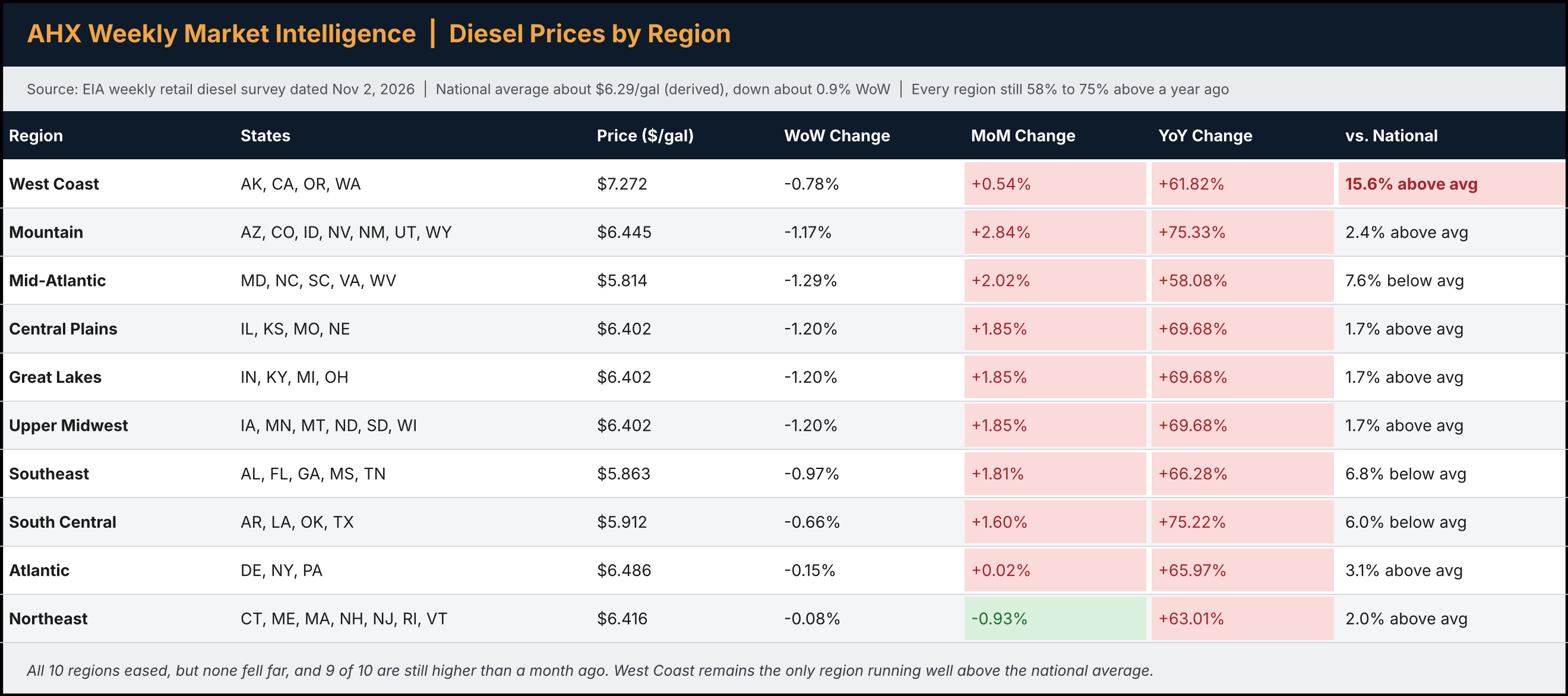
Diesel slipped in all 10 regions this week, and the national average fell about 0.9% to roughly $6.29 a gallon. That is welcome. It is not relief. Nine of 10 regions are still higher than they were a month ago, and every region remains 58% to 75% above where it was a year ago. If you read "prices fell" as "transport costs are coming down," you will misprice your next shipment.
Flooding is the bigger operational story, and it is spreading. The Mountain region logged 28 severe alerts and the Southeast logged 11. Flood warnings also showed up around Kansas City and Des Moines this week. Here is what that means for your inventory moves.
Diesel Prices: A Small Dip on a Very High Base
What moved
The Mid-Atlantic posted the biggest weekly drop, down 1.3% to $5.81. It remains the least expensive diesel in the country relative to the national average.
The three Midwest regions, Great Lakes, Central Plains, and Upper Midwest, all fell 1.2% to $6.40. That is still $0.14 higher than three weeks ago. If you source from Midwest auctions, the drop trims the climb of recent weeks but does not erase it.
Mountain eased 1.2% to $6.45. It is also the region with the biggest monthly increase, up 2.8% from a month ago, and it has the highest year-over-year gain at 75%.
West Coast slipped 0.8% to $7.27. It still runs about 16% above the national average, and no other region comes close to that gap. California alone is at $8.08, about $1.50 above the rest of the West Coast. California, Oregon, and Washington shipments keep their fuel premium.
Why a drop in every region is not good news yet
Every drop this week was small, from a fraction of a cent to about eight cents a gallon. At the same time, nine of 10 regions are higher than a month ago. The honest read: prices paused after a few weeks of climbing, and they sit at a very high level. Plan around that, not around a trend lower.
Weather Alert Summary: Flooding Is the Story

Alert data is current as of Tuesday afternoon. Several warnings expire before this post goes live, so check local conditions on the day you dispatch.
Mountain: the week's biggest disruption
The Mountain region went from a handful of severe alerts a week ago to 28. The flood warnings come from National Weather Service offices covering Arizona and New Mexico. Many expire by Wednesday, but washed-out roads and slow cleanup can last longer. If you have a vehicle at an Arizona or New Mexico pickup, tell your carrier and expect a delay of a day or so.
Plains and Upper Midwest: new and growing
The Central Plains went from no severe alerts last week to 6, with flood warnings around Kansas City running through the end of the week. The Upper Midwest has 5, including a flood watch around Des Moines that runs through Friday. These are not Mountain-scale disruptions. They are new this week, and they are growing. Give western Missouri, eastern Kansas, and Iowa pickups a flexible window.
Southeast and South Central
The Southeast logged 11 severe alerts out of 30. Flood warnings around Tampa Bay run into Wednesday evening, so add a day on Florida west coast pickups. Rip current and coastal flood advisories along the coast do not affect trucks much. South Central had thunderstorm and flash flood warnings near Shreveport that were short-lived.
West Coast and the East: calm
The West Coast had zero severe alerts, only wind and a couple of winter weather advisories, and far fewer alerts than last week. The Northeast, Atlantic, and Great Lakes report none, and the Mid-Atlantic has only a test message.
What We're Seeing on the Platform
Carriers still hold the leverage. They are choosing the best-priced shipments first, and that is why shipments priced at market book fast while stale prices sit. Carrier coverage is healthy across all major lanes. Ohio, Iowa, Wisconsin, and Missouri lead as delivery markets, and Indiana, Kansas, and Minnesota lead on pickups. Posting activity eased slightly from last week.
For dealers, the takeaway is simple. In a carrier-favorable market, the price you post decides how fast the vehicle moves. The AHX Market Estimate Tool shows where the market sits for your lane today, and the AI Pricing Engine adjusts your posted price within the range you set so a shipment does not stall while you are busy on the lot.
Corridor Outlook
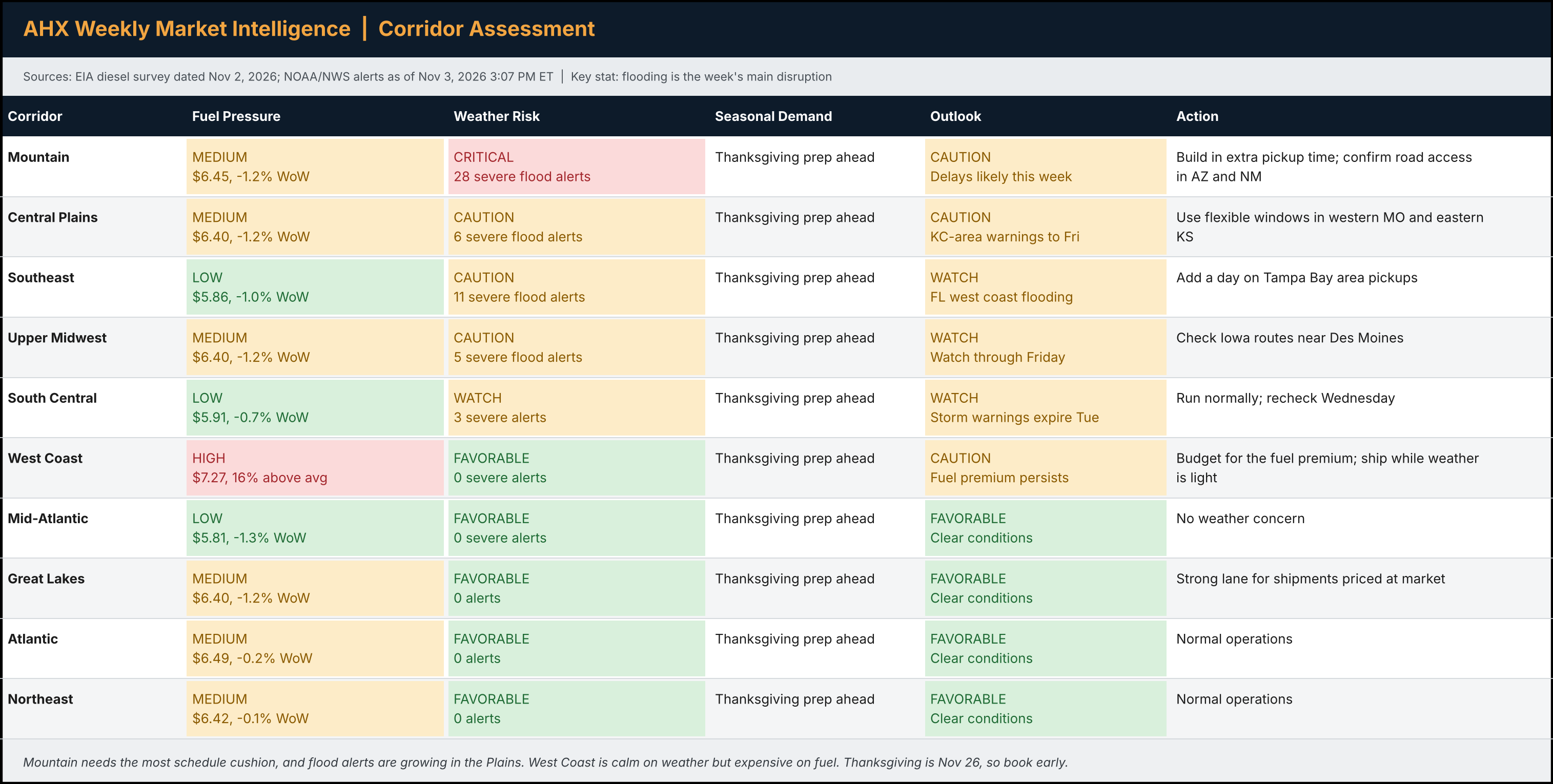
- Mountain: caution. Fuel is moderate, but weather is the issue. Build extra pickup time into Arizona, New Mexico, and nearby lanes.
- Central Plains: caution. Flood warnings around Kansas City run through the week. Use flexible windows.
- Southeast and Upper Midwest: watch. Flooding around Tampa Bay and Des Moines is the concern. Fuel in the Southeast is among the lowest in the country.
- South Central: watch. Storm warnings were short-lived. Fuel is low.
- West Coast: caution on cost. Weather is favorable, so this is a good week to move vehicles. Budget for the fuel premium.
- Mid-Atlantic, Great Lakes, Atlantic, and Northeast: favorable. Weather is clear. Expect smooth operations and price for a fuel level that is still high.
Seasonal Context: Thanksgiving Is Three Weeks Out
Thanksgiving falls on Thursday, November 26. Carrier availability tightens through the week before the holiday, and it is typically the biggest availability dip of the year. Dealers who want vehicles on the lot for the long retail weekend should have pickups booked now, not the Monday of Thanksgiving week. Winter weather is also starting to show up, with winter weather advisories on the West Coast, so add schedule cushion on northern routes as November goes on.
What Dealers Should Do This Week
- Price to the market, not last month. Run every shipment through the AHX Market Estimate Tool before you post. With carriers choosing the best-priced shipments first, a stale price costs you days.
- Add a day on Arizona, New Mexico, and Tampa Bay area pickups. Flood warnings can slow dispatch even after they expire.
- Use flexible windows around Kansas City and Des Moines. Flood alerts there run through the end of the week and have been growing.
- Book Thanksgiving-week vehicles now. Target pickups before November 20. Carrier availability tightens in the week of November 23.
- Budget West Coast fuel realistically. Weather is quiet, so ship now. A 0.8% dip does not change the premium.
- Use tracking. Real-time ELD tracking on every active shipment shows a delay early so you can tell the customer before they ask.
- Do not budget for lower costs yet. Fuel is still higher than a month ago in nine of 10 regions. Treat this week as a pause.
FAQ
Is diesel getting cheaper for vehicle shipping?
Slightly this week, but not in a way you can bank on. The national average fell about 0.9% to roughly $6.29, and all 10 regions eased. Nine of 10 regions are still higher than a month ago, and every region is 58% to 75% above a year ago.
Which region has the most expensive diesel right now?
The West Coast, at $7.27 a gallon, with California alone at $8.08. The region slipped 0.8% on the week and still runs about 16% above the national average.
How are the Arizona and New Mexico floods affecting vehicle transport?
The Mountain region logged 28 severe alerts, nearly all flood warnings. Many expire by Wednesday, but expect pickup delays of about a day and plan around washed-out routes.
Are flood warnings spreading outside the Mountain West?
Yes. The Central Plains has 6 severe alerts around Kansas City and the Upper Midwest has 5, including a flood watch around Des Moines through Friday. Both are new this week.
When should I book vehicles for Thanksgiving week?
Now. Thanksgiving is November 26, and carrier availability tightens in the week before it. Aim to have pickups booked and moving before November 20.
Why do shipments priced at market book faster?
Carriers are choosing the best-priced shipments first. The AHX Market Estimate Tool shows where the market sits on your lane, and the AI Pricing Engine adjusts your posted price within the range you set.
The Bottom Line
Fuel eased, but it is still high. Weather is local but growing in the Plains. The market still favors carriers. Price your shipments at market, pad the schedule where flooding is active, and book your Thanksgiving-week vehicles before the holiday squeeze. AHX gives you the support you need with the pricing transparency you deserve, with 5,500+ vetted carriers on the platform and real-time ELD tracking on all active shipments.
Sign up free at autohaulerexchange.com
Data sources: U.S. Energy Information Administration (EIA) weekly retail diesel survey, survey dated November 2, 2026; NOAA/National Weather Service active alerts as of November 3, 2026, 3:07 PM ET; AHX platform data. Industry sources not included this week.